1750 terms were found.
| Term | Definition |
| ABALONE | A member of the gastropod family Haliotidae (e.g., Haliotis spp.). The interior of Abalone shells exhibit a NACREOUS layer known as MOTHER OF PEARL. | |
| ABAPICAL | Away from the APEX; opposite of ADAPICAL; see also: APICAL. | |
| ABAXIAL | Away from the AXIS; opposite of ADAXIAL; see also: AXIAL. | |
| ABERRANT | Abnormal; of freak shape or coloration. | |
| ABORAL | Situated away from the mouth; see also: ORAL. | |
| ABUTTING | Touching; contiguous; adjacent; see also: NAUTILOCONIC. | |
| ABYSS ABYSSAL |
Ocean depths from 2,000 to 6,000 meters, See also: HADAL, PELAGIC. | |
| ABYSSOPELAGIC | The PELAGIC depth zone 4,000 to 6,000 meters. See also: PELAGIC; EPIPELAGIC (0-200m depth); MESOPELAGIC (200-1000m depth); BATHYPELAGIC (1000-4000m depth; HADAL (greater than 6,000m depth); NERITIC; OCEANIC; BENTHIC; PLANKTONIC. | |
| ACCESSORY BORING ORGAN (= ABO; A.B.O.) |
[need definition]. Term coined by Mel Carriker. 
|
|
| ACCESSORY MUSCLE | Any muscle other than ADDUCTOR and PALLIAL muscles, with SCAR of attachment to shell (convenient noncommittal term when referring to scars of muscles of uncertain origin). | |
| ACCESSORY PLATE | A secondary CALCAREOUS structure formed in some bivalves (e.g., the Pholadidae) to protect the soft parts; see also: HYPOPLAX; MESOPLAX; METAPLAX; PROTOPLAX; SIPHONOPLAX. | |
| ACCESSORY VALVE | See: ACCESSORY PLATE. | |
| ACETABULUM | The cup-shaped portion of a SUCKER of a CEPHALOPOD arm or TENTACLE. | |
| ACHIRAL | A non-CHIRAL object; = AMPHICHIRAL. | |
| ACLINE | Perpendicular to HINGE AXIS or almost so (applied to HINGE TEETH or, in some genera, to direction of elongation of body of shell; = ORTHOCLINE. | |
| ACTINODONT | Descriptive of a bivalve shell having a HINGE with teeth that radiate outward from the UMBOS; with teeth radiating from BEAK, outer ones more or less elongate (applied to certain bivalves of early origin). | |
| ACULEATE | Having sharp SPINES; see also: SPINOUS. | |
| ACUMINATE | Tapering to a slender point; see also: ATTENUATED. | |
| ACUTE | Sharply angled, pointed or edged; e.g., a spire with an angle of less than 90 degrees. | |
| ADAPICAL | Toward the APEX; opposite of ABAPICAL; see also: APICAL. | |
| ADAXIAL | Toward the AXIS; opposite of ABAXIAL; see also: AXIAL. | |
| ADDUCTOR MUSCLE | One of two muscles connecting bivalve shells, tending to draw them together; these muscles leave diagnostic impressions on the inner surface of the valves; see also: ADDUCTOR SCAR; DIMYARIAN; MONOMYARIAN. | |
| ADDUCTOR SCAR | See: ADDUCTOR MUSCLE SCAR. | |
| ADHERENT | Closely ATTACHED. | |
| ADNATE | Barely attached. A term sometimes applied to shells of the bivalve family Unionidae, which are joined together by rigid CALCAREOUS material rather than a flexible LIGAMENT. | |
| ADPRESSED | [need definition]; see also: IMPRESSED; CHANNELED; SUTURE, ADPRESSED. | |
| ADULT | Fully grown; sexually mature; see also: JUVENILE. | |
| ADULT WHORLS | All whorls of a GASTROPOD shell beyond those of the nucleus, or PROTOCONCH; = TELEOCONCH; see also: NUCLEAR WHORL; PROTOCONCH. | |
| AESTHETES | Sensory epidermal PAPILLAE in the Gastropoda and Polyplacophora; small ones are called MICRAESTHETES, while larger ones are MEGALAESTHETES, and may form eyes with a simple lens. | |
| AESTIVATION verb: AESTIVATE |
To pass the summer or dry periods in an inactive state (common for some land snails, which may create an EPIPHRAGM to seal the APERTURE of the shell to conserve moisture); see also: HIBERNATE. | |
| AFF. (AFFINIS) | An indication that a species has an affinity to another species, but is not that species; e.g. Conus aff. crocatus Lamarck, 1810. See also: CF (CONFER). | |
| ALATE | Winged; having alae; = AURICLE; see also: BIALATE; DIFFUSE; DILATED; PINNATE. | |
| ALBINISTIC | Tending toward being an ALBINO; nearly all white; see also: MELANISTIC. | |
| ALBINO | All white in shell and soft parts; often, without having seen the ANIMAL, the white shell is called an albino; see also: ALBINISTIC. | |
| ALIVINCULAR | Type of bivalve LIGAMENT not elongated in longitudinal direction nor necessarily situated entirely posterior to beaks, but located between CARDINAL AREAS (where present) of respective valves, with lamellar layer both anterior and posterior to fibrous layer; example: Ostrea; see also: DUPLIVINCULAR; MULTIVINCULAR; PARIVINCULAR. | |
| ALLOMORPHISM | A term used erroneously by some authors for XENOMORPHISM. | |
| AMBISEXUAL | Producing both eggs and sperm side by side; see also: HERMAPHRODITE; MONECIOUS. | |
| AMMONITE | Members of an extinct group of CEPHALOPODS in the subclass Ammonoidea. See also: BELEMNITE. | |
| AMMONOTELIC | [need definition]; see also: URICOTELIC. | |
| AMPHICHIRAL | See: ACHIRAL. | |
| AMPHIDETIC | Extending on both anterior and posterior sides of the BEAK; said of the ligamentary area in certain bivalve shells, e.g., Arca. | |
| ANACHOMATA | Small tubercles or ridgelets on periphery of inner surface of right valve of bivalves; see also: CATACHOMATA; CHOMATA (sing. CHOMA). | |
| ANAL | Pertaining to or near the anus or posterior opening of the alimentary canal. | |
| ANAL CANAL | = POSTERIOR CANAL; = ANAL SULCUS. See illustration: Composite Gastropod. | |
| ANAL FASCIOLE | A band on the outer lip generated by a sinus, notch, or slit, close to the suture and anal opening of a gastropod aperture; see also: SELENIZONE; SLIT BAND. | |
| ANAL NOTCH | A break in the circumference of the aperature over the spot where the outgoing current leaves the mantle cavity on the right; i.e., a notch in the outer lip where it joins the body whorl (present in mesogastropods, especially in the Turridae [the "TURRID NOTCH"]). See illustration: Composite Gastropod. | |
| ANAL SINUS | [need definition]. See illustration: Composite Gastropod. | |
| ANAL SIPHON | A tube exiting at the posterior end of the gastropod aperture, through which solid waste matter is voided; in the Typhinae (Muricidae), the anal siphon is housed in a shelly tube. | |
| ANAL SULCUS | A groove in the posterior portion of the aperture that accommodates the ANAL SIPHON; = POSTERIOR CANAL; = ANAL CANAL. | |
| ANASPID | A Opisthobranch gastropod which belongs to the suborder Anaspidea, which is an older name for the Aplysiomorpha (SEA HARES, e.g. Aplysia spp.); the term is from the Greek meaning "without a shield" and refers to the lack of a head shield such as is common to the CEPHALASPID gastropods. | |
| ANGULATE | Tabulate, as distinct from CONVEX; said of the whorl profile; formed with corners; angled. See also: BIANGULATE. | |
| ANGULATION | The edge along which two surfaces meet at an angle. | |
| ANIMAL | The fleshy, or soft part of a MOLLUSC; see also: CONCH. | |
| ANISOMYARIAN | The condition, in bivalve molluscs, of having adductor muscle scars of unequal size, with the posterior one usually being the larger of the two; see also: MONOMYARIAN; DIMYARIAN; HETEROMYARIAN. | |
| ANNULATE | Bearing more or less concentric rings, as on the inner surface of a gastropod operculum; see: OPERCULUM, ANNULATE. | |
| ANNULUS | One of several concentric rings. | |
| ANODONT | Lacking hinge teeth (in bivalves); = EDENTULOUS. | |
| ANOMPHALOUS | Lacking an UMBILICUS; see also: OMPHALOUS. | |
| ANTERIOR | Toward the end at or from which the head, in gastropods, or the FOOT in bivalves, tends to emerge; opposite of POSTERIOR; see also: PROSOGYRATE. | |
| ANTERIOR CANAL | The SIPHONAL CANAL; a tubular or trough-like extension of the anterior end of the gastropod aperture, enclosing the INHALANT SIPHON; = CAUDAL CANAL; see also: POSTERIOR CANAL. | |
| ANTERODORSAL | Being both forward and upward; toward the front and upper regions. | |
| ANTEROLATERAL | Forward, towards the ANTERIOR and also toward the side or LATERAL. | |
| ANTEROVENTRAL | Being both forward and downward; toward the front and lower regions; see also: POSTEROVENTRAL. | |
| ANTEROVENTRAL MARGIN | In bivalves, the anterior end of the valve margin opposite the hinge; See also: POSTEROVENTRAL MARGIN; | |
| APERTURAL | Pertaining to the APERTURE. | |
| APERTURAL LIP | The most recently formed margin of the aperture; = PERISTOME; see also: HOLOSTOMATE; SIPHONOSTOMATE; see also: INNER APERTURAL LIP; OUTER APERTURAL LIP. | |
| APERTURAL LIP, INNER | [need definition]. See illustration: Composite Gastropod. See also: APERTURAL LIP; OUTER APERTURAL LIP | |
| APERTURAL LIP, OUTER | [need definition]. See illustration: Composite Gastropod. See also: APERTURAL LIP; INNER APERTURAL LIP. | |
| APERTURAL TOOTH | Shelly protuberances in the APERTURE or opening in the shell of a gastropod. | |
| APERTURE | The major opening of a GASTROPOD shell, through which the animal protrudes. See illustration: Composite Gastropod. See also: PERISTOME; HOLOSTOMATE; MOUTH; SIPHONOSTOMATE. | |
| APEX (pl. APICES) |
The first-formed end of a gastropod shell, generally more or less pointed; the tip of the PROTOCONCH or NUCLEAR WHORLS; opposite of BASE; see also: APICAL. | |
| APICAL | Pertaining to the APEX; see also: ABAPICAL; ADAPICAL. | |
| APICAL PLUG | A CALCAREOUS plate at the spire-end of the tubular shells of the Caecidae (Gastropoda); see also: MUCRO. | |
| APLACOPHORAN | A member of the class Aplacophora, a group of molluscs made up of the subclasses Neomeniomorpha (=Solenogastres) and Chaetodermomorpha (=Caudofoveata). See the WHOI website for details. | |
| APOMORPHY |
A derived or specialized character. See also: PLESIOMORPHY; SYNAPOMORPHY.>. See the Paleos website for greater detail. |
|
| APOPHYSIS (1) (pl. APOPHYSES) |
In bivalves: A projecting peg-like or finger-like structure, functioning as a support for a muscle, e.g., that serving for attachment of pedal muscle in the Pholadidae or adductor muscle in some RUDISTS; = MYOPHORE. See also: APOPHYSIS (2). | |
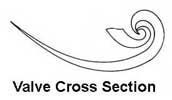
|
| APOPHYSIS (2) (pl. APOPHYSES) |
In CHITONS, the articulating plate on valves II to VII of a chiton shell. See also: APOPHYSIS (1). | |
| APPRESSED | Pressed against or lying flat against another surface; having the WHORLS overlapping; see also: ADHERENT. | |
| AQUACULTURE | The farming of organisms or plants in a water (AQUATIC) environment. The term is often used in reference to both freshwater and marine environments, but MARICULTURE is a better term for referring to marine environments. | |
| AQUATIC | Pertaining to or living in the water; sometimes restrictively used to refer to fresh water only (as opposed to OCEANIC; MARINE); see also: FLUVIATILE; FRESH WATER; ESTUARINE; FLUVIATILE. | |
| ARAGONITE | One crystalline form of CALCIUM CARBONATE, CaCO3 most evident in mollusks as NACRE or MOTHER OF PEARL; see also: CALCITE; VATERITE. | |
| ARBOREAL | Pertaining to or living entirely in the trees; see also: TERRESTRIAL; HABITAT. | |
| ARCHEOGASTROPOD | A large group of marine prosobranch gastropods, comprising the taxonomic order Archeogastropoda, which initially thrived in the Cambrian and which are still well represented today. They are mainly HERBIVOROUS, typically having two GILLS and a double-chambered HEART. To reproduce, their EGGS and SPERM are released into the water. | |
| ARCHIBENTHIC | Ocean bottom depths from 800 to 1,000 meters; See also: BENTHIC; HADAL | |
| ARCUATE | Arched or CURVED. | |
| ARGONAUT |
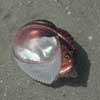
The common name for Argonauta argo (and others of that genus), a CEPHALOPOD mollusc that lives a PELAGIC existence in the tropics and subtropics. The female produces an egg case called the PAPER NAUTILUS. See: Mangold (1922-2003), Katharina M., Michael Vecchione, and Richard E. Young. 2010. Argonautidae Tryon, 1879. Argonauta Linnaeus 1758. Paper Nautilus. Version 03 February 2010. Photo: Argonauta argo Linne, 1758 |
|
|
| ARK SHELL |
A member of the BIVALVE family Arcidae. See the website: iEspana for examples of Arc Shells. |
|
| ARM | In squid, all but the 4th pair (TENTACLES) of 5 pair of appendages surrounding the mouth. | |
| ARROW-HEADS | A common name by which fossils of the genus Belennites are known. | |
| ARTICOID TYPE | Type of HETERODONT dentition in bivalves, intermediate between LUCINOID and CORBICULOID types; formerly termed: CYPRINOID TYPE. | |
| ARTICULAMENTUM | Inner layer of a CHITON shell; the inner, usually hard, semi-porcelaneous shell layer, generally projecting past the TEGMENTUM on the sides and front of the valves to form the INSERTION PLATES and the sutural laminae. | |
| ARTICULATED | Jointed; applied to parts of a shell which are fitted or jointed into each other (e.g., the valves of CHITONS, the OPERCULUM and shell of NERITES). | |
| ASCOGLOSSAN |
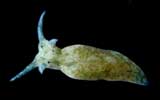
[need definition]. Newer, preferred term for the old term: Sacoglossan. They have a UNISERIATE RADULA from which old teeth fall from the
RADULA RIBBON into an ASCUS SAC.
See also: SEA SLUG; NUDIBRANCH. Photo: Elysia chlorotica (Gould, 1870) |
|
|
| ASCUS SAC | The pouch-like container in ASCOGLOSSANS (previously called Sacoglossans) which stores old, used RADULA TEETH. | |
| ASPELLOID | An informal group within the family Muricidae, which contains the genera Aspella, Dermomurex, and Ingensia. | |
| ASTHENODONT | Hinge often essentially mactrid, but usually degenerate or OBSOLETE, owing to modifications due to the burrowing habit. | |
| ATTACHED | Refers to shell which are connected to the substrate in some way, perhaps by a byssus (e.g., Mytilus spp.) or by calcareous secretions (e.g., Chama spp. or Spondylus spp.); see: FREE; ATTACHED BIVALVE; RADICATED; REPENT; VALVE, INFERIOR; VALVE, LOWER; ADHERENT; REPENT; PLEUROTHETIC. | |
| ATTENUATED | Becoming thin and fine; see: ACUMINATE; LIGULATE. | |
| AUCTT. (AUCT.) (= AUCTORUM) |
"Of authors;" when several authors erroneously identify and publish a name that does not apply to the original description, it is referred to (for example) as Conus crocatus of authors, OR: Conus crocatus Auctt. It means this cone is not true Conus crocatus Lamarck, 1810, but rather what authors have thought was crocatus; see also: TESTE. | |
| AUGER | Common name for a SNAIL in the family Terebridae. | |
| AURICLE | An anterior or posterior projection along the hinge line of a bivalve shell, commonly separated from body of shell by a notch or sinus; = HINGE EAR. See illustration: Composite Bivalve. See also: ALATE; BIALATE; SUBMARGIN. | |
| AURICULAR CRURA (sing. CRUS) |
Blunt internal ridges, swelling out distally as low tubercles, marking lower border of auricles in some Pectinidae. | |
| AURICULAR SULCUS | External furrow at junction of AURICLE (of bivalves) with body of shell. See illustration: Composite Bivalve. | |
| AURICULATE | Having ears or ear-like appendages, e.g., the shells of the Pectinidae, or some ascoglossan rhinophores (Stiliger spp.); those shells having but one ear are UNIAURICULATE, while those with two ears are BIAURICULATE; see also: BIALATE. | |
| AURIFORM | Shaped like a human ear; used in describing the rhinophores of Hermaea spp.; see also: AURICULATE; HALIOTOID. | |
| AUSTRAL | Pertaining to the south (i.e., southern hemisphere); southern. | |
| AUTOPHAGY | Eating part of itself. | |
| AUTOTOMY | Voluntary separation of a part of the body; self amputation (usually initiated to avoid predation). | |
| AVICULIFORM | [need definition]. | |
| AXIAL | Pertaining to or more or less parallel to the axis of coiling in a gastropod shell; see also: ABAXIAL; ADAXIAL; SPIRAL. | |
| AXIAL SCULPTURE | SCULPTURE running parallel to the axis of the gastropod shell; see also: CONCENTRIC SCULPTURE. | |
| AXIS | The center around which the WHORL of a gastropod shell coil. See illustration: Composite Gastropod. See also: COLUMELLA. | |
| BANDING |
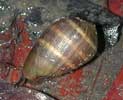
A color marking in continuous stripes; see also: FASCIATE. Photo: Melampus coffeus (Linne, 1758) |
|
|
| BASAL | Pertaining to the base or bottom. | |
| BASAL FASCIOLE | A special band on the base of a shell formed by a series of more or less curved growth lines that define the SIPHONAL SINUS (canal). | |
| BASAL FOLD | A fold (PLICA) near the anterior end of the columella and above the SIPHONAL CANAL; see also: COLUMELLAR FOLD. | |
| BASAL MARGIN | Edge of shell opposite hinge, in bivalves; = VENTRAL MARGIN. | |
| BASAL TOOTH | Calcareous deposit on the base of the apertural lip. | |
| BASE | In coiled gastropods, the area below the periphery of the body whorl, excluding the aperture; opposite of APEX; in uncoiled or limpet-like gastropods, the apertural rim; also used, less precisely, for the flattened apertural side of cowries (Cypraeidae). In bivalves, the basal margin opposite the upper or hinge margin. | |
| BATHYAL or BATHYPELAGIC | The PELAGIC depth zone 1,000 to 4,000 meters. See also: PELAGIC; EPIPELAGIC (0-200m depth); MESOPELAGIC (200-1000m depth); ABYSSOPELAGIC (4000-6000m depth; HADAL (greater than 6,000m depth); NERITIC; OCEANIC; BENTHIC; PLANKTONIC. | |
| BEACHWORN | Referring to the quality of a shell as being of poor color and texture due to having been ERODED, as an empty dead shell, occurring on and being deteriorated by beach conditions. | |
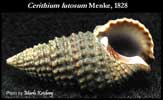
| BEADED |
Sculptured in such a way as to resemble beads or strings of beads. See illustration: Composite Gastropod. See also: MONILIFORM. Photo by Marlo F. Krisberg; Cerithium lutosum Menke, 1828. |
|
|
| BEAK (1) |
In bivalves, the earliest part formed, = UMBO; any part which is drawn out like a beak or ROSTRATED. See illustration: Composite Bivalve.
See: Bivalve terminology, Anatomy of bivalves by Marlo Krisberg. |
|
| BEAK (2) |
In cephalopods, the CHITINOUS plates of the mouth, which resemble the beak of a parrot.
See the excellent "Cephalopod Glossary" by Richard E. Young, Michael Vecchione, and Katharina M. Mangold. |
|
| BEAN COWRIE | Common name for Trivia spp. | |
| BELEMNITE | Members of an extinct group of CEPHALOPODS in the subclass Belemnoidea. See also: AMMONITE. | |
| BELOPTERA | The bony support of a species of CUTTLEFISH, partly resembling Sepia; see also: CUTTLEBONE | |
| BENTHAL | See: BENTHIC; = BENTHONIC. | |
| BENTHIC | Living on the bottom or in the bottom sediments; see also: BATHYAL; ARCHIBENTHIC, PELAGIC; PLANKTONIC. | |
| BENTHONIC | = BENTHAL. | |
| BIALATE | With 2 wings or AURICLES, in bivalves (e.g., Pectinidae); see also: BIAURICULATE. | |
| BIANGULATE | Having two angles. See also: ANGULATE. | |
| BIAURICULATE | Having two AURICLES; see also: BIALATE. | |
| BICOLORED | Composed of two different colors; see also: MULTICOLORED; VARIEGATED. | |
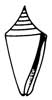
| BICONIC | Composed of two conical shapes, base to base; diamond-shaped and having the spire about the same size and shape as the body whorl, in gastropods; CONICAL. See other gastropod shapes. | |
|
| BIFID | Divided into two parts, often by a GROOVE; applied especially to the hinge teeth in bivalves; see also: BIFURCATE; BISECTED. | |
| BIFURCATE | Forked, or double pronged; divided into two parts by a groove or cleft; = BIFID; BISECTED. | |
| BILOBATE | Having two LOBES, See also: LOBATE; TRILOBATE. | |
| BINARY NOMENCLATURE = BINOMIAL NOMENCLATURE |
The use of BINOMEN, that is a GENUS and SPECIES name combination to name and refer to a SPECIES; see also: ICZN; NONBINOMIAL. | |
| BINOMEN (adj: BINOMIAL) |
The combination of a GENUS and SPECIES name, conforming to the principles of binary nomenclature; the full generic and specific name of a species, e.g., Strombus gigas. Together, these names comprise the SCIENTIFIC NAME of a species; see also: COMMON NAME. | |
| BIPARTITE | Divided into two parts; see also: TRIPARTITE. | |
| BIPECTINATE | Having two comb-like margins; branched like a feather; see also: PECTINATE; MONOPECTINATE. | |
| BIRAMOSE (=BIRAMOUS) |
Having two projecting parts or branches. See also: Having projecting parts or branches. See also: RAMOSE; TRIRAMOSE. | |
| BIROSTRATE | Having two ROSTRUMS. | |
| BISECTED | Divided into two parts; see also: BIFID; BIFURCATE. | |
| BITTERSWEET | A COMMON NAME referring to a member of the bivalve genus Glycymeris. | |
| BIVALVE | Typically, a mollusc in the class Bivalvia, with two shelly valves, such as an oyster or scallop; = CLAM. Additionally, other bivalved molluscs exist such as the Paleozoic ROSTROCONCHS, and the Recent bivalved gastropods of the family Juliidae; other phyla, such as the Brachiopoda, are not strictly referred to as "bivalves"; see: LAMELLIBRANCH; see also: UNIVALVE; MUSSEL. | |
| BIVALVE, ATTACHED | Bivalves which have cemented themselves to a substrate, e.g., species in genera such as Crassostrea, Ostrea, Spondylus, Chama, Mytilus; see also: ATTACHED; BORING BIVALVES; CEMENTATION; INFERIOR VALVE. | |
| BIVALVE, BORING | Bivalves with dissolve their substrate (rock or wood), forming burrows into which they exist and grow, e.g. SHIPWORMS, Teredo spp.; see also: ATTACHED BIVALVE. | |
| BIVALVE, BROODING | A bivalve which undergoes internal fertilization, and sheds its young as miniature adults (commonly) or sometimes as larvae (less commonly) after having brooded or incubated them within the MANTLE CAVITY of the parent, e.g. Bornia spp., Parastarte spp., Lyonsia spp. | |
| BIVALVED GASTROPOD | A GASTROPOD (e.g., Julia spp. [Ascoglossa: Juliidae]) with two VALVES, like a clam. | |
| BLADE | An erect, flattened sculptural element perpendicular (or nearly so) to the shell surface; the broadened, distal portion of a PALLET. | |
| BLUE MUSSEL | BIVALVES of the species Mytilus edulis or Mytilus trossulus. See also: MUSSEL. | |
| BOARS TUSK | Common name applied to SCAPHOPOD shells of the genus Dentalium, due to their similar appearance to a boars tusk; = ELEPHANTS TUSK or, generally, TUSK SHELL. | |
| BODY | In a gastropod shell, the body whorl exclusive of the shoulder and the siphonal canal. In bivalves, the entire shell, with the exception of WINGS or AURICLES; = DISK. In all molluscs, the ANIMAL, or soft tissue. | |
| BODY WHORL |
The most recently formed WHORL of a gastropod shell, usually enclosing most of the animal's body. See illustration of Composite Gastropod. |
|
| BOREAL | Pertaining to the north (i.e., northern hemisphere; northern). See also: BOREAL PROVINCE; CIRCUMBOREAL. | |
| BORER | A general term applied to species of molluscs which bore into rocks (some Pholadidae) or wood (Teredo spp.); = TEREBRATING SHELLS. | |
| BOURRELET | Either of two portions of bivalve ligamental area flanking RESILIFER on its anterior and posterior sides, each comprises growth track and seat of the lamellar LIGAMENT. The posterior bourrelet is flattish in all oysters except the Exogyrinae, in which it is a narrow, sharp-crested spiral ridge on the left valve and a corresponding GROOVE on the RIGHT VALVE. | |
| BRANCH (pl. BRANCHIAE) |
The gills; see: GILL for list of the various type of taxonomic groupings. | |
| BRANCHIAL PLUME | [need definition]. In nudibranchs… See illustration: Composite Nudibranch. | |
| BRANCHITELLUM (pl. BRANCHITELLA) |
Point on posteroventral margin of OYSTERS nearest to palliobranchial fusion, commonly forming conspicuously projected posteroventral tip on left valve, especially in sickle-shaped oysters; ABORAL end of GILLS points towards it. | |
| BREATHING PORE | Opening in the MANTLE or mantle edge of SLUGS for passage of air (or often water in aquatic species) into the air sac or lung cavity; see also: PNEUMOSTOME. | |
| BREVICONE | [need definition]; see also: CYRTOCONE; ORTHOCONE. | |
| BRISTLE | A stiff, fine projection. In CHITONS, the GIRDLE may be adorned with bristles. See illustration: Composite Chiton. | |
| BROODER | Term applied to a bivalve or gastropod which retains the young within the parental shell, and liberates them as miniature forms of the adult, or as larvae, but not as fertilized or unfertilized eggs; see also: BIVALVE, BROODING; DEVELOPMENT, DIRECT. | |
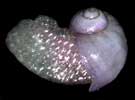
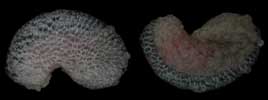
| BUBBLE FLOAT, BUBBLE RAFT |
A mass of bubbles (left image) generated by planktonic snails to keep them at the surface, maintaining accessibility to their prey (e.g., Portuguese Man of War, Physalia; the By The Wind Sailor, Vellella; or the Blue Buttons, Porpita. Also, Janthina creates a bubble raft (right, dual image) to support its EGGS. Left Photo: Janthina pallida (Thompson, 1840) Two Right Photos: Janthina sp. upperside and underside of its EGG MASS. |
|
|
| BUBBLE SHELL | A CEPHALASPID OPISTHOBRANCH mollusk. Examples are those species in the genera Bulla and Acteocina. | |
| BUCCAL | Pertaining to the organs of the mouth area. In a gastropod, pertaining especially to the bulging, flexible tissue mass that supports the radula. In cephalopods, the rounded orifice containing the mouth and surrounded by tissue (the buccal membrane) at the base of the arms. | |
| BUCCAL MASS | [need definition] | |
| BUCCAL PUMP | The organ, in the nudibranch family Goniodorididae, which sucks only the juices of its food, the polyzoa and ascidians. | |
| BUCCINOID | Having the shape of shells of the gastropod family Buccinidae. See other gastropod shapes. | |
| BULBOUS | Bulging or globular. | |
| BULLA | The form of a young COWRY (aka Cowrie), before it forms its final whorls and generates APERTURAL TEETH. | |
| BULLOID |
Bubble-shaped; in the shape of a shell of the genus Bulla. See also: BUBBLE SHELL. See other gastropod shapes. |
|

|
| BUTTRESS | A shell-strengthening structure, e.g., a complete or partial supporting ridge. In bivalves, an internal projection from wall of shell, supporting hinge plate or chondrophore; see also: CLAVICLE. | |
| BYNE'S DISEASE |
A reaction of shells to acid vapors in the air, resulting in a white powdery residue on the shells. Oak wood is one source of such vapors. One thing to remember about Bynes Disease is that the cause has two components. The development of the condition requires (1) a material capable of releasing acid vapors, and (2) sufficient moisture to allow those acid vapors to form. Some woods, such as oak have the capacity to release such vapors, in the presence of moisture. If you cannot keep your cabinets in an area free of high humidity, you should be careful about the wood they are made from. But if you have a good dry place to keep the collection, then the type of wood in the cabinets is far less problematic. Good ventilation is a plus, but it is not the deciding factor. If you have an acid-producing wood in a moist environment, then Bynes can occur, even with good ventilation (though probably more slowly than with poor ventilation). If you have the collection is a low humidity environment, then Bynes should not occur, even if the ventilation is poor. It is a good idea to control humidity regardless of what kind of cabinets you have, since high humidity tends to favor other problems as well, especially fungal growth. (Per: Paul Monfils, Conch-L listserve May 21, 2001). See the Bynes Disease article, (Byne's Disease – Questions and Answers), on the Conchologists of America (COA) web site. |
|
| BYSSAL | Pertaining to the BYSSUS. | |
| BYSSAL FORAMEN | Opening in the right valve in Anomiidae for passage of calcified byssus; see also: BYSSAL GAPE; BYSSAL NOTCH; BYSSAL SINUS. | |
| BYSSAL GAPE | Opening between margins of a bivalve shell for passage of the BYSSUS; see also: BYSSAL FORAMEN; BYSSAL NOTCH; BYSSAL SINUS. | |
| BYSSAL NOTCH |
Indentation below anterior auricle of right valve in many Pectinacea for passage of the byssus or protrusion of the foot. See illustration: Composite Bivalve. See also: BYSSAL FORAMEN; BYSSAL GAPE; BYSSAL SINUS.
See: Bivalve terminology, Anatomy of bivalves by Marlo Krisberg. |
|
| BYSSAL PLUG | [need definition] | |
| BYSSAL SINUS | Embayment of margin below anterior auricle of left valve in many Pectinacea, corresponding to byssal notch of right valve but usually shallower; see also: BYSSAL FORAMEN; BYSSAL GAPE; BYSSAL NOTCH. | |
| BYSSAL THREAD | See: BYSSUS. | |
| BYSSATE | Having a BYSSUS; = BYSSIFEROUS. | |
| BYSSIFEROUS | Having a BYSSUS; = BYSSATE. | |
| BYSSUS (=BYSSUS THREAD; =BYSSAL THREAD) |
A clump of thread-like, CHITINOUS (usually) filaments secreted by the foot of a MUSSEL or other bivalve which serves to anchor it to the substrate; the byssus of the Anomiidae is CALCAREOUS. See illustration: Composite Bivalve. See also: RADICATED. | |
| CAECUM | A blind pouch or cavity open at one end; see examples in the family Caecidae. See also: MUCRO. | |
| CALCAREOUS | Composed mostly of, or impregnated with, CALCIUM CARBONATE (lime), three forms of which commonly occur in molluscs: ARAGONITE, CALCITE, and VATERITE; see also: CORNEOUS. | |
| CALCITE | A common crystalline form of natural CALCIUM CARBONATE, CaCO3, that is the basic constituent of seashells (as well as limestone, marble, and chalk); see also: ARAGONITE; VATERITE. | |
| CALCIUM CARBONATE = CaCO3 |
The mineral, CaCO3, which makes up molluscan shells, occurring in different forms such as ARAGONITE, CALCITE, and VATERITE. See also: PRISMATIC LAYER; PORCELANEOUS LAYER; PRISMATIC LAYER. | |
| CALLOSITY | see: CALLUS. | |
| CALLOUS | Coated with a smooth enamel-like layer (INDUCTURA). | |
| CALLUM | Shell material filling a gape between valves in certain bivalves. Secondary CALCAREOUS structure present in some Pholadidae, forming anterior extension of shell proper and closing PEDAL GAPE in adult. Example: the MESOPLAX in Martesia striata (Linne, 1758). | |
| CAMEO | A low relief carving into the surface of an object, such as a mollusc shell. Shells of the genus Cassis are often used for such art. | |
| CANAL | In gastropods, a narrow notch or semitubular extension of the aperture, usually enclosing a siphon; see also: CANALICULATE; SIPHONAL CANAL. | |
| CANALICULATE | Having a distinct groove or canal. | |
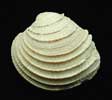
| CANCELLATE |
Having sculptural lines that intersect at right angles; = DECUSSATE; RETICULATE. See illustration: Composite Gastropod and Composite Bivalve. See also: TESSELLATE. Photo: Chione cancellata (Linne, 1767) |
|
|
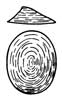
| CANTED | Slanted or sloped in relation to an adjoining structure; nonperpendicular. | |
|
| CAPACIOUS | Large, roomy, spacious; said of the aperture or shell body of gastropods. | |
| CAPSA (pl. CAPSAE) |
[need definition] | |
| CAP-SHAPED | Broadly conical, as in the shell of LIMPETS; see also: CANTED; PATELLATE; PATELLIFORM. See other gastropod shapes. | |
|
|
| CAPTACULA | The cluster of feeding appendages of SCAPHOPODS. See illustration at UCMP. | |
| CARDINAL AREA | In bivalves, situated more or less in the central part of the hinge area, immediately below the BEAKS. Flat or slightly concave, commonly triangular surface extending between beak and hinge margin in many bivalves, and partly or wholly occupied by LIGAMENT. | |
| CARDINAL AXIS | Imaginary straight line along which 2 valves of shell are hinged; = HINGE AXIS. | |
| CARDINAL COSTA | Ridge or rib demarcating cardinal area from outer surface of shell. | |
| CARDINAL CRURA (sing. CRUS) |
Narrow lamelliform teeth radiating from apex of LIGAMENT PIT in the Pectinacea. | |
| CARDINAL MARGIN | The edge of a BIVALVE shell on which the HINGE TEETH are located. | |
| CARDINAL PIT | [need definition] | |
| CARDINAL PLATFORM | Shelly internal plate bearing hinge teeth, situated below beak and adjacent parts of dorsal margins and lying in plane parallel to that of commissure; = HINGE PLATE. | |
| CARDINAL TOOTH | The main or largest teeth (usually) in a bivalve HINGE, located just below the UMBONES. See illustration: Composite Bivalve. See also: TOOTH, LATERAL. | |
| CARDO | [need definition]; (see: Popov, 1980). | |
| CARINA (pl. CARINAE) |
A keel-like part; a prominent knife-edged ridge; = KEEL. See illustration: Composite Gastropod. See also: WHORL, CARINATE; WHORL, BICARINATE. | |
| CARINATE | Having a CARINA, especially at the periphery of a WHORL; = KEELED. | |
| CARNIVOROUS | Feeding on animal matter; see also: HERBIVOROUS; OMNIVOROUS; DETRITIVOROUS. | |
| CARRIER SHELL | A SNAIL of the family Xenophoridae. These snails attach objects to the periphery of their whorls, thereby "carrying" them. | |
| CARTILAGE | An old term used for the INTERNAL LIGAMENT in bivalves. The substrate on which a radula sits. | |
| CARTILAGINOUS | Having a flexible or HORNY texture, as contrasted with SHELLY or CALCAREOUS. | |
| CAST | The mould from a FOSSIL shell, composed of matter which entered the shell in a soft state and has subsequently hardened, the shell eroded away, and the hardened material left to represent the internal form of the shell. See also ENDOCAST. | |
| CATACHOMATA | pits in the left valve of bivalves for reception of ANACHOMATA; see also: CHOMATA (sing., CHOMA). | |
| CAUDAL CANAL | The elongated, hollow process which terminates the aperture anteriorly, in some gastropod shells (e.g., Murex spp.); = ANTERIOR CANAL; = SIPHONAL CANAL. | |
| CAUDAL PIT | A conspicuous depression in the posterior dorsum of the foot of some snails which contains mucous glands. | |
| CAUDATE | With narrow, tail-like extremity. | |
| CEMENT BODY | Gland near the top of a SPERMATOPHORE containing a glue-like fluid. | |
| CEMENTATION | Permanent fixation to the substrate in sessile molluscs, especially bivalves. See also: ATTACHED. | |
| CENTRAL | At the center; see also: SUBCENTRAL. | |
| CEPHALASPID | An OPISTHOBRANCH gastropod mollusc which possesses a "HEAD SHIELD"; examples include those in the genera Bulla and Acteocina. = BUBBLE SHELL. See also: ANASPID. | |
| CEPHALOPOD |
A member of the molluscan class Cephalopoda (once referred to, by Pliny, as Mollia), which is characterized by muscular tentacles attached directly to their head. They have a beaked mouth and their eyes are well developed. This term pertains to SQUID, OCTOPUS, CHAMBERED NAUTILUS, CUTTLEFISH and the extinct AMMONITES and BELEMNITES; see also: TEUTHOLOGIST; TEUTHOLOGY. See the excellent "Cephalopod Glossary" by Richard E. Young, Michael Vecchione, and Katharina M. Mangold. |
|
| CEPHALOTOXIN |
A toxin produced by the posterior salivary glands of CEPHALOPODS, used by OCTOPUS to paralyze crabs. See: Ghiretti, F. 1959. Cephalotoxin: the crab-paralysing agent of the posterior salivary glands of cephalopods. Nature 183:1192-1193 (25 April 1959). |
|
| CERAS (pl. CERATA) |
On of the slender, club-shaped or horn-shaped dorsal appendages in the NUDIBRANCHIA and ASCOGLOSSA, which either lie separately or in several rows or may be clustered together in tufts and palmate bunched; they contain blood from the HAEMOCOEL and are invaded also by tubular branches of the digestive gland which, as evolution proceeds, becomes deployed on On of the slender, club-shaped or horn-shaped dorsal appendages in the Nudibranchia and Ascoglossa, which either lie separately or in several rows or may be clustered together in tufts and palmate bunched; they contain blood from the haemocoel and are invaded also by tubular branches of the digestive gland which, as evolution proceeds, becomes deployed on the dorsal surface; see also: CLADOHEPATIC; HOLOHEPATIC. See illustration: Composite Nudibranch. | |
| CERATUS | A hornlike structure; a large spur; see also: LABIAL TOOTH. | |
| CF (CONFER) | Sometimes put in front of a species name to mean that the species being identified is close to, but not exactly, a certain species; it also implies that you know for sure that it is not that species mentioned, but merely close to it, e.g., Conus cf. crocatus Lamarck, 1810; (a "?" prior to a species name indicate that the correct name is possibly the one mentioned). See also: AFF (AFFINIS). | |
| CHAETODERM | [need definition]. | |
| CHALAZA | An EGG capsule; (see: Franz, 1971:177). See also: NIDAMENTAL GLAND. | |
| CHAMBERED | Having an essentially discontinuous cavity, usually separated by diaphragms or septa, as in the chambers of the CHAMBERED NAUTILUS (chambers also occur in some species of Spondylus and several turrited gastropods); see also: CONCAMERATIONS. | |
| CHAMBERED NAUTILUS | [need definition]. A CEPHALOPOD… ; see also: CONCAMERATIONS; PHRAGMOCONE; SIPHUNCLE. | |
| CHANNEL | A deep groove; see also: FLUTED. | |
| CHANNELED | Sculptured with deep grooved; having a groove; see also: FLUTED; STRIATE. | |
| CHARACTER, ADAPTIVE | Those characters which are immediate modifications for a particular mode of life; see also: CHARACTER, PROGRESSIVE; CHARACTER, CONSERVATIVE. | |
| CHARACTER, CONSERVATIVE | Those characters that persist unchanged over long periods. It is these characters that are most useful in showing real affinities of one group toward another; see also: CHARACTER, ADAPTIVE; CHARACTER, PROGRESSIVE. | |
| CHARACTER, PROGRESSIVE | Those characters which usually show a definite trend of advance, often running parallel through several unrelated groups; see also: CHARACTER, ADAPTIVE; CHARACTER, CONSERVATIVE. | |
| CHERRYSTONE | The midsized QUOHOG clam, Mercenaria mercenaria. See also: LITTLENECK. | |
| CHEVRON (GROOVE) | V-shaped furrow on cardinal area in some Arctacea and early Pectinacea, for insertion of the LIGAMENT. | |
| CHIASTONEURY | The condition in the GASTROPOD visceral nerve loop being twisted into a figure-8, during TORSION. | |
| CHINK | A long, narrow cleft, especially in the umbilical area. | |
| CHIRAL | An object having the property of CHIRALITY. | |
| CHIRALITY | An asymmetry property important in several branches of science. An object or a system is called CHIRAL if it differs from its mirror image, and its mirror image cannot superimpose on the original object. A chiral object and its mirror image are called ENANTIOMORPHS (Greek opposite forms) or, when referring to molecules, enantiomers. A non-chiral object is called ACHIRAL (sometimes also AMPHICHIRAL) and can be superimposed on its mirror image. Used in the context of Busycon and the SINISTRAL and DEXTRAL forms. | |
| CHITIN | The general name for a group of HORNY, proteinaceous substances, one of which (CONCHIOLIN) is found in PROTOCONCHS, RADULAE, etc. | |
| CHITINOUS | Chitin-like; composed of CHITIN; see also: HORNY. | |
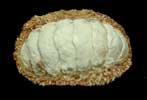
| CHITON |
Common name for members of the molluscan class POLYPLACOPHORA, commonly called COAT OF MAIL SHELLS. Photo: Acanthopleura granulata (Gmelin, 1791) A glossary of chiton terms is also available on the Gallery of Chitons website. |
|
|
| CHOMATA | Collective term for ANACHOMATA, which are small tubercles or ridgelets on periphery of inner surface of right valve of bivalves, and CATACHOMATA, which are pits in the left valve for reception of anachomata; both generally restricted to vicinity of the hinge, but may encircle whole valve. | |
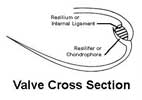
| CHONDROPHORE | A pit or spoon-like shelf in the hinge of a bivalve, such as Mactra, and into which fits a CHITINOUS cushion or RESILIUM.. See illustration: Composite Bivalve. See also: LIGAMENT PIT; RESILIFER. | |
|
| CHRESONYMY | A SYNONYMY that includes misuses of names as well as true synonyms (i.e., most "synonymies"). | |
| CHROMATOPHORE | Tiny, elastic, transparent cell fringed with pigment, and responsible for display of coloration; common in CEPHALOPODS. | |
| CICATRIX | Old term for the scar, on the interior of a shell, due to a muscle attachment; see also: MUSCLE SCAR. | |
| CILIA | Minute hairs; see also: MUCOCILIARY FEEDING. | |
| CILIATED | Having minute hairs (or CILIA); see also: MUCOCILIARY FEEDING. | |
| CINEREOUS | Grayish or ash-colored. | |
| CINGULUM (pl. CINGULA) |
A band or girdle, e.g., a band of color or raised sculpture. | |
| CIRCUMBOREAL | Distributed around the world, in the northern BOREAL region. See also: PROVINCE. | |
| CLADISTICS |
[need definition]. See also: CLADOGRAM. See the Paleos website. |
|
| CLADOGRAM | [need definition]. See also: CLADISTICS. | |
| CLADOHEPATIC | Having the "liver" or digestive gland broken up and dispersed throughout the body and often into club-shaped CERATA or fleshy fingers on the DORSUM of OPISTHOBRANCHS. This condition originated independently in various groups and can be used only for identification and not classification; see also: CERATA; HOLOHEPATIC. | |
| CLAM | Common term for a BIVALVE. See also some common names for various types of clams: COQUINA; DATE MUSSEL; GIANT CLAM; MUSSEL; OYSTER; PIDDOCK; QUAHOG; RAZOR CLAM; SHIPWORM. | |
| CLANDESTINE EVOLUTION | see: EVOLUTION, CLANDESTINE. | |
| CLASSIFICATION | An arrangement or hierarchy of animals and plants into taxonomic groups; i.e., grouped according to their similarities; see also: TAXONOMY; SYSTEMATICS. | |
| CLATHRATE | Having intersecting sculptural elements forming a broad lattice. | |
| CLAUSILIUM (=CLAUSIUM) |
A CALCAREOUS, loose "sliding door" in the Clausiliidae (Pulmonata) which fits into the grooves of the COLUMELLA, serving as a door. When not prevented by counteracting pressure, the clausilium springs forward on its elastic LIGAMENT and encloses the animal into its shell. | |
| CLAUSIUM | see: CLAUSILIUM. | |
| CLAVATE | Having one extremity of a shell attenuated and the other suddenly VENTRICOSE or GLOBULAR. | |
| CLAVICLE | Shelly buttress supporting a CHONDROPHORE in some genera. | |
| CLEIDOIC | A type of egg which is not impermeable to water (the cytoplasm of the egg is adapted to tolerate a considerable water loss, rather than the shell to prevent it). | |
| CLOSED | In bivalves, having the valves meet tightly along the entire margin; see also: GAPE; GAPING. | |
| CLOSURE SEAM | A line of junction; a line, groove, or ridge formed by or between abutting edges. | |
| CLUB | In squid, the expanded area (generally bearing large suckers) on the distal end of the tentacle. | |
| CLUB-SHAPED | In a GASTROPOD shell, having a compact, rounded body and a long SIPHONAL CANAL. | |
| COALESCED | Fused or merged together. | |
| COAT OF MAIL (SHELL) | Common name applied to CHITONS (the molluscan class Polyplacophora), due to their resemblance to jointed armour. | |
| COCHLEATE | Being hollow and oval, like a spoon, e.g., the LIGAMENT PIT of Mya spp. | |
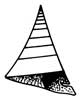
| COELOCONOID |
Slightly concave; see also: CYRTOCONOID. See other gastropod shapes. |
|
|
| COELOM | [need definition]. | |
| COFFEE BEAN SNAIL | A GASTROPOD of the genus Melampus. | |
| COGNATE | Of, or proceeding from, the same stock; allied; of the same or similar nature, as in the case of closely related forms or species on both sides of the Central American isthmus. | |
| COILING | In gastropods, the wrapping of one WHORL around a previous whorl; see also: LOGARITHMIC SPIRAL; LOOSELY COILED; TIGHTLY COILED. | |
| COLL. | An abbreviation for the latin, Collegit, meaning: Collected by. However, this abbreviation is also interpreted as: In the collection of. Because of this ambiguity, the use of LEG. is preferred over COLL. | |
| COLLABRAL | Parallel or nearly so. See also: COLLABRAL LINES. | |
| COLLABRAL LINES | A series of similar, adjacent lines. See also: GROWTH LINE. | |
| COLLAR | A raised rim bordering a suture. In cephalopods, the free edge of the mantle in squids, etc., at the "neck." | |
| COLUMELLA | A pillar surrounding the AXIS around which the shell is coiled, formed by the inner surface of the WHORL; the wall opposite the outer APERTURAL LIP. See illustration: Composite Gastropod. See also: AXIS; PILLAR. | |
| COLUMELLA, STRAIGHT | [need definition]. | |
| COLUMELLA, TRUNCATE | [need definition]. | |
| COLUMELLAR | Pertaining to the COLUMELLA. | |
| COLUMELLAR CALLUS | A smooth, shelly layer extending over the COLUMELLAR area, secreted by the mantle; see also: PARIETAL CALLUS. | |
| COLUMELLAR FOLD | A raised ridge on the COLUMELLA that follows the helical growth pattern of a gastropod shell.; see also: FUNICLE. | |
| COLUMELLAR LIP | The part of the inner lip, of a gastropod shell, nearest to the axis of coiling, and comprising the visible part of the COLUMELLA. | |
| COLUMELLAR PLAIT | [need definition]. See illustration: Composite Gastropod. | |
| COLUMELLAR PLICAE | [need definition]. See illustration: Composite Gastropod. | |
| COLUMELLAR TOOTH | A sharply raised projection, emanating from the COLUMELLA and protruding into the APERTURE of a GASTROPOD. See illustration: Composite Gastropod. | |
| COLUMELLAR WALL | Surface of the COLUMELLA. | |
| COMMARGINAL | [need definition]. | |
| COMMARGINAL RIB | [need definition]; see also: OVERRIDE. | |
| COMMENSAL | The association of one species with a different species in which one or more is benefitted, and others are not harmed. See also: PARASITE. | |
| COMMISSURE | Line of junction of 2 VALVES of a BIVALVE. | |
| COMMON NAME | See: VERNACULAR NAME; see also: SCIENTIFIC NAME. | |
| COMPLANATE | Flattened; level; unsculptured; see: COMPRESSED. | |
| COMPRESSED | Flattened, typically laterally (opposite of DEPRESSED); having reduced thickness or height; see: COMPLANATE. | |
| CONCAMERATIONS | A series of chambers joining each other, as in Nautilus spp.; see: CHAMBERED; PHRAGMOCONE. | |
| CONCAVE | Hollowed and curved or rounded; opposite of convex; see also: COELOCONOID; CYRTOCONOID. | |
| CONCAVITY | The quality or state of being CONCAVE; a concave point. | |
| CONCENTRIC | Having a common center, as circles. In gastropod shells, said of structures roughly parallel to growth lines (referred to as LONGITUDINAL by some authors); see also: ANNULATE; TRANSVERSE. The term COMMARGINAL is preferred by some modern authors. See also: ECCENTRIC. | |
| CONCENTRIC LINE | See: GROWTH LINE. See illustration: Composite Bivalve. | |
| CONCENTRIC SCULPTURE | [need definition]; see also: AXIAL SCULPTURE. | |
| CONCH |
A COMMON NAME referring to a member of the gastropod family Strombidae. Also, and generally, a seashell; see also: ANIMAL. People that study seashells (conchs) are CONCHOLOGISTS. |
|
| CONCH PEARL | A PEARL, often pink in color, produced by the Queen Conch, Strombus gigas. | |
| CONCHIOLIN | A HORNY, proteinaceous material that makes up the periostracum of a shell and also forms the organic matrix for calcareous parts of the shell; often termed CHITIN; see also: PRISMATIC LAYER; CALCITE; ARAGONITE; VATERITE. | |
| CONCH-L LISTSERV |
A mailing list on a LISTSERV supported by the University of Georgia (UGA). Members subscribe to "the list" to facilitate an easy exchange of emails via "posting" one email to "the list" which is distributed by the Listserve to all subscribers of the list to which the initial email was sent. See also: GASTROPODNET; MOLLUSCAlist; STROMBUS-L; SHELLFISH. See the compilation of information about Molluscan Listserves. |
|
| CONCHOLOGIST | A specialist in the study of molluscan shells (CONCHS). A group organized to share such interests is the CONCHOLOGISTS OF AMERICA (COA). See also: MALACOLOGIST; TEUTHOLOGIST. | |
| CONCHOLOGISTS OF AMERICA (COA) | A group organized to share interests in CONCHOLOGY and which describes itself on the COA website as a "society for shell enthusiasts from all walks of life, at all levels of interest." This organization publishes American Conchologist. See also: MALACOLOGICAL SOCIETY; SHELL CLUB. | |
| CONCHOLOGY | The study of molluscan shells (CONCHS). See also: CONCHOLOGIST; CONCHOLOGISTS OF AMERICA; MALACOLOGY; TEUTHOLOGY; CONCHOMETRY. | |
| CONCHOMETRY |
[need definition]. See references: Boycott, A.E. 1928. Conchometry. Proc. Malac. Soc. London 18:8-31. Parodiz, J.J. 1951a. Me´todos de conquiliometry #305;´a. Physis 20(58):241–248. Parodiz, J.J. 1973e. Gastropod conchometry. Pittsburgh Shell Club Bulletin 8:14–16. |
|
| CONDYLE | An enlarged and prominent end of a RIDGE, serving as a pivot. | |
| CONE SHELL |
Common name applied to a SNAIL of the genus Conus. See also: CONOTOXIN. Also, see: The Conus Biodiversity Website. |
|
| CONFLUENT | Coming together; merging; see also: COALESCED. | |
| CONGENER | A species belonging to the same genus as the species used as a point of reference; see also: CONSPECIFIC. | |
| CONGENERIC | Belonging to the same genus as the species used as a point of reference; see also: CONGENER. | |
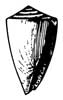
| CONICAL |
Cone-shaped; tapering; see also: BICONIC; CONICAL; CYLINDRICAL. See other gastropod shapes. |
|
|
| CONMARGINAL | Preferred term by some modern authors for structure with direction coinciding with that of growth lined; = CONCENTRIC, in bivalves. | |
| CONOTOXIN | A neurotoxin produced by the venom gland of GASTROPODS of the genus Conus; often referred to as CONE SHELL venom. | |
| CONSPECIFIC | Of the same species as an organism used as a point of reference; see also: CONGENER; CONGENERIC. | |
| CONSTRICTED | Marked by a more or less abrupt narrowing; waist-like; pinched. | |
| CONSTRICTION | A narrowed area. | |
| CONTIGUOUS | Touching each other, as in the WHORLS of some gastropods in which the whorls rest upon or touch each other; see: DISCONTIGUOUS; DISCONTINUOUS; DISTAL; PROXIMAL. | |
| CONTINUOUS | Uninterrupted; intact from one point to another; see: CONTIGUOUS; DISCONTINUOUS; HOLOSTOMATE; SIMPLE. | |
| CONTRACTED | Drawn together; reduced in extent; shrunken. | |
| CONTRACTILE | Capable of reducing length by shortening and thickening; see also INVERSIBLE. | |
| CONVEX | Curved or rounded; bulging outward; opposite of CONCAVE; see also: CYRTOCONOID. | |
| CONVEXITY | Degree of inflation. | |
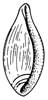
| CONVOLUTE | Having the body whorl of the shell expand abruptly so as to wrap around and conceal all the older, subsequent whorls. See also: INVOLUTE. See other gastropod shapes. | |
|
| COPULATORY ORGAN | Usually a penis or other organ used by the male to insert sperm into the female; see also: VERGE. | |
| COQUINA CLAM | Common name for CLAMS of the genus Donax. | |
| CORBICULOID TYPE | Heterodont dentition (in bivalves) with 3 cardinal teeth in each valve, middle one of right valve occupying median posterior position below BEAKS; formerly termed CYRENOID TYPE. | |
| CORBULIFORM | Shaped like the shells of the bivalve genus Corbula. | |
| CORD | A thickened round-topped transverse (i.e., spiral) or axial sculptural element. | |
| CORDATE | Shaped like a heart; often applied to shells such as Cardium, Cardita, and Venus; see also: CORDIFORM; SEMICORDATE. | |
| CORDED | Sculptured with cords. | |
| CORDIFORM | Heart shaped, as in the bivalve Corculum cardissa. See also: CORDATE. | |
| CORNEOUS (=CORNEUS) |
HORNY in texture and composition; see also: CALCAREOUS. | |
| CORONA | A crown-like structure; see also: CORONATE. | |
| CORONATE | Crown-like; having a CORONA; encircled by a row of spines or prominent nodes, especially at the shoulder of the last whorl in gastropods. | |
| CORRODED | Worn away (usually with age), as in the UMBONES of some bivalves or SPIRES of some gastropods; see: DECOLLATE; OBSOLETE. | |
| CORRUGATE | Folded or ridged on the surface; broadly or heavily sculptured with FOLDS. | |
| CORSELET | A differentiated (by sculpture) POSTERIOR area of a BIVALVE. | |
| COSTA (pl. COSTAE) |
A round-topped sculptural element, stronger than a cord, usually formed by periodic thickening of the outer lip in gastropods. Moderately broad and prominent elevation of surface of shell, directed radially or otherwise; see also: COSTELLA. | |
| COSTATE |
Having rib-like AXIAL sculptural elements. See illustration: Composite Gastropod and Composite Bivalve. |
|
| COSTELLA | Rather narrow linear elevation of surface of shell; formerly: COSTULE; see also: COSTA. | |
| COSTULATION | A pattern of sculpture in small RIDGES. | |
| COSTULE | Old term for COSTELLA. | |
| COWL | A hood; a fold-like structure extending over the front or outward like a hood. | |
| COWRY (= COWRIE) |
Common name applied to gastropods in the family Cypraeidae. See also: BULLA. | |
| CRABBED | A gastropod shell, usually in poor condition, formerly used as a home for a hermit crab (Crustacea: Paguridae). The columella may have a U-shaped worn area. | |
| CRENATE | Having a regularly notched or scalloped edge; see also: CRENULATE. | |
| CRENULATE (pl. CRENULATIONS) |
Same as CRENATE, but implying smaller or finer divisions. See illustration: Composite Bivalve. See also: DENTICULATION | |
| CRENULE | Small notches or beads. | |
| CREST | The apex of a peak or ridge; the top of a sculptural element. | |
| CRISPATE | Irregularly curled; roughened into small frets, waves, or folds. | |
| CROSSED-LAMELLAR | Type of shell structure comprised of primary and secondary LAMELLAE, the latter inclined in alternate directions in successive primary lamellae. | |
| CRUMPLED | Creased or pressed into wrinkles or folds. | |
| CRURAL | Pertaining to CRURA. | |
| CRUS (pl. CRURA) |
Pairs of diverging ridges on the hinge of some bivalves, resembling teeth. | |
| CRYPTODONT | Lacking HINGE TEETH (applied to certain groups of early origin only); see also: EDENTULOUS; EDENTATE; ANODONT. | |
| CRYSTALINE STYLE | [need definition]. In bivalves... | |
| CTENIDIUM (pl. CTENIDIA) |
The respiratory organ in the Mollusca; a GILL which has been modified for food-gathering in the BIVALVIA; see also: DIBRANCH; EULAMELLIBRANCH; FILIBRANCH; LAMELLIBRANCH; PROTOBRANCH; PSEUDOLAMELLIBRANCH; SEPTIBRANCH; TECTIBRANCH; TETRABRANCH. | |
| CTENODONT | [need definition]; see also: PSEUDOCTENODONT; PSEUDOTAXODONT. | |
| CTENOLIUM |
Comb-like row of small teeth on the lower side of BYSSAL NOTCH in some Pectinacea.
See: Bivalve terminology, Anatomy of bivalves by Marlo Krisberg. |
|
| CUNEIFORM | Wedge-shaped. | |
| CURVED | Arched or gently bent; = ARCUATE. | |
| CUSP | A prominence or point, especially on a RADULAR TOOTH or a DENTICLE on the shell. | |
| CUSPIDOBLAST | One of the cells in a CAECUM or pouch at the posterior of the RADULA which secrete the radular teeth. | |
| CUTICULAR SHIELD | In Aplacophorans… | |
| CUTTLEBONE CUTTLEFISH BONE |
The internal shell of the CUTTLEFISH (Cephalopoda), Sepia officinalis. See also: BELOPTERA. | |
| CUTTLEFISH | [need definition]. A CEPHALOPOD… See also: BELOPTERA. | |
| CYATHIFORM | Cup-shaped (as in the "cup" of "cup and saucer" limpets, the Calyptraeidae). | |
| CYCLODONT | BIVALVE DENTITION with HINGE TEETH curving out from below HINGE MARGIN, HINGE PLATE being small or absent. | |
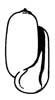
| CYLINDRICAL | Like a cylinder; applied to shells with sides which are nearly parallel, with the extremities either rounded, flat or conical. See also: CONICAL. See other gastropod shapes. | |
|
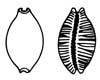
| CYPRAEIFORM | A shape exemplified by the gastropod genus Cypraea. See other gastropod shapes. | |
|
| CYPRINOID TYPE | Same as ARTICOID TYPE. | |
| CYRENOID TYPE | Old name for CORBICULOID TYPE. | |
| CYRTOCONE | In cephalopods, laterally compressed, curved shells; see also: BREVICONE; ORTHOCONE. | |
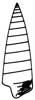
| CYRTOCONOID | Slightly convex. See also: COELOCONOID. See other gastropod shapes. | |
|
| DART SAC | A muscular caecum developed from the vagina in which is produced a fine, pointed, calcareous shaft, the TELUM AMORIS, or "love dart;" see also: SARCOBELUM. | |
| DATE MUSSEL | Common name applied to CLAMS of the genus Lithophaga. See also: MUSSEL. | |
| DEAD SHELL | Term applied by collectors to a shell which did not have a live animal in it when collected; see: LIVE SHELL. | |
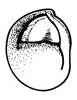
| DECK (1) | A small sheet of SHELLY substance in the UMBONAL region of a valve; see also: DECK (2). | |
| DECK (2) | The diaphragm of slipper shells (Crepidula spp.), sometimes called the SHELF; see also: DECK (1). | |
|
| DECOLLATE | Cut off; TRUNCATED, e.g., the top several whorls of the spire (as in Truncatella spp.); typically, the loss of this portion of the shell is by design, rather than wear or corrosion; see: CORRODED. | |
| DECORTICATED | Missing the NACRE and/or true coloration. | |
| DECURRENT | Extending downward; see also: DEFLEXED. | |
| DECUSSATE | Having intersecting sculptural elements, not necessarily at right angles; RETICULATE. See illustration: Composite Gastropod and Composite Bivalve. See also: CANCELLATE; LATTICED. | |
| DEFLEXED | Bent sharply backward or downward; see also: DECURRENT; RECURVED; REFLEXED. | |
| DEHISCENT | Capable of falling off very easily; often used in reference to the PERIOSTRACUM; see also: EXFOLIATE. | |
| DELIMITING | Bounding; fixing a limit. | |
| DELTOID | Triangular, TRIGONAL. | |
| DEMARCATION LINE | In bivalves, an imaginary line on the surface of valve originating at the BEAK and marking locus of points on successive positions of margin where transverse growth component has had maximum effect; forms dorsoventral profile when VALVE is viewed from one end; see also: CORSELET; DIAGONAL RIDGE; ESCUTCHEON RIDGE. | |
| DEMIBRANCH | One of the paired lamellibranch gills. The longitudinal half of a feather-shaped gill; see also: DIBRANCH; TETRABRANCH. | |
| DENTAL FORMULA | See: RADULA FORMULA. | |
| DENTATE | Toothed; having HINGE TEETH; having a toothed margin; see also: DENTICULATE; TRIDENTATE. | |
| DENTICLE | A small, tooth-like projection. | |
| DENTICULATE | Having small, tooth-like projections; see also: DENTATE; SERRATE. | |
| DENTICULATION | The overall pattern of DENTICLES in a given shell or specimen. | |
| DENTITION | Gastropoda: referring to the structure of the elements of the RADULA. Bivalvia: referring to the tooth structure of the hinge; the hinge teeth and sockets, considered collectively; see also: ACTINODONT; CORBICULOID TYPE; ANODONT; CRYPTODONT; CTENODONT; CYCLODONT; CYPRENOID TYPE; DIAGENODONT; DYSODONT; HETERODONT; ISODONT; ORTHODONT; PACHYODONT; PANTODONT; PRIONODONT; PSEUDOCTENODONT; PSEUDOTAXODONT; SCHIZODONT; TAXODONT; TELEODONT; ARTICOID TYPE; HINGE; LUCINOID TYPE; VINCULUM. | |
| DEPAUPERATE | Poorly developed. | |
| DEPRESSED | Pressed down, typically dorso-ventrally (opposite of COMPRESSED); low in proportion to diameter.; see also: DISCOIDAL. | |
| DEPRESSION | A hollowed area; a concavity. | |
| DET. = DETERMINAVIT |
Identified by. Example on a specimen label: Det: John Doe; or: John Doe, det. See also: LEG. | |
| DETACHED | Separated; marked off; see also ATTACHED. | |
| DETORSION | [need definition]. See also: TORSION. | |
| DETRITIVOROUS | Feeding on detritus. See also: CARNIVOROUS; HERBIVOROUS; OMNIVOROUS. | |
| DEVELOPMENT, DIRECT | Passing the entire larval stages within an egg case or within the adult; lacking a free-swimming or floating larval stage; see also: BROODER; DEVELOPMENT, PLANKTONIC. | |
| DEVELOPMENT, PLANKTONIC | Having a free-swimming or floating larval stage; see also: DEVELOPMENT, DIRECT; LECITHOTROPHIC; PLANKTOTROPHIC, PLANKTON. | |
| DEVOLUTE | [need definition]; see also: LOOSELY COILED. | |
| DEXTRAL |
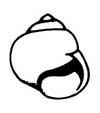
Turning clock-wise or to the right, or "right-handed" in gastropods; the direction of coiling in which, with the shell held upright (apex at the top), the aperture is at the right; and in which, with the shell viewed from above the apex, the coiling proceeds from the apex in clockwise direction; = RIGHT HANDED.; opposite of
SINISTRAL; See also:
CHIRALITY;
ENANTIOMORPH;
HETEROSTROPHY; ULTRADEXTRAL. See other gastropod shapes. |
|
|
| DIAGENODONT | Bivalve DENTITION with differentiated CARDINAL and LATERAL TEETH located on HINGE PLATE, laterals not exceeding 2 or cardinals 3 in either valve; example: Astarte spp.; see also: TELEODONT. | |
| DIAGNOSIS | A short, comparative description of a SPECIES. | |
| DIAGNOSTIC | Central to identification; especially characteristic; reflecting critical comparative scrutiny. | |
| DIAGONAL RIDGE | In bivalves, a ridge running from the UMBO toward posteroventral part of VALVE; see also: CORSELET; DEMARCATION LINE. | |
| DIAMETER | The greatest width of a snail shell at right angles to the shell axis. See illustration: Composite Gastropod. See also: WIDTH; WRS. | |
| DIAPHANOUS | Clear, or TRANSPARENT; see also: PELLUCID; OPAQUE. | |
| DIAPHRAGM | The septa which divide the chambers of MULTILOCULAR and other shells. Also, the DECK of SLIPPER SHELLS. | |
| DIBRANCH | Possessing two gills (CTENIDIA); the name applied to all living cephalopods, except Nautilus, which is a TETRABRANCH; see also: EULAMELLIBRANCH; FILIBRANCH; LAMELLIBRANCH; PROTOBRANCH; PSEUDOLAMELLIBRANCH; SEPTIBRANCH; TECTIBRANCH. | |
| DIFFUSE | Spread out; applied to the APERTURE of a gastropod shell which is widened into a flat surface; = ALATE; = DILATED. | |
| DIGESTIVE GLAND | [need definition]. | |
| DIGITATE | In a finger-like fashion; having finger-like processes. | |
| DIGITATION | A finger-like part; a pattern of finger-like parts. | |
| DILATED | Expanded or spread; = ALATE; = DIFFUSE. | |
| DIMORPHISM | Having two forms, e.g., differing forms for different sexes = sexual dimorphism; see also: POLYMORPHISM. | |
| DIMYARIAN | The condition in bivalve molluscs of having two ADDUCTOR MUSCLES, the anterior and posterior; see also: ANISOMYARIAN; HETEROMYARIAN; MONOMYARIAN. | |
| DIOECIOUS | Having the male and female sexes separate; see also: AMBISEXUAL; HERMAPHRODITE; MONECIOUS; PROTANDRY. | |
| DIOTOCARDIAN | Having a heart with two auricles. See also: MONOTOCARDIAN. | |
| DIRECT DEVELOPMENT | See: DEVELOPMENT, DIRECT. | |
| DIRECTIVE SPIRAL | Spiral curve formed by DIRECTIVE RIB within its own plane. | |
| DISC | The VALVES of bivalves; in Pectinacea, the whole of the valve, excluding the AURICLES; see also: FLANK. | |
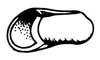
| DISCOIDAL | Round and flat, like a disk.; see also: DEPRESSED; LENTICULAR; PLANISPIRAL; SEMIDISCOIDAL. See other gastropod shapes. | |
|
| DISCONTIGUOUS | Not touching each other, as in the whorls of some gastropods in which the whorls are separated and do not rest upon or touch each other; see: CONTIGUOUS; CONTINUOUS; WHORL, DISJUNCT; GYROCONIC. | |
| DISCONTINUOUS | Interrupted; not continuing intact from one point to another; see: CONTINUOUS. | |
| DISSOCONCH | The postlarval shell of bivalves (and scaphopods?). See illustration: Composite Bivalve. See also: MESOCONCH; NEPIOCONCH; PRODISSOCONCH. | |
| DISTAL | Situated away from the base or point of attachment; = DISTANT; opposite of PROXIMAL; see also: CONTIGUOUS. | |
| DISTANT | See: DISTAL; see also: REMOTE<.a>. | |
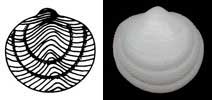
| DIVARICATE |
Having the sculpture composed of pairs of rather widely divergent COSTAE or threads, as in the genus Divalinga. See illustration: Composite Bivalve. See also:
LATTICED;
SCISSULATE;
TRANSVERSE. Photo: Divalinga quadrisulcata (d'Orbigny, 1846) |
|
|
| DOCOGLOSSATE | Having a radula in which the RACHIDIAN TOOTH is small or absent, and there are 3 LATERAL TEETH with hard, black tips, flanked by 3 smaller, unpigmented MARGINALS on each side; = STEREOGLOSSATE; examples in the Patellacea: Acmaeidae, Lepetidae, Patellidae; RADULAR FORMULA: 3+D+2+R+2+D+3 or 3+D+2+0+2+D+3 (where R = RACHIDIAN, D = DOMINANT DENTICLE). | |
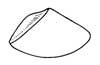
| DONACIFORM | A form of TRIGONAL shape exemplified by the BIVALVE genus Donax. See other bivalve shapes. | |
|
| DORATOPSIS | The LARVAL stage of the CEPHALOPOD family Chiroteuthidae. | |
| DORSAL | Of, pertaining to, or situated on the back or upper surface; in bivalves, at or toward the HINGE; see also: VENTRAL. | |
| DORSUM | The DORSAL surface of a shell or animal. The "back" of a gastropod shell, opposite the APERTURAL side. | |
| DOUBTFUL NAME | See: NOMEN DUBIUM. | |
| DRAP MARIN | The French naturalist term for periostracum. | |
| DRUPE | Common name applied to gastropod shells of the genus Drupa. | |
| DUPLIVINCULAR | The type of bivalve LIGAMENT with lamellar component repeated as a series of bands, each with its 2 edges inserted in narrow grooves in cardinal areas of respective valves; example: Arca; see also: ALIVINCULAR; PARIVINCULAR; MULTIVINCULAR. | |
| DWARF | Of less than usual or normal size for a given stage of development. | |
| DYMANTIC | Referring to a response to fear or disturbance, characterized by changes in coloration (in the cephalopoda) and appearance. | |
| DYSODONT | In bivalves, a HINGE with small, weak teeth close to BEAKS (as in some Mytilacea). | |
| EAR | See: HINGE EAR; WING. | |
| EAVES | In CHITONS, the portions of the TEGMENTUM just over the points where the INSERTION PLATE and sutural laminae push from under it. | |
| ECCENTRIC | Not having the same center; not CONCENTRIC; deviating from the center, as in an elliptical orbit. In the gastropod shell, not following the GROWTH LINES. | |
| ECHINOSPIRA | A type of VELIGER, in the Lamellariidae, Cypraeidae (Eratoinae) and Capulidae [all Gastropoda], in which the young definitive shell is covered by a much larger secondary shell, the SCAPHOCONCHA, which has practically no weight and assists in floatation during the long swimming life of a larva.; see: LARVA. | |
| ECOLOGIC FORM | A morphological condition brought about by the influence of the environment, such as long SPINES in quiet waters; also called: ECOTYPE or ECOPHENOTYPE. See also: FORM or FORMA | |
| ECOMORPH | One whose morhology is determined by the ecology; = ECOPHENOTYPE. | |
| ECOPHENOTYPE | An organism whose visual characteristics (PHENOTYPE) have been influenced by the environment. Example: a shell having longer spines due to growing in calm waters vs. having short or no spines due to life in fast-flowing waters. See also: ECOMORPH; ECOPHENOTYPIC VARIATION; FORM; GENOTYPE. | |
| ECOPHENOTYPIC VARIATION | Variation caused by environmental conditions. Such variability has been use by SPLITTERS to distinguish one "species" from another. See also: ECOLOGIC FORM; ECOPHENOTYPE. | |
| ECOTYPE | See: ECOLOGIC FORM; ECOPHENOTYPE. | |
| ECTOPARASITE | Living PARASITICALLY on the outside of another organism; for example, the Pyramidellidae. | |
| EDENTATE | Toothless; same as ANODONT, in bivalves. | |
| EDENTULATE | Toothless; EDENTATE; EDENTULOUS. | |
| EDENTULOUS | Toothless; EDENTATE; EDENTULATE.. | |
| EGG | A female gamete or reproductive body; an ovum. See also: CHALAZA; EGG MASS; EGG CAPSULE. | |
| EGG CAPSULE | See: CHALAZA. | |
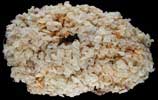
| EGG MASS |
A cluster of EGGS, sometimes deposited by an individual, but sometimes by multiple individuals contributing to a single mass (e.g., some Muricids). For a PELAGIC example, see: BUBBLE FLOAT. Photo: Murex pomum Gmelin, 1791 |
|
|
| ELEPHANTS TUSK | Common name applied to SCAPHOPOD shells of the genus Dentalium, due to their similar appearance to an elephants tusk; = BOARS TUSK or, generally, TUSK SHELL. | |
| ELEVATED | ERECT; raised; said of prolonged sculptural elements and other structures; see also: DEPRESSED. | |
| ELLIPTICAL |
Like an ellipse or flattend oval; see also: ELONGATE ELLIPTICAL. See other bivalve shapes |
|

|
| ELONGATE |
Lengthened; extended in one dimension. Illustration: Solen sp. See also: ENSIFORM; LINGUIFORM. See other bivalve shapes. Photo: Tagelus divisus (Spengler, 1794) |
|
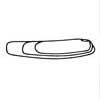 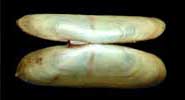
|
| ELONGATE ELLIPTICAL |
A basically ELLIPTICAL shape that has been elongated; like a flattened oval. See other bivalve shapes. |
|
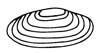
|
| EMARGINATE | Notched at the MARGIN. | |
| EMBAYMENT | An indentation; a bay. Sometimes used referring to the PALLIAL SINUS in bivalves. | |
| EMBRYONIC WHORL | A single WHORL of the NUCLEUS or PROTOCONCH; the earliest portion of the LARVAL SHELL. | |
| ENANTIOMORPH | A mirror image of another; perhaps said of two GASTROPOD specimens of a single species, one specimen which has a SINISTRAL shell and one which has a DEXTRAL shell. | |
| ENCRUSTED | Covered with foreign matter derived from living organisms. | |
| ENDEMIC | Confined to a particular geographic area; native; see also: INDIGENOUS. | |
| ENDOCAST | A FOSSIL formation created by material entering the interior of a shell hardening; the exterior shell material then degrades and dissolves away with the outside of the CAST taking on the interior shape of the shell; = STEINKERN. | |
| ENSIFORM | An ELONGATE bivalve shape, like an Ensis; with outline resembling a curved sword. See other bivalve shapes. | |
| ENTIRE | Continuous; having no breaks; said of the margin (PERISTOME) of a shell aperture; see also: HOLOSTOMATE. | |
| EPIDERMIS | Skin of the soft part (= "ANIMAL") of a mollusk; see also: PERIOSTRACUM. | |
| EPIPELAGIC | The PELAGIC depth zone 0 to 200 meters. See also: PELAGIC; MESOPELAGIC (200-1000m depth); BATHYPELAGIC (1000-4000m depth; ABYSSOPELAGIC (4000-6000m depth; HADAL (greater than 6,000m depth); NERITIC; OCEANIC; BENTHIC; PLANKTONIC. | |
| EPIPHRAGM | A temporary apertural seal of dried mucous constructed prior to AESTIVATION to prevent loss of moisture; found in the higher PULMONATE gastropods, such as Helicidae. The epiphragm may become very thick and even calcified, as in the Achatinidae. | |
| EPIPODIUM | A fringe, like a false MANTLE, around the base of the gastropod foot, which bears delicate tentacles that come in contact with the substratum and are probably both chemosensory and tactile. | |
| EQUILATERAL | In bivalves, having the anterior and posterior ends of equal size; see also: EQUIVALVE; INEQUILATERAL; SUBEQUILATERAL. | |
| EQUIVALVE |
In bivalves, having each VALVE equal in size and shape; see also: EQUILATERAL; INEQUIVALVE. See other bivalve shapes. |
|
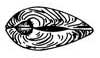
|
| ERECT | Upthrust or upright; see also: ELEVATED. | |
| ERODED | Worn away; see also: BEACHWORN. | |
| ESCARGOT | Common name for SNAILS, typically of the genus Helix (often H. pomatia, but also H. aspersa and H. lucorum), which are an epicurean delicacy cooked in a garlic and butter sauce and served as an appetizer. | |
| ESCUTCHEON |
In bivalves, a long, somewhat depressed area on the dorsal surface just posterior to the BEAKS. See illustration: Composite Bivalve. See also: LUNULE.
See: Bivalve terminology, Anatomy of bivalves by Marlo Krisberg. |
|
| ESCUTCHEON RIDGE | Ridge extending posteriorly from beak in each valve (of bivalves) and forming border of ESCUTCHEON; see also: DEMARCATION LINE. | |
| ESOPHAGUS | The tubular portion of the digestive tract that leads from the PHARYNX to the stomach. | |
| ESTUARINE | Pertaining to or living in salt water which is measurably diluted with fresh water (to decrease the salinity below oceanic levels: 35 parts per thousand); see also: AQUATIC; FRESH WATER; HABITAT; MARINE; OCEANIC. | |
| EULAMELLIBRANCH | A type of bivalve CTENIDIUM or gill in which [need definition]; see also: DIBRANCH; EULAMELLIBRANCH; FILIBRANCH; LAMELLIBRANCH; PROTOBRANCH; PSEUDOLAMELLIBRANCH; SEPTIBRANCH; TECTIBRANCH; TETRABRANCH. | |
| EUPYRENIC | The numerous, small, normal type of SPERM; see also: OLIGOPYRENIC. | |
| EUTHYNEUROUS | Having straight visceral nerve loops (as in some gastropods); see also: STREPTONEUROUS. | |
| EVANESCENT | Transient; ephemeral; barely discernable. | |
| EVOLUTE | [need definition]; see also: DEVOLUTE. | |
| EVOLUTION | [need definition]; see also: EVOLUTION, CLANDESTINE; EVOLUTION, PROGRAMME. | |
| EVOLUTION, CLANDESTINE | The development of many structures by the larvae for its own needs, as distinct from the morphology of the adult; as such, larvae are not always reliable guides to PHYLOGENY; see also: ONTOGENY. | |
| EVOLUTION, PROGRAMME | Having several independent groups running through a series of broadly similar changes. | |
| EX | From; example: Ex Doe, MS. = from Doe's manuscript or unpublished work; ex pisces = from the stomach (usually) of a fish. | |
| EXCAVATED | Strongly depressed; hollowed out. | |
| EXCERTED | Prominently extended or elongated; = EXSERTED. | |
| EXCURRENT | Forming a passage for current of water expelled from within the MANTLE CAVITY; applied to mantle opening or siphon; = EXHALENT; see also: HYPONOME. | |
| EXFOLIATE | To come off in layers or scales. See also: DEHISCENT. | |
| EXHALANT SIPHON | [need definition]; see also: HYPONOME; INHALANT SIPHON. | |
| EXHALENT | Same as: EXCURRENT. | |
| EXOGASTRIC | In CEPHALOPODS, having the hyponomic sinus on the convex side. | |
| EXOGYRATE | Shaped like the shell of Exogyra, that is, with the left valve (of bivalves) strongly convex and its dorsal part coiled in posterior direction, with right valve flat and spirally coiled. | |
| EXPANDED | Enlarged; swollen; distended; see also: COMPRESSED. | |
| EXSERTED | See: EXCERTED. | |
| EXTANT | Living; typically referring to a SPECIES or taxonomic group of species; opposite of EXTINCT. | |
| EXTENDED | In gastropods, the state of the animal being exposed out of its shell; also the condition of its TENTACLES being out and functioning or (in NUDIBRANCHSs) a branchial BRANCHIAL PLUME being exposed. In bivalves, the condition of the clam having its FOOT and/or SIPHONS exposed during digging or feeding, respectively. See also: RETRACTED. | |
| EXTERNAL | On the outside; see: INTERNAL. | |
| EXTINCT | No longer continuing to exist, typically referring to a SPECIES or a taxonomic group of species; opposite of EXTANT. | |
| EXTRA-BRANCHIAL APPENDAGE | [need definition]. In NUDIBRANCHS… See illustration: Composite Nudibranch. | |
| EXTRAPALLIAL FLUID | That fluid between MANTLE and the PERIOSTRACUM, which is rich in CaCO3 in solution, which precipitates out, forming the shell. | |
| EYE STALK | The extensible and retractable (sometimes INVERSIBLE) pedestal which terminates with the eye of many gastropods. See also: TENTACLE. | |
| FAIR | Term used in shell trade to designate the quality of a shell as having either major breaks or poor coloration; see also: GRADING SYSTEM. | |
| FALCIFORM | Sickle-shaped. | |
| FAN SHAPED |
A CLAM (bivalve) shape exemplified by the bivalve genus Atrina. See other bivalve shapes. Photo: Atrina rigida (Lightfoot, 1786) |
|
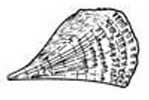 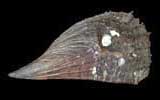
|
| FASCIATE | Banded or striped. See also: BANDING. | |
| FASCICLE | Small bunch (of RIBS); see also: FASCICULATED. | |
| FASCICULATED | Having a little bunch of hairs or BRISTLE against each end of each VALVE (as in some species of the genus Chiton). Arranged in small bunches; see also: FASCICLE. | |
| FASCIOLE | A spiral band generated by a notch, bordered by successive lamellar growth striae of a canal (either anterior or posterior) in gastropods; see also: SIPHONAL FASCIOLE. | |
| FATHOM | A measure of water depth, equal to six feet. | |
| FAUNA | The animal life living in a given region or during a specified period of time. | |
| FENESTRATE | Having depressed, rectangular, pit-like "windows." | |
| FERRUGINEOUS | Of an iron rust color. | |
| FIDE | Trusting to; on the word of; often used to document the designation of a SYNONYM. | |
| FILIBRANCH | A type of bivalve CTENIDIUM or gill in which [need definition]. The Mytilacea, Pteriacea, Pectinacea, and Anomiacea have filibranch CTENIDIA. See also: DIBRANCH; EULAMELLIBRANCH; LAMELLIBRANCH; PROTOBRANCH; PSEUDOLAMELLIBRANCH; SEPTIBRANCH; TECTIBRANCH; TETRABRANCH. | |
| FIMBRIA (pl. FIMBRIAE) |
A border or fringe; see also: FIMBRIATE; FIMBRIATION. | |
| FIMBRIATE (=FIMBRICATED) |
Fringed; bordered by fine, frilly sculptural elements; = FIMBRICATED; see also: FIMBRIA; FRILLED; LACINIATE. | |
| FIMBRIATION | A fringe; see also: FIMBRIA. | |
| FIN, LATERAL | Fleshy projections on the each side of the mantle of squids. | |
| FINE | A term used in the shell trade to designate the quality of a shell as having minor breaks or scars; see also: GRADING SYSTEM. | |
| FINE+ | A term used in the shell trade to designate the quality of a shell as very slightly irregular. See also: GRADING SYSTEM. | |
| FISSURE | A slit or cut. See also: GROOVE. | |
| FLABELLIFORM | Fan-shaped. | |
| FLAGELLUM | A tubular outgrowth of the PENIS in which the SPERMATOPHORE is secreted by the male duct. | |
| FLAMULATION | See: FLAMULE. | |
| FLAMULE |
A small, flame-shaped spot of color; = FLAMULATION; see also: FULGURATE. Photo: Astyris lunata (Say, 1826) |
|
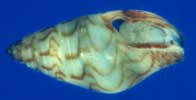
|
| FLANGE | A rib or flattened ridge lending strength and reinforcing the juncture of two shell structures. | |
| FLANK | Median part of surface of valve (of a bivalve), limited posteriorly by posterior ridge where present; see also: DISC. | |
| FLARING | Opening or spreading outward rapidly, said especially of the outer APERTURAL LIP. | |
| FLATTENED | Level; even. | |
| FLEXICLAUDENT |
A type of OPERCULUM that flexes upon retraction.
See also: RIGICLAUDENT. See the 1998 article by Checa and Jiménez-Jiménez: Constructional morphology, origin, and evolution of the gastropod operculum.. |
|
| FLEXUOUS | Having windings or bendings (e.g., the posterior twist of Macoma spp.); see also: HAMIFORM; RECURVED. | |
| FLEXURE | A bending or angulation. | |
| FLUTED | Grooved; decorated with flutes or CHANNELS. | |
| FLUVIATILE | Living in or belonging to rivers or streams; see also: AQUATIC. | |
| FOLD | A spirally wound ridge on the COLUMELLAR WALL of the gastropod shell.; see also: COLUMELLAR FOLD; PLAIT; PLICAE; RUGA. | |
| FOLIACEOUS | Resembling foliage; furnished with or made up of foliations or leaflike small plates; = FOLIATE; FOLIOSE. | |
| FOLIATE | See: FOLIACEOUS. | |
| FOLIATION | A single leaflike structure; see also: FROND; FOLIACEOUS. | |
| FOLIOSE | See: FOLIACEOUS. | |
| FOOT |
A muscular organ of locomotion, projecting anteriorly through the
APERTURE of shelled GASTROPODS (often for crawling); see also:
LANMGUIR TROTH;
PARAPODIA. In BIVALVES, a organ lying anteroventrally between the VALVES of many bivalves (often for digging). In SCAPHOPODS, an anterior organ also used for digging; See illustration at UCMP. |
|
| FORAMEN |
A round hole or fissure; usually applied to the hole in the LOWER VALVE of Anomia spp. which exists for passage of the BYSSAL PLUG. Photo: Anomia simplex Orbigny, 1842 |
|
|
| FORM or FORMA | A minor genetic variant, color phase, aberration, or variation due to diet or environment (e.g., an ECOLOGIC FORM); see also: ECOPHENOTYPE; ECOPHENOTYPIC VARIATION; ECOTYPE; VARIETY. | |
| FORNICATED | Arched or vaulted (e.g., exfoliations on the COSTAE of Tridacna spp.) | |
| FOSSA | A ditch-like or trench-like depression; see also: FURROW; SCROBICULATE; SULCATE. | |
| FOSSETTE | A pit-like resilifer for the attachment of the internal ligament; a socket, as for cardinal tooth in bivalves; see also: CHONDROPHORE; RESILIFER. | |
| FOSSIL | The remains of an animal (or plant) from past ages; see also: CAST; ENDOCAST; TAPHONOMY. | |
| FOSSULA | A shallow linear depression on the inner LIP of some cypraeid gastropods. | |
| FRAGILE | Tender, easily broken; delicate. | |
| FREAK | A malformed shell; see also: GRADING SYSTEM. | |
| FREE | Refers to a shell which is not ATTACHED (e.g., to substrate); see also: VALVE, FREE. | |
| FREE EDGE | The outer margin or OUTER APERTURAL LIP of a gastropod shell. | |
| FREE VALVE | In attached bivalves, the valve which is not attached to the substrate; = UPPER VALVE. | |
| FRESH WATER | Rererring to those which inhabit rivers and streams (= FLUVIATILE), ponds and lakes; see: ESTUARINE; MARINE. | |
| FRILL | See: EPIPODIUM. For an example illustration see images of a live ABALONE. | |
| FRILLED or FRILLY | Having a wrinkled, fluted, or crumpled edging of laminae, flanges, or blade-like varices; see also: FIMBRIATE. | |
| FRINGED | Having an edging or trimming of projecting ends of sculptural elements; twisted or PLAITED at the margin. | |
| FROND | A FOLIACEOUS, leaf-like extension of a sculptural element, as on a vertical spine; see also: FOLIATION. | |
| FRONDOSE | Resembling a much divided leaf, like a palm leaf; see also: FOLIATION. | |
| FRONT | The surface of a shell on which the aperture appears. | |
| FULGURATE | Like a flash of lightning; said of coloration patterns; see also: FLAMMULE. | |
| FUNICLE | A ridge of callus spiraling into the UMBILICUS in the naticid gastropods; see also: COLUMELLAR FOLD. | |
| FUNICULAR | Pertaining to a cord, shaped like a small cord or band. | |
| FUNNEL |
In CEPHALOPODS, the tube on the ventral side of the body used to expel water from the mantle cavity. See also: MULLERS ORGAN. See illustration of composite squid by Young, Vecchione, and Mangold. |
|
| FUNNEL PLATES | Transverse LAMINAE in wall of radiolitid lower valve, inclined downward and funnel-wise toward axis and combining with radial laminae to produce cellular structure. | |
| FUNNEL-SHAPED | See: INFUNDIBULIFORM. | |
| FURROW | A narrow channel, GROOVE, or wrinkle; see also: SCROBICULATE; SULCATE. | |
| FUSED | United or bound together; merged into a single structure or surface. | |
| FUSIFORM |
Spindle-shaped; biconic, i.e., swelling in the central part and tapering at the extremities. See other gastropod shapes. |
|
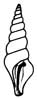
|
| FUSION | Something formed by merging; the process of merging. | |
| FUSION LAYER | Part of LIGAMENT secreted where the MANTLE edges are united dorsally by secondary FUSION (i.e., anteriorly and posteriorly to mantle isthmus). | |
| FUSOID | See: FUSIFORM. | |
| GAPE | A narrow opening remaining between the VALVES of a bivalve when the ADDUCTOR MUSCLE have closed the shell. | |
| GAPING | Not closing tightly; in bivalves, having the VALVES not meet, so as to leave a hole or GAPE; see: CLOSED. | |
| GARSTANG'S THEORY | [need definition]; see also: TORSION. | |
| GASTRIC SHIELD | A flange of protective cuticle of the stomach wall on which the head of the rotating STYLE bears upon or is partly surrounded by. | |
| GASTROPOD | A UNIVALVE, a SNAIL, a member of the class Gastropoda; see also: CONCH, PERIWINKLE, etc. | |
| GASTROPODNET LISTSERV |
A mailing list on a LISTSERV which is hosted by Georgia State University (GSU) for "researchers using molluscs as model systems". See also: CONCH-L; MOLLUSCAlist; STROMBUS-L; SHELLFISH. See the compilation of information about Molluscan Listserves. |
|
| GASTROVERM | Common name for a member of the molluscan class Monoplacophora; limpet-shaped, segmented, snail-like molluscs living in very deep water. Living genera include Laevipilina, Monoplacophorus, Neopilina, and Vema. | |
| GELOINA | [need definition]. | |
| GEM | A term used to designate the quality of a shell as perfect... no flaws whatsoever; see also: GRADING SYSTEM. | |
| GENITAL OPENING | See: GENITAL PORE. | |
| GENITAL PORE | [need definition]; = GENITAL OPENING; See labelled photo on www.jaxshells.org/eraj1.htm | |
| GENOTYPE | The genetic makup of an organism. The genetic makeup of an organism can distinguish one species from another, as well as document lineage. See also: PHENOTYPE. | |
| GENUS (pl. GENERA) |
[need definition] | |
| GENUS NOVUM (abbrev: GEN. NOV.) |
A new GENUS; Used in publication the first time (and first time only!) that a new genus is presented; see also: SPECIES NOVUM. | |
| GEODUCK |
A clam of the Pacific Northwest (USA) by the name Panopea generosa Gould, 1850. Pronounced GOO-ee-duck, the clams are farmed and harvested commercially and may live to over 100 years (oldest=168). See: Discovery Channel episode of "Dirty Jobs" that featured Geoduck farming. See: Vadopalas, B.; T.W. Pietsch & C.S. Friedman. 2010. The proper name for the geoduck: resurrection of Panopea generosa Gould, 1850, from the synonymy of Panopea abrupta (Conrad, 1849) (Bivalvia: Myoida: Hiatellidae). Malacologia 52(1):169−173. Photo: Panopea sp. |
|
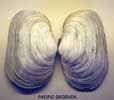
|
| GERONTIC | Showing the characteristics of old age, and/or abnormally extreme SIZE. | |
| GIANT CLAM | A CLAM of family Tridacnidae, genus Tridacna. | |
| GIANT SQUID |
SQUID, often of extremely large size, typically members of the CEPHALOPOD genera Architeuthis and Ommastrephes. Photo: Ommastrephes caroli (with a meter stick in the photo, for reference) |
|
|
| GIBBOSE (or GIBBOUS) | Swollen. | |
| GILL | A BRANCH; the respiratory organ in the mollusc; see also: CTENIDIUM; PLICATIDIUM; TETRABRANCH; DIBRANCH; PROTOBRANCH; FILIBRANCH; PSEUDOLAMELLIBRANCH; EULAMELLIBRANCH; SEPTIBRANCH; TECTIBRANCH. | |
| GILL RETRACTOR MUSCLE | Muscle present in a few bivalvia, attaching one of the GILLS to the shell. | |
| GIRDLE | A flexible, leathery, muscular integument holding the CHITON valves in place, often ornamented with BRISTLES, SCALES, SPICULES, GRANULES or hairy processes. See illustration: Composite Chiton. | |
| GIZZARD PLATES | [need definition]. | |
| GLABROUS | Smooth. | |
| GLADIUS |
The "PEN" or internal remnant of a shell, in some CEPHALOPODS, e.g. SQUID. See the detailed web page on gladius terminology, from the excellent "Cephalopod Glossary" by Richard E. Young, Michael Vecchione, and Katharina M. Mangold. |
|
| GLAND | A body organ producing one or more specific chemical substances. | |
| GLASS SCALLOP | Common Name for CLAMS (bivalves) of the family Propeamussiidae; See also: SCALLOP. See Henk Dijkstra's website on Scallops. | |
| GLAZED | Having a shiny surface or shiny deposit; see also: MARGARITACEOUS; NACREOUS. | |
| GLOBOSE | Roughly spherical in form; rounded; see also: GLOBULAR; NERITIFORM. See other gastropod shapes. | |
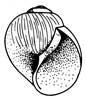
|
| GLOBULAR | Globe-shaped or sphere-shaped, like a ball; see also: GLOBOSE. | |
| GLOCHIDIUM (pl. GLOCHIDIA) |
The LARVAE of freshwater Unionacean bivalves. As a dispersal mechanism, this larva temporarily attaches itself to the gills of fish. | |
| GONAD | The sex gland in which the sperm or eggs are formed. | |
| GOOD | A term used to designate the quality of a shell as deficient in one character, as color, otherwise "FINE;" see also: GRADING SYSTEM. | |
| GRADING SYSTEM |
Degrees of condition of specimens, usually employed by shell dealers.
GEM: perfect FINE+: very slightly irregular FINE: minor breaks or scars GOOD: deficient in one character FAIR: with either major break or poor color POOR: badly beachworn; having major breaks See also: FREAK; MICRO; MINIATURE; SIZE.. |
|
| GRANULATED | Having a rough surface of grain-like elevations; see also: GRANULOSE. | |
| GRANULE | A pustular surface sculpture. In CHITONS, these may adorn the GIRDLE. See illustration: Composite Chiton. See also: PUSTULE. | |
| GRANULOSE | Grainy or finely pustulose; covered with granules; see also: GRANULATED. | |
| GROOVE |
A distinct furrow, depression, channel, or hollow cut occurring on the surface as opposed to a thin, shallow scratch (e.g., a STRIA); see also:
FISSURE;
SCROBICULATE;
SULCATE;
SPIRAL GROOVE. Photo by Marlo F. Krisberg; Nerita fulgurans Gmelin, 1791. |
|
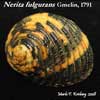
|
| GROWING EDGE | The outermost edge of the outer APERTURAL LIP of a gastropod shell, or the margin of a bivalve shell. | |
| GROWTH LINE | A line on the shell surface indicating the position of the shell margin at an earlier stage of growth; = INCREMENTAL LINE; = CONCENTRIC LINE. See illustration: Composite Gastropod and Composite Bivalve. See also: COLLABRAL LINES. | |
| GROWTH RING | Concentric rings of shell material evident as a result of differential growth. These rings may be seasonal, and thereby used to determine the age of the specimen. See: SCLEROCHRONOLOGY. | |
| GROWTH RUGA | Irregular wrinkle on surface of shell, of similar origin to growth line, but corresponding to more pronounced hiatus in growth; see also: RUGA. | |
| GROWTH THREAD | Thread-like elevation of surface of shell, of similar origin to growth line. | |
| GROWTH, EXPONENTIAL | Rapidly, but regularly increasing in size. | |
| GRYPHAEATE | Shaped like shell of Gryphaea (Bivalvia), i.e., with left VALVE strongly CONVEX and its dorsal part incurved, and with RIGHT VALVE flat. | |
| GUTTERED | Marked with wide, shallow GROOVES. | |
| GYROCONIC | Having the WHORLS not in contact with each other; see also: DISCONTIGUOUS; LOOSELY COILED; NAUTILOCONIC. | |
| HABITAT | The kind of place where an organism normally lives. See: AQUATIC; ARBOREAL; ESTUARINE; MARINE; PELAGIC; TERRESTRIAL. | |
| HADAL or HADALPELAGIC | The PELAGIC depth zone greater than 6,000 meters. See also: PELAGIC; EPIPELAGIC (0-200m depth); MESOPELAGIC (200-1000m depth); BATHYPELAGIC (1000-4000m depth; ABYSSOPELAGIC (4000-6000m depth; HADAL (greater than 6,000m depth); NERITIC; BENTHIC; PLANKTONIC. | |
| HAEMOCOEL | [need definition]. | |
| HAEMOCYANIN | A copper-containing substance carried in the blood plasma of gastropods and cephalopods, which acts as the respiratory pigment; it colors the blood a faint blue. NOTE: A few gastropods have developed haemoglobin; it is not certain that any bivalve has haemocyanin, but some possess haemoglobin (most do not possess any oxygen-carrying substance, the oxygen partial pressure in the blood being that of the surrounding medium). | |
| HAIRY | see: HIRSUTE; SETIFEROUS. | |
| HALIOTOID | Ear-shaped, like species of Haliotis; see: AURIFORM. | |
| HAMIFORM | Curved at the extremity; see also: FLEXUOUS; RECURVED; REFLECTED. | |
| HEAD | The ANTERIOR end of an animal. | |
| HEAD SHIELD | The shovel-like configuration (designed for burrowing) of the head of CEPHALASPID gastropods. | |
| HEAD VALVE |
The first of (typically) eight valves of a CHITON. See also: TAIL VALVE; MEDIAN VALVE. See illustration: Composite Chiton. |
|
| HEART | [need definition]. | |
| HECTOCOTYLUS (pl. HECTOCOTYLI) |
A specially modified ARM of CEPHALOPODS which is used to transfer SPERMATOPHORES from the male to the female.; see also: SPADIX; TENTACLE. | |
| HEIGHT | In bivalves: the greatest distance measured vertically, from the UMBONES to the ventral margin, i.e., dorsoventrally. In gastropods: the distance from the tip of the SPIRE to the most DISTAL point along the AXIS of the shell. See illustration: Composite Gastropod. See also: LENGTH; WIDTH; WRS. | |
| HELICAL | Spirally coiled. | |
| HELICIFORM | Shaped like shells of the genus Helix. See also: ESCARGOT. See other gastropod shapes. | |
| HERBIVOROUS | Feeding on vegetable matter. See also: CARNIVOROUS; OMNIVOROUS; DETRITIVOROUS. | |
| HERMAPHRODITE | Having both sexes in the same animal; see also: AMBISEXUAL; MONECIOUS. | |
| HETERODONT | In certain bivalves, having the hinge differentiated into distinct cardinal and lateral areas. See illustration: Composite Bivalve. See also: ARTICOID TYPE; CORBICULOID TYPE; DENTITION; LUCINOID TYPE. | |
| HETEROMYARIAN | The restriction of the anterior adductor muscle (in bivalves) to a small size, with the moving of the byssus and foot to the anterior (as in the Mytilidae); see also: ANISOMYARIAN; DIMYARIAN; MONOMYARIAN. | |
| HETEROPOD | [need definition]; see also: PTEROPOD. | |
| HETEROSTROPHIC | Having APICAL whorls coiled in a direction apparently opposite to that of succeeding WHORLS; see also: HYPERSTROPHIC. | |
| HETEROSTROPHY | Condition of having the gastrpod PROTOCONCH coiled at 90 degrees to the POSTMETAMORPHIC whorls. | |
| HEXAGONAL | Having six sides; see also: POLYGONAL; OCTOGONAL; QUADRATE; RHOMBOID. | |
| HIBERNATE | To pass the winter in an inactive state; see also: AESTIVATE. | |
| HIBERNATION | See: HIBERNATE. | |
| HIGH SPIRED |
Said of a gastropod shell which is much higher than wide; see also: LOW SPIRED. See other gastropod shapes. |
|
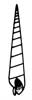
|
| HINGE | Collective term for structures of dorsal region of bivalves, consisting of the teeth and ligament, whose function is to facilitate the opening and closing of valves; see also: ACTINODONT; ANODONT; ASTHENODONT; CRYPTODONT; CTENODONT; CYCLODONT; DIAGENODONT; DYSODONT; HETERODONT; ISODONT; ORTHODONT; PANTODONT; PACHYODONT; PRIONODONT; PSEUDOCTENODONT; PSEUDOTAXODONT; SCHIZODONT; TAXODONT; TELEODONT; ...as well as: ACLINE; ARTICOID TYPE; CORBICULOID TYPE; LUCINOID TYPE; ORTHOCLINE; VINCULUM. | |
| HINGE AXIS | Imaginary straight line along which 2 valves of a shell are hinged; = CARDINAL AXIS; see also: HINGE LINE. | |
| HINGE EAR | In bivalves, an anterior and/or posterior expansion of the VALVE in the hinge area; = AURICLE. | |
| HINGE LINE | In bivalves, the region along which the VALVES are attached to each other. Term applied loosely by many authors to part of bivalve shell bordering dorsal margins and occupied by or close to hinge teeth and ligament; used by some in same sense as HINGE AXIS. | |
| HINGE MARGIN | Edge of bivalve shell that approximates most closely to hinge axis. | |
| HINGE PLATE | In bivalves, the dorsal margin carrying the hinge teeth; = CARDINAL PLATFORM. A shelly, internal platform, bearing hinge teeth, situated below the beak and adjacent parts of dorsal margins, and lying in plane parallel to that of the commissure. See illustration: Composite Bivalve. | |
| HINGE TOOTH | Shelly STRUCTURE in bivalves (usually on of a series) adjacent to dorsal margin and received in socket in opposite VALVE; hinge teeth serve to hold valves in position when closed. | |
| HINGE TOOTH SOCKET | The indentation, in a bivalve shell, which accepts the protruding HINGE TOOTH when the valves are closed. See illustration: Composite Bivalve. | |
| HINGE TOOTH | See: HINGE TOOTH. | |
| HINGE, TRANSPOSED | Condition in which certain hinge teeth present in one valve occupy positions of teeth usually found in the other (= TRANSPOSED HINGE TOOTH). See: Van der Schalie, H. 1936. Transposed hinge teeth of North American naiades. Nautilus 49(3):79-84. | |
| HIPPURITID | A type of RUDIST. | |
| HIRSUTE | Covered with hairs. | |
| HOLLOW SPINE | A stiff, sharp, sculptural structure, the interior of which is not filled with shell matter. see also: HYOTE SPINE. | |
| HOLOHEPATIC | Having the "liver" or digestive gland compact; see also: CERATA; CLADOHEPATIC. | |
| HOLOPLANKTON | PLANKTON which spends its entire life in the water column. See also: MEROOPLANKTON. | |
| HOLOSTOMATE | Characterizing an aperture lip of a gastropod shell that is uninterrupted by any anterior notch or sinus; = HOLOSTOMATOUS; see also: ENTIRE; SIMPLE; SIPHONOSTOMATE (= SIPHONOSTOMATOUS). | |
| HOLOSTOMATOUS | See: HOLOSTOMATE. | |
| HOLOTYPE |
A single specimen upon which a species is based; the only specimen unquestionably identifiable as a given species; see also: LECTOTYPE; TYPE SPECIMEN. See the publication: "Terminology of Types" by Frizzell. |
|
| HOMOMYARIAN | Bivalves having two ADDUCTOR MUSCLES equal in size or almost so; = ISOMYARIAN. | |
| HOMONYM | One of two identical names given to separate species (the latter would be termed the JUNIOR SYNONYM, the first, the SENIOR HOMONYM). See also: HOMONYM; HOMONYMY; PRIMARY HOMONYM; SECONDARY HOMONYM. | |
| HOMONYMY | A nomenclatural situation in which two or more different species bear the same name. See also: HOMONYM; SYMONYMY. | |
| HOOK | A SPINE tip that is bent or strongly recurved. | |
| HORNY | [need definition]; see also: CHITINOUS. | |
| HUMPED | Being somewhat higher in the center of the dorsum than towards the anterior or posterior (as in some Cypraea spp.). | |
| HYALINE | Glassy and semi-transparent; see also: PELLUCID. | |
| HYBRID | The offspring of parents of two different populations, and usually two different SPECIES. | |
| HYOTE SPINE | Hollow, tubular, and cylindrical shell outgrowths open distally at their tips as well as on their distal flanks, arising periodically from the thin edges of shell margins of OYSTERS [the tip ends are rounded, ear-shaped openings, typically developed on Hyotissa hyotis (Linne, 1758)]. | |
| HYPERSTROPHIC |
[need definition]; see: ULTRADEXTRAL; see also: HETEROSTROPHIC. See other gastropod shapes. |
|
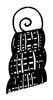
|
| HYPNOMIC SINUS | In cephalopods, the notch in the shell margin for the HYPONOME or excurrent siphon. | |
| HYPOBRANCHIAL | Situated below the gills. | |
| HYPOBRANCHIAL GLAND | Large mucous gland beside the rectum ("hypobranchial" is a misnomer) and which consolidates particles before the leave the pallial cavity. | |
| HYPONOME | The EXHALANT SIPHON of CEPHALOPODS. | |
| HYPONOTAL LAMELLAE | Folds, on the underside of a NUDIBRANCH, that contain the branches of the digestive gland. | |
| HYPOPLAX |
An accessory, ventral shell piece between the valves in some burrowing clams. Elongate, calcareous ACCESSORY PLATE extending along posterior end of ventral margin in some Pholadidae. MESOPLAX; METAPLAX; SIPHONOPLAX. Photo: Cyrtopleura costata (Linne, 1758) |
|
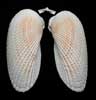
|
| HYPOSTRACUM | (1) Inner layer of shell wall, secreted by entire epithelium of MANTLE (original usage of term); (2) part of shell wall secreted at attachments of ADDUCTOR MUSCLES. | |
| HYPOTYPE |
A specimen not in the original TYPE MATERIAL of a species but known from a published illustration or description. See the publication: "Terminology of Types" by Frizzell. |
|
| I.C.Z.N. (also: ICZN) |
International Commission on Zoological Nomenclature (convenes in London). Also, the International Code of Zoological Nomenclature, that is maintained by the Commission. An associated publication of interest is the Bulletin of Zoological Nomenclature. See also: ITZN. | |
| I.T.Z.N. (also: ITZN) |
The International Trust for Zoological Nomenclature states its mission as "The International Trust for Zoological Nomenclature (ITZN or “the Trust”) was established in 1947, registered in England as a non profit company limited by guarantee. ITZN acts on behalf of the Commission to raise and administer funds in accordance with the policy of the Commission and the International Union of Biological Sciences (IUBS)." [note: "the Commission" = ICZN] | |
| IBIDEM (abbrev: IBID) |
The same. | |
| ICONOGRAPH | An illustrated systematic treatment; an illustrated MONOGRAPH. | |
| IMBRICATE | Having overlapping scales or laminae; see also: SQUAMOUS. | |
| IMMATURE | Not fully developed; said of shell characters that are partly or completely different from those at maturity. | |
| IMMERSED | Sunken; said especially of APICAL whorls. | |
| IMPERFORATE | Not open or perforated; often said of a closed UMBILICUS; see also: PERFORATE. | |
| IMPRESSED | Indented, as in the case of a line pressed into an otherwise unscored surface; said of a shell SUTURE; see also: ADPRESSED; CHANNELED; SUTURE, IMPRESSED. | |
| IMPRESSION | See: MUSCULAR IMPRESSION. | |
| IN LITTERIS (abbrev: IN LITT) |
Information conveyed in literature, e.g., a letter or by other correspondence; see also: PERS. COMM. | |
| INCIPIENT | About to develop or appear; beginning to appear. | |
| INCISED | Sculptured with sharply cut GROOVES. | |
| INCRASSATE | Thick or thickened (e.g., the hinge of Glycimeris spp.); see also: MARGINATE. | |
| INCREMENTAL AXIAL | In gastropods, the GROWTH LINES between lines of AXIAL ribbing. | |
| INCREMENTAL LINE | see: GROWTH LINE. | |
| INCURRENT | Forming passage for current of water drawn into mantle cavity from medium (applied to mantle opening or siphonal opening); = INHALANT; see also: EXCURRENT. | |
| INCURVED | Curved inwardly toward the shell or upward and inward toward the SPIRE; see: INFLECTED. | |
| INCUT | See: INCISED. | |
| INDENTATION | A NOTCH or recess in the margin of an APERTURAL LIP, vertical margin, or other surface. | |
| INDENTED | Pressed in or having dents or a series of small cavities. | |
| INDIGENOUS | Occurring naturally in a particular region; not introduced; see also: ENDEMIC. | |
| INDUCTURA | An unusually large and erect expansion of the inner APERTURAL LIP of a gastropod shell; a smooth, shelly layer extending from the inner side of the APERTURE; see also: CALLUS. | |
| INEQUILATERAL | In bivalves, having the parts of the shell anterior and posterior to the beaks differing appreciably in length; see: INEQUIVALVE; SUBEQUILATERAL. | |
| INEQUIVALVE |
In bivalves, having one valve that is larger (as in the genera Anadara and Corbula) or more convex (as in the genus Pecten) than the other valve. See also: EQUIVALVE; MARGIN, DISCORDANT. See other bivalve shapes. Photo: Anadara brasiliana (Lamarck, 1819) |
|
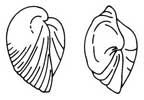 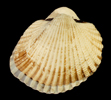
|
| INFERIOR VALVE | That valve (of "attached" bivalves) which is attached to the substrate; = ATTACHED VALVE; = LOWER VALVE. | |
| INFLATED | Swollen; typically applied to rotund shells of a thin texture; see also: TUMID; TURGID; VENTRICOSE. | |
| INFLATION | The distance, in bivalves, between two planes parallel to the plane of commissure and touching outermost parts of two valves. | |
| INFLECTED | Turned inwards, e.g., the outer lip of a spiral shell when it turns toward the body whorl; see: REFLECTED; INCURVED. | |
| INFRAMARGINAL | Situated below a MARGIN. | |
| INFUNDIBULIFORM | Funnel-shaped, as in the siphon or funnel of a CEPHALOPOD. | |
| INHALANT | See: INCURRENT. | |
| INHALANT SIPHON | [need definition]; see also: EXHALANT SIPHON. | |
| INNER LIGAMENT | See: LIGAMENT, INNER. | |
| INOPERCULATE | Lacking an OPERCULUM; see also: OPERCULATE. | |
| INSERTAE SEDIS | Uncertain classification. | |
| INSERTION | In gastropods, the point where the OUTER LIP meets the PARIETAL WALL. | |
| INSERTION PLATE | Narrow marginal extensions of the ARTICULAMENTUM of the valves of CHITONS projecting into the GIRDLE. | |
| INSERTION TEETH | Articulating processes that unite the valves of a chiton to the GIRDLE or INSERTION PLATES. | |
| INTEGROPALLIATE (or INTEGRIPALLIATE) |
The condition in bivalves of having no PALLIAL SINUS; see also: SINOPALLIATE. | |
| INTEGUMENT | An outer covering layer of the soft parts. | |
| INTERBAND | Longitudinal band on surface of lower valve of radiolitid rudist, separating two bands designated as siphonal bands. | |
| INTERCALATE | Interposed; interspersed. | |
| INTERCOSTAL | Of or in the spaces between ribs or COSTAE. | |
| INTERDENTUM | Shelly plate present in some Unionidae bridging space between PSEUDOCARDINAL and LATERAL TEETH. | |
| INTERGRADE | To possess characters (as in a series of specimens) that bridge the morphological gap between one entity and another. | |
| INTERNAL | On the inside; see: EXTERNAL. | |
| INTERNAL CAST | See: ENDOCAST. | |
| INTERNAL SHELL | Having the shell always inside of an animal (as is the shell of Aplysia spp.). | |
| INTERSPACE | Space between regular sculptural features; in particular, channels between sculptural ribs; see also: INTERSTICE. | |
| INTERSTICE | A space between structures; see: INTERSTITIAL. | |
| INTERSTITIAL | Pertaining to or occurring in INTERSTICES. | |
| INTERTIDAL | Located on the shore between low-tide and high-tide levels. | |
| INTERVAL | A space or gap, in many cases between sculptural or color elements; synonymous with INTERSPACE, when applied to ornament. | |
| INTERVARICAL | Lying between two VARICES. | |
| INTERVARICAL SPACE | The area between one VARIX and another; a shell area indicative of active growth. | |
| INTRITICALYX | A chalky, white, surface layer in the shells of many marine molluscan groups. Prominent in the Muricidae, where its patterns of MICROSCULPTURE are often useful in identification. | |
| INTRORSE | Turned inward; turned toward the AXIS. | |
| INVAGINATED | Folded back within itself; see: INVERSIBLE. | |
| INVALID SPECIES | Names not to be used; said of an improper name (those proposed improperly) in TAXONOMY. Do not confuse with validly proposed names which have become NOMINAL SPECIES or SYNONYMS. | |
| INVERSE | Term formerly applied to a chamid bivalve in which attachment is by left valve or a rudist in which attachment is by right valve. | |
| INVERSIBLE | Capable of being withdrawn by being inverted (as in some gastropod tentacles) See also: CONTRACTILE; INVAGINATED. | |
| INVOLUTE | Having the last whorl enveloping earlier ones, so that the height of the APERTURE is generally the height of the shell, as in the Bullidae; see also: CONVOLUTE. See other gastropod shapes. | |
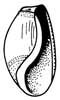
|
| IRIDESCENT | Reflecting the colors of the rainbow; see also: NACRE; MOTHER OF PEARL. | |
| IRREGULAR | Descriptive of shells which, being attached to or embedded in other marine bodies, have no consistent form due to conforming to the shape of their attachment substrate. | |
| IRREGULARLY COILED | Gastropod coiling in a nonuniform manner, as exemplified by the genus Distorsio; see also: LOOSELY COILED; TIGHTLY COILED; SPIRALLY COILED. See other gastropod shapes. | |
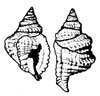
|
| IRRORATE | Having minute marks of color or minute grains or specs of color, as in Littorina irrorata. | |
| ISODONT | Descriptive of a bivalve shell that has a HINGE with one pair of teeth and one pair of pits on one valve that articulate with two pits and two teeth on the other. See illustration: Composite Bivalve. See also: DENTITION. | |
| ISOMYARIAN | Descriptive of a bivalve shell having two adductor muscle scars on the inner surface which are approximately equal in size; = HOMOMYARIAN. | |
| ISOSTROPHIC |
Gastropod COILING coiling in which [need definition]. See other gastropod shapes. |
|
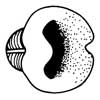
|
| JAW | [need definition]. | |
| JUGAL SINUS | In CHITONS, the depression between the sutural laminae; = SUTURAL SINUS; see also: JUGUM. | |
| JUGAL TRACT | In CHITONS, the surface of the TEGMENTUM adjacent to the JUGUM; see also: JUGUM. | |
| JUGUM | A longitudinal ridge, sharp or rounded, on some intermediate CHITON valves. See illustration: Composite Chiton. See also: JUGAL SINUS; JUGAL TRACT. | |
| JUNIOR SYNONYM | A latter name for a SPECIES with an acceptable prior name. | |
| JUVENILE | Demonstrating the characteristics of immaturity, as in shell growth; see also: ADULT. | |
| KEEL | A prominent, sharply raised sculptural element, most frequently spiral in orientation. See illustration: Composite Gastropod. | |
| KEELED | Having a prominent sharp ridge; see also: CARINATE; KEEL. | |
| KNOBBY | Bumpy or NODULOSE. | |
| LABIAL | See: LABRAL. | |
| LABIAL PALPS | [need definition]. | |
| LABIAL TOOTH | A CERATUS, a relatively long, spur-like or hornlike extension of the outer lip margin of a gastropod shell, projecting toward the interior of the aperture. | |
| LABIUM (pl. LABIA) |
The INNER LIP of the APERTURE; see also: PERISTOME. | |
| LABRAL | Pertaining to the outer APERTURAL LIP margin (by common usage; properly: LABIAL). | |
| LABRUM | The OUTER LIP of the aperture; see also: PERISTOME. | |
| LACUNAE (adj. LACUNOSE) |
Small gap or pits. | |
| LAMALLA, AXIAL | [need definition]. See illustration: Composite Gastropod. | |
| LAMELLA (pl. LAMELLAE) |
A thin plate or scale, generally more or less erect; see also: LAMINA; RUFFLED; SQUAMOUS; WEBBING. | |
| LAMELLAR LAYER | Plate-like; the thick middle layer of a shell; see also: PRISMATIC LAYER; PORCELANEOUS LAYER. | |
| LAMELLATE | Having LAMELLAE. | |
| LAMELLIBRANCH | Older name for any BIVALVE having platelike gills. | |
| LAMELLOSE | Having numerous plates or scales on the surface; see also: LAMELLATE. | |
| LAMINA (pl. LAMINAE) |
A plate or scale, generally parallel to the shell surface. | |
| LAMINAR TOOTH | [need definition]; used in describing Neaeromya (see: Abbott, 1974). | |
| LAMINATE | Formed of thin, overlapping plates or scales. | |
| LAMINOSE | Having many LAMINAE. | |
| LANCEOLATE | Shaped like a lance; extended to a point at both ends. | |
| LANGMUIR TROTH | The groove, constructed by the FOOT of gastropods floating upside down on the surface of water, which collects the surface monolayer of protein, draws it over the foot by CILIA, and is intercepted by the RADULA. This process accomplished by the freshwater Lymnaea, and tropical prosobranchs Ampullarius and Pila. | |
| LAPPET | A fold, lobe, or small flap. | |
| LAPSUS CALAMI (abbrev: LAPSUS) |
An unintentional error in spelling. | |
| LARVA (pl. LARVAE) |
The juvenile stage, following the egg, of many forms of life; usually provides a mechanism for dispersal of the species; see also: DORATOPSIS; ECHINOSPIRA; GLOCHIDIUM; LECITHOTROPHIC; NEOTENY; PEDIVELIGER; PLANKTOTROPHIC; PROTOCONCH; RHYNCHOTEUTHIS; SPAT; TROCHOPHORE; VELIGER. | |
| LATERAL | Situated at the side of or arising from the side of a structure (in reference to a shell, RADULAR tooth, etc.). | |
| LATERAL HINGE SYSTEM | Hinge structures present in some PRODISSOCONCHS anterior and posterior to the PROVINCULUM. | |
| LATERAL SECTION | More or less raised area on the TEGMENTUM of valves II to VII of a chiton shell, bounded by the posterior edge of the valve and by a line from the midpoint to the ANTEROLATERAL edge; see also: MEDIAN SECTION; POSTERIOR SECTION. | |
| LATERAL TOOTH |
In gastropods, those teeth of a RADULA which lie immediately to the side (left and right) of the RACHIDIAN or central tooth and more inward from the MARGINAL TOOH (if present). See also: RADULA FORMULA. In bivalves, those shelly protuberances on the dorsal margins of the shell, and at some distance from the UMBONES. In Bivalves, at or of the hinge area on either side of the cardinal area, well removed from the BEAKS. |
|
| LATTICED | Having crossed sculptural elements; see also: DECUSSATE; DIVARICATE. | |
| LEADING EDGE | The side or surface of a sculptural structure nearest the line of active growth; TRAILING EDGE. | |
| LECITHOTROPHIC | A type of egg having a large supply of yolk; the LARVA takes no food while in the plankton, and is considered to be a rather clumsy "YOLK LARVA"; see also: PLANKTOTROPHIC. | |
| LECTOPARATYPE |
[need definition]. See the publication: "Terminology of Types" by Frizzell. |
|
| LECTOTYPE | A specimen selected from primary syntypic material to serve in place of a HOLOTYPE where one either was never selected by the original author or has definitely been lost or destroyed; other specimens in the SYNTYPE lot then become LECTOPARATYPE; see also: TYPE SPECIMEN. | |
| LEFT HANDED | Same as SINISTRAL. | |
| LEFT VALVE (abbrev: LV) |
Valve of a bivalve lying on left-hand side when shell is placed with anterior end pointing away from observer, and with COMMISSURE vertical, the hinge being uppermost; see also: RIGHT VALVE. Visit Let's Talk Seashells for how to distinguish between right and left valves. |
|
| LEG. = LEGIT |
An abbreviation for the Latin word, legit, which means: Collected by. To avoid confusion, this term is preferred over COLL. which can mean: collected by, but can also mean: in the collection of. Example on a specimen label: Leg. John Doe See also: LEG. | |
| LENGTH | The distance of a specimen, from anterior extremity to posterior extremity. See illustration: Composite Gastropod. See also: HEIGHT; WIDTH; WRS. | |
| LENTICULAR | Shaped like a lentil or lens; having a narrowly doubly convex form, as in the aperture of certain gastropod shells; see also: DISCOIDAL; PLANISPIRAL. See other gastropod shapes. | |
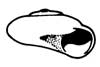
|
| LESSEPSIAN | Lessepsian comes from the name of Monsieur de Lesseps, the French engineer who cut the Suez Channel and refers to the phenomena of migration facilitated by humans, e.g., through the Suez Channel. "Lessepsian" does not refer only to molluscs, but also to fish, crustaceans, and all forms of marine life which have undertaken this geographic expansion, made possible only by human intervention. | |
| LIG (pl. LIGS) |
A short, common name for a tree snail of the genus Liguus; see also: LIG POLE. | |
| LIG POLE | A long, sometimes collapsible pole with a cup attached to the distal end. This pole is used to extend one's reach up into the trees to dislodge and collect "LIGS" (tree snails of the genus Liguus) in the terminal cup. | |
| LIGAMENT |
A band of tough, brown, elastic material which unites the dorsal margins of a clam, usually posterior to the BEAKS, sometimes externally visible, rarely internal; causes the valves to open when the adductor muscles relax; see also: ALIVINCULAR;
AMPHIDETIC;
BOURRELET;
CARTILAGE;
DUPLIVINCULAR;
LIGAMENT, FIBROUS;
MULTIVINCULAR;
PARIVINCULAR;
RESILIAL RIDGE.
TENSILIUM.
See: Bivalve terminology, Anatomy of bivalves by Marlo Krisberg. |
|
| LIGAMENT FULCRUM | Narrow, lunate platform extending posteriorly from beak along dorsal margin and serving for attachment of ligament; = NYMPH. | |
| LIGAMENT GROOVE | Narrow depression in CARDINAL AREA for attachment of fibers of the LIGAMENT. | |
| LIGAMENT PIT | Relatively broad depression in cardinal area for attachment of ligament in bivalves; see also: CHONDROPHORE; COCHLEATE. | |
| LIGAMENT RIDGE | Narrow ridge or lamina formed by projection of outer layer of shell wall into body cavity of many rudists (particularly hippuritids and radiolitids), thought to have served for attachment of ligament. | |
| LIGAMENT STRUCTURE | Elongated space behind UMBONES apparent after erosion of LIGAMENT. | |
| LIGAMENT, EXTERNAL | That part of the ligament visible from outside the bivalve shell, consisting of a LAMELLAR LAYER under tensional stress. See illustration: Composite Bivalve. See also: LIGAMENT, (types). | |
| LIGAMENT, FIBROUS | See: LIGAMENT, INNER. See also: LIGAMENT, (types). | |
| LIGAMENT, INTERNAL | (1) = RESILIUM; (2) Inner layer of ligament; = FIBROUS LIGAMENT. See also: LIGAMENT, (types). | |
| LIGAMENT, LAMELLAR | Part of ligament characterized by lamellar structure and containing no CALCIUM CARBONATE; secreted at mantle edge and elastic to both compressional and tensional stresses. See also: LIGAMENT, (types). | |
| LIGAMENT, PRIMARY | Part of ligament, of bivalves, representing original condition of structure, consisting of PERIOSTRACUM and lamellar and fibrous layers, but excluding secondary additions, notably FUSION LAYER. See also: LIGAMENT, (types). | |
| LIGAMENTIFEROUS | Having or containing the LIGAMENT, e.g., the CARDINAL PIT of Mya spp. | |
| LIGULATE | Thin, slender, like a slip or neck of any thing (e.g., the muscular impression of Lucina spp.); see: ATTENUATED. | |
| LIMACIFORM | [need definition]; used by Abbott, 1974 (pg. 367) in description of Dendronotus. | |
| LIMPET | A common name for saltwater and freshwater SNAILS (GASTROPODS) which have a low profile, conical (PATELLIFORM) shell. | |
| LINE OF GROWTH | See: GROWTH LINE. | |
| LINEAR | Resembling a line; long, often narrow, and of uniform breadth; see also: RECTILINEAR. | |
| LINGUIFORM | Tongue-shaped. See also: ELONGATE | |
| LIP | The margin of the aperture; the inner lip (= LABIUM) extends from the foot of the columella to the suture and consists of the columellar lip and the parietal lip. The outer lip (= LABRUM) is that part of the aperture farthest from the axis of coiling; see also: PALATAL; PERISTOME. | |
| LIP, COLUMELLAR | The lower portion of the INNER APERTURAL LIP; see also: LIP, PARIETAL. | |
| LIP, FLARED | [need definition]. In the Strombidae… | |
| LIP, INNER | The portion of the apertural margin of a gastropod shell opposite the outer lip and abutting the earliest portion of the body whorl; = LABIUM; the combination of the COLUMELLAR LIP and the PARIETAL LIP. | |
| LIP, OUTER | The outer, distal, growing or leading edge of a gastropod shell; = LABRUM; = PERISTOME. See illustration: Composite Gastropod. See also: OUTER APERTURAL LIP; PALATAL. | |
| LIP, PARIETAL | The upper portion of the inner APERTURAL LIP, which is attached to the subsequent WHORL. | |
| LIP, REFLECTED | [need definition]. | |
| LIRA (pl. LIRAE) |
Fine linear elevation on shell surface or within OUTER LIP (Cox, 1960); this feature is often on the inner surface of the outer lip of the APERTURE; see also: STRIA. | |
| LIRATE | Sculptured with spirally oriented RIDGES, as in the APERTURE of a shell; see also: STRIATE; VERMICULATION. | |
| LIRATION | A fine, threadlike spiral sculptural element; see also: LIRA. | |
| LIST SERVE; LISTSERVE; LIST SERVE; LIST SERV; LIST SERVER |
These are all misspellings, and perhaps misuse, of the licensed registered trademark LISTSERV®. See the compilation of information about Molluscan Listserves. |
|
| LISTSERV also: LISTSERVE |
"LISTSERV"® is a licensed registered trademark for an "opt-in" mailing list system that permits people to send one email which gets distributed automatically to many other people with similar interests. This system was developed in 1986 and licensed/registered by L-Soft. The term has come to be used rather loosely to refer to any such system.
See also: CONCH-L; GASTROPODNET; MOLLUSCAlist; STROMBUS-L; SHELLFISH. See the compilation of information about Molluscan Listserves. |
|
| LITHODESMA | A CALCAREOUS reinforcement of an INTERNAL LIGAMENT; = OSSICLE and OSSICULUM. Characteristic of some genera of the Anomalodesmaceae. | |
| LITTLENECK | The young of the QUOHOG clams, Mercenaria mercenaria. See also: CHERRYSTONE. | |
| LITTORAL | Pertaining to the shore. | |
| LIVE SHELL | Term applied by collectors to a shell which had a live animal in it when collected; see: DEAD SHELL. | |
| LOBATE | Having prominent projecting and rounded divisions (LOBES); see also: BILOBATE; TRILOBATE. | |
| LOBE | A rounded or flap-like projection; see also: BILOBATE; LOBATE; TRILOBATE. | |
| LOBIFORM | Lobe-shaped. | |
| LOCULAR | Having a chamber; see: MULTILOCULAR; UNILOCULAR. | |
| LOGARITHMIC SPIRAL | The kind of spiral exemplified by the shell WHORLS of the chambered nautilus; the kind of spiral formed by the rolling up of a cone, as distinct from one formed by the rolling up of a coil of rope; see also: COILING. | |
| LONGITUDINAL | Direction of the longest diameter; in snails, spoken of as AXIAL (as in axial ribs); in bivalves, the direction parallel to that of the cardinal axis; see also: CONCENTRIC. | |
| LOOSELY COILED |
Having few, widely expanding WHORLS; see: GYROCONIC; DEVOLUTE; DISCONTIGUOUS; see also: IRREGULARLY COILED; TIGHTLY COILED; SPIRALLY COILED. See other gastropod shapes. |
|
| LOT | One or more specimens of one species from one locality and collected at the same time. | |
| LOVE DART | See: TELUM AMORIS. | |
| LOW SPIRED |
Said of a gastropod shell which is much wider than high; see also: HIGH SPIRED. See other gastropod shapes. |
|

|
| LOWER VALVE | In attached bivalves, the valve which is attached to the substrate; = ATTACHED VALVE; = INFERIOR VALVE. See also: UPPER VALVE. | |
| LUCINOID TYPE | Type of HETERODONT dentition in bivalves, with two CARDINAL TEETH in each valve, anterior one in LV occupying median position below BEAKS. | |
| LUMEN | The hollow center of a tube or cylinder. | |
| LUMPER | In taxonomy, one who recognizes fewer species because they believe that differences between two or more species are minor and that they all should be treated as one species. See also: SPLITTER. | |
| LUNAR | See: LUNATE. | |
| LUNATE | Shaped like a moon; see also: SEMILUNATE. | |
| LUNG | A breathing organ of the Pulmonate gastropods; see also: GILL. | |
| LUNULE |
A heart-shaped (CORDIFORM), depressed area in front of the BEAKS of a bivalve. See illustration: Composite Bivalve. See also: ESCUTCHEON.
See: Bivalve terminology, Anatomy of bivalves by Marlo Krisberg. |
|
| LV | The abbreviation for "LEFT VALVE" of a bivalve shell. See also: RV. | |
| LWC - Little White Clam | LWC is an abbreviation for Little White Clam. The term is typically applied to a multitude of unidentified specimens of small, white bivalves. | |
| LYRATE | Shaped like a lyre. | |
| MACROSCULPTURE | Large, obvious SCULPTURE; opposite of MICROSCULPTURE. | |
| MACROSMATIC | Being small-dependant, rather than dependant on some other sense or condition. | |
| MACULATED | Spotted or patched, usually referring to coloration. | |
| MACULATION | An arrangement of regular or irregular spots or markings. | |
| MALACOLOGICAL | Pertaining to MALACOLOGY. | |
| MALACOLOGICAL SOCIETY |
An organized group of individuals
(MALACOLOGISTS) dedicated to
MALACOLOGY. Examples in the United States of America (USA) include:
|
|
| MALACOLOGIST | A specialist in the study of molluscs (MALACOLOGY), especially one who deals with soft parts as well as shells. See also: CONCHOLOGIST; TEUTHOLOGIST. | |
| MALACOLOGY | The study of both the anatomy (soft parts) and shells of molluscs. The term was introduced as "malacologie" by Rafinesque in 1814, in his "Somiologie," a treatise on the nomenclature and classification of animals and plants. See also: MALACOLOGICAL SOCIETY; CONCHOLOGY; MALACOLOGIST; TEUTHOLOGY. | |
| MALLEATE | Having a minutely hammered or beaten appearance. | |
| MAMMILLATE | Having nipple-like structures; see also: PAPILLATE; PUSTULATE. | |
| MANTLE | The fleshy outer layer of a molluscan body that secretes the shell. The mantle edge may be folded or otherwise modified to form a SIPHON or other structure. See also: EPIPODIUM. | |
| MANTLE CAVITY | A space or chamber formed where the MANTLE edge overlaps the VISCERAL MASS, housing the GILLS (or LUNG) and the outlets of most body systems. | |
| MANTLE EDGE | The portion of the MANTLE that contains the shell-secreting cells; = MANTLE SKIRT. | |
| MANTLE SKIRT | See: MANTLE EDGE. | |
| MARGARITACEOUS | Pearly; see also: MARGARITIFEROUS; NACREOUS. | |
| MARGARITIFEROUS | Pearl-bearing; see also: MARGARITACEOUS. | |
| MARGIN | The free edge, generally of a sculptural element; the edge of the aperture. See: CARDINAL MARGIN; MARGIN, DISCORDANT. | |
| MARGIN, DISCORDANT | With margins of closed valves not in exact juxtaposition, but one overlapping the other; example: Anadara; see also: INEQUIVALVE. | |
| MARGINAL | Located on the margin, or near the edge; see also: TOOTH, MARGINAL"/a>. | |
| MARGINAL CARINA | Ridge in Trigoniacea (Bivalvia) that runs from UMBO to posteroventral angle of shell and delimits posterior area. | |
| MARGINAL TOOTH | Those teeth of a RADULA, which lie to the outside of the LATERAL TEETH; see also: RACHIDIAN; RADULA FORMULA. | |
| MARGINATE | Having an edge or border thicker than the rest of the shell (as in the genus Marginella); see also: EMARGINATE; INCRASSATE. | |
| MARICULTURE | The farming of organisms (e.g., OYSTERS) or plants in an estuarine or salt water environment. The term is used as a restricted subset of AQUACULTURE. | |
| MARINE | Pertaining to or living in salt water; sometimes restrictively used to refer to salt water of approximately 35 parts per thousand salinity; = OCEANIC. See also: AQUATIC; ARBOREAL; ESTUARINE; PELAGIC; TERRESTRIAL. | |
| MATTE | Lusterless; dull surface texture. | |
| MEDIAL | Occurring in the middle. | |
| MEDIAN | Central; a central line or axis. | |
| MEDIAN SECTION | Triangular area of the TEGMENTUM of valves II to VII of a CHITON shell, bounded by the anterior edge of the shell and by the lateral sections; see also: LATERAL SECTION; POSTERIOR SECTION. | |
| MEDIAN VALVE INTERMEDIATE VALVE |
The 2nd through 7th of (typically) eight valves of a CHITON. See also: TAIL VALVE; HEAD VALVE See illustration: Composite Chiton. |
|
| MEGALAESTHETES | Large sensory epidermal PAPILLAE in the Gastropoda and Polyplacophora; see: AESTHETES; MICRAESTHETES. | |
| MELANISTIC | A black or nearly black color form of a species; see also: ALBINISTIC. | |
| MENTUM | A shelf-like projection, in pyramidellids, which lies ventral to the opening of the proboscis sac, between it and the front edge of the foot (its importance is unknown). | |
| MERISTIC | Having bilateral or longitudinal symmetry of parts ; having regular, equal segmentation. | |
| MEROPLANKTON | PLANKTON which spends only a portion of its life in the water column. See also: HOLOPLANKTON. | |
| MESOCONCH | Part of the DISSOCONCH formed at an intermediate stage of growth and separated from earlier and later formed parts by pronounced discontinuities; see also: NEPIOCONCH; PRODISSOCONCH. | |
| MESOGASTROPOD | [need definition]. | |
| MESOPELAGIC | The PELAGIC depth zone 200 to 1,000 meters. See also: PELAGIC; EPIPELAGIC (0-200m depth); BATHYPELAGIC (1000-4000m depth; ABYSSOPELAGIC (4000-6000m depth; HADAL (greater than 6,000m depth); NERITIC; OCEANIC; BENTHIC; PLANKTONIC. | |
| MESOPLAX |
One of the ACCESSORY PLATES in the Pholadacea, that straddles the two valves at the beaks; a transversely elongated accessory plate lying athwart the umbonal region in some Pholadidae; see also: CALLUM; HYPOPLAX; METAPLAX; SIPHONOPLAX. Photo: Martesia striata (Linne, 1758) |
|
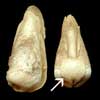
|
| MESOPODIUM | That part of the FOOT which forms the sole on which the gastropod mollusc creeps; see also: PROPODIUM. | |
| MESOSTRACUM | [need definition]; (refers to some aspect of CHITONS) | |
| METAMORPHOSIS | [need definition]. See also: NEPIONIC; POSTMETAMORPHIC; PREMETAMORPHIC. | |
| METAPLAX | One of the ACCESSORY PLATES in the Pholadacea. Long, narrow plate covering the gap between posterodorsal margins in some Pholadidae; see also: HYPOPLAX; MESOPLAX; SIPHONOPLAX. | |
| METAPOSIUM | Middle section. | |
| MICRAESTHETES | Small sensory epidermal PAPILLAE in the Gastropoda and Polyplacophora; see: AESTHETES; MEGALESTHETES. | |
| MICRO | A size classification of shells used to depict those that are microscopic or requiring a microscope to fully examine. This term may sometimes be used as a display category in SHELL SHOWS, although requiring a microscope to judge the show is not done. One is more likely to see the display category: MINIATURE or simply MINI. See also: GRADING SYSTEM. | |
| MICROSCOPIC | Requiring a microscopic to examine; see also: SUBMICROSCOPIC. See also, size classifications for shell shows: MICRO and MINI. | |
| MICROSCULPTURE | Minute SCULPTURE; opposite of MACROSCULPTURE. | |
| MINIATURE (abbrev: MINI) |
A size classification of shells, often used as a display category in SHELL SHOWS, to describe shells 6 mm or less in size as a mature or adult shell. See also: MICRO; GRADING SYSTEM. | |
| mm | An abbreviation for millimeter, a unit of measure equal to 0.03937 of an inch; there are 25.4 mm in one inch and 10 mm to one centimeter (cm). | |
| MODIOLIFORM | Shaped like the shell of Modiolus spp.; differing from MYTILIFORM in that the BEAKS are not quite terminal and ANTEROVENTRAL region forms slight bulge. | |
| MOLLUSC | A member of the invertebrate phylum Mollusca. The taxon Mollusca was first used by Johstonus in 1650 to replace the name Mollia (a taxon name used by Pliny for the Cephalopoda). The Phylum Mollusca includes the classes: Gastropoda (gastropods/snails), Rostroconchia (Paleozoic bivalves), Bivalvia (Recent and fossil bivalves/clams), Cephalopoda (squid, octopus, cuttlefish), Polyplacophora (chitons/coat of mail shells), Scaphopoda (tusk shells or tooth shells), Aplacophora (Chaetoderms & Solenogasters) and Monoplacophora (Gastroverms). | |
| MOLLUSCAlist LISTSERVE |
A mailing list (not technically a LISTSERV) which is supported by the University of California, Berkeley. Members subscribe to "the list" to facilitate an easy exchange of emails via "posting" one email to "the list" which is distributed by the application to all subscribers of the list to which the initial email was sent.
See also: CONCH-L; GASTROPODNET; STROMBUS-L; SHELLFISH. See the compilation of information about Molluscan Listserves. |
|
| MOLLUSCICIDE | A chemical used to kill molluscs, typically used to kill SLUGS and other garden snails that have become pests. | |
| MONECIOUS | Having the male and female sexes in the same animal; see also: DIOECIOUS, AMBISEXUAL; PROTANDRY; HERMAPHRODITE. | |
| MONILIFORM | Composed of a row of beads, like a necklace; see also: BEADED. | |
| MONOGRAPH | An advanced and comprehensive treatment of a family or a group of species or genera; see also: ICONOGRAPH. | |
| MONOMYARIAN | Having only one adductor muscle, the posterior, usually lying in the center of the valves (Ostrea and Pecten are examples); see also: DIMYARIAN; ANISOMYARIAN; HETEROMYARIAN. | |
| MONOPECTINATE | Having one set of comb-like filaments; see also: BIPECTINATE; PECTINATE. | |
| MONOPHYLY | [need definition]. See also: PHYLOGENY; POLYPHYLY; PARAPHYLY. | |
| MONOPLACOPHORAN | [need definition]. | |
| MONOTOCARDIAN | Having a heart with only one auricle, as a mollusc of the order Pectinibranchia. See also: DIOTOCARDIAN. | |
| MONOTYPE |
The type species of a genus so designated by virtue of being the only species originally associated with the genus.
See the publication: "Terminology of Types" by Frizzell. |
|
| MOON SNAIL | A SNAIL (GASTROPOD) of the genus Polinices. See also: SAND COLLAR. | |
| MORPHOLOGY | Structure or form; the study of physical structure. | |
| MOTHER OF PEARL | See: NACRE. See also: PEARL. | |
| MOUTH | The APERTURE of the shell of gastropods; the opening through which the radula is exposed to obtain and pass food inward to the esophagus. | |
| MS | Abbreviation for manuscript, an unpublished work. | |
| MUCOCILIARY FEEDING | A feeding method consisting of exuding a MUCUS net into which food adheres and is subsequently pulled in and consumed. This is employed by sedentary organisms such as Crepidula spp. See also: CILIA; CILIATED | |
| MUCRO (1) |
The posterior, pointed septum of caecid gastropods ( = APICAL PLUG). Photo: Meioceras cornucopiae |
|
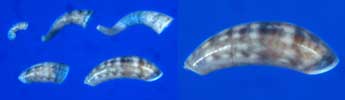
|
| MUCRO (2) | The high point on the eighth (VIII) VALVE of a CHITON shell. See illustration: Composite Chiton. | |
| MUCRONATE | Sharp; see also: MURICATED. | |
| MUCUS (adj. MUCOUS) |
A sticky, slimy, watery secretion; see also: MUCOCILIARY FEEDING | |
| MULLERS ORGAN | In CEPHALOPODS, glandular tissue in the funnel. See also: FUNNEL. | |
| MULTICOLORED | Composed of many different colors; see also: BICOLORED; STRIGATE VARIEGATED. | |
| MULTILOCULAR | Many chambered; see also: LOCULAR; UNILOCULAR. | |
| MULTISERIATE RADULA | A RADULA which has a RACHIDIAN TOOTH and LATERAL TEETH and MARGINAL TEETH; see also: UNISERIATE RADULA. | |
| MULTISPIRAL | Consisting of whorls of uniform width, as in the OPERCULUM of Batillaria spp.; = OPERCULUM, ANNULATE. See also: PAUCISPIRAL; CONCENTRIC. | |
| MULTIVINCULAR | Type of bivalve LIGAMENT consisting of serially repeated elements of alivincular type; e.g., Isognomon spp.; see also: ALIVINCULAR; DUPLIVINCULAR. | |
| MURICATED | Having sharp points or prickles; see also: MUCRONATE; SPINOUS. | |
| MUSCLE SCAR |
An impression on the interior of a shell marking the former place of attachment of a muscle; see also:
ACCESSORY MUSCLE;
DIMYARIAN;
HETEROMYARIAN;
MONOMYARIAN;
CICATRIX. See illustration: Composite Bivalve. See also: MUSCULAR IMPRESSION. See also: Bivalve terminology, Anatomy of bivalves by Marlo Krisberg. |
|
| MUSCLE SCAR, ADDUCTOR |
The imprint, on the interior of a bivalve shell, created by the attachment of the ADDUCTOR MUSCLE. See illustration: Composite Bivalve.
See: Bivalve terminology, Anatomy of bivalves by Marlo Krisberg. |
|
| MUSCLE SCAR, CRUCIFORM | [need definition]. | |
| MUSCLE SCAR, PEDAL RETRACTOR | The imprint, on the interior of a bivalve shell, created by the attachment of the PEDAL RETRACTOR MUSCLE. See illustration: Composite Bivalve. | |
| MUSCULAR IMPRESSION | Lines on the interior of shells, generated by the attachment of muscles; e.g., ADDUCTOR SCAR; PALLIAL LINE. | |
| MUSSEL | Bivalves, typically the edible species, of the family Mytilidae. Do not confuse with MUSCLE. See also: BLUE MUSSEL; DATE MUSSEL. | |
| MYOPHORE | See: APHOPHYSIS. | |
| MYOSTRACUM | Part of shell wall secreted at attachments of ADDUCTOR MUSCLES (of bivalves); see also: HYPOSTRACUM. | |
| MYTILIFORM |
Shaped like the shell of the genus Mytilus. See other bivalve shapes. Photo: Modiolus modiolus (Linne, 1758) |
|
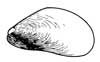 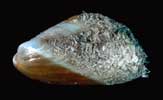
|
| NACRE | Iridescent layer of shell, sometimes called "MOTHER OF PEARL." A form of shell structure consisting of thin leaves of ARAGONITE lying parallel to the inner surface of the shell and exhibiting a characteristic luster; see also: DECORTICATED; IRIDESCENT; HYPOSTRACUM; ORTHOGONAL. | |
| NACREOUS | Consisting of the character of NACRE; see also: GLAZED; MARGARITACEOUS; PORCELANEOUS; VITREOUS. | |
| NAIAD | Common name for freshwater BIVALVES of the family Unionidae. | |
| NATES | Old name for UMBONES. | |
| NAUTILOCONIC | Having the WHORLS in contact with each other; see also: DISJUNCT WHORL; GYROCONIC; ABUTTING; TIGHTLY COILED. | |
| NAUTILOID | Having the shape of a Nautilus; see also: PAPER NAUTILUS. | |
| NEBULOUS | Vague, not clearly defined. | |
| NECK | [need definition]. See illustration: Composite Gastropod. | |
| NEOTENY | The attainment of sexual maturity in the LARVAL stage; see also: PAEDOMORPHOSIS. | |
| NEPIOCONCH | Earliest formed part of dissoconch, when separated from later part by pronounced discontinuity; see also: MESOCONCH; DISSOCONCH; PRODISSOCONCH. | |
| NEPIONIC | In the earliest postlarval stage. See also: METAMORPHOSIS; POSTMETAMORPHIC. | |
| NERITE | Common name for members of the GASTROPOD family Neritidae. | |
| NERITIC | That part of the open sea PELAGIC zone over the continental shelf, vs the OCEANIC zone beyond the continental shelf. See also: EPIPELAGIC (0-200m depth); MESOPELAGIC (200-1000m depth); BATHYPELAGIC (1000-4000m depth; ABYSSOPELAGIC (4000-6000m depth; HADAL (greater than 6,000m depth); BENTHIC; PLANKTONIC. | |
| NERITIFORM | A GLOBOSE GASTROPOD shape resembling that of a Nerite snail (e.g., Nerita spp.; Neritina spp.): with few subglobose and rapidly enlarging whorls with a very reduced SPIRE. See other gastropod shapes. | |
| NESTLER | One of the various small mollusks, mostly bivalves, that enter crevices and cavities as larvae and remain there throughout adult life; see also: SEDENTARY; SESSILE. | |
| NEW NAME | A replacement name (NOMEN NOVUM) for a species having a preoccupied previous name (NOMEN NUDUM) or one that is otherwise invalid. | |
| NEW SPECIES | A previously undescribed SPECIES; = SPECIES NOVUM. | |
| NIDAMENTAL GLAND | Organ which secretes the covering for the eggs. See also: CHALAZA. | |
| NODE | A knot, protuberance, or knob; see also: NODULE. | |
| NODOSE | Having numerous protuberances or knobs; PUSTULOSE; see also: NODULOSE. | |
| NODULE | A small NODE. See illustration: Composite Gastropod and Composite Bivalve. | |
| NODULOSE |
Having small, rounded protuberances (i.e., NODULES). Photo: Cerithiopsis greeni (C.B. Adams, 1839) |
|
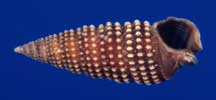
|
| NOMEN CONSERVANDUM | [need definition]. | |
| NOMEN DUBIUM NOM. DUB. |
A name of doubtful validity for nomenclatural purposes, according to the rules of the ICZN. | |
| NOMEN NOVUM NOM. NOV. |
A NEW NAME. | |
| NOMEN NUDUM NOM. NUD. (pl. NOMINA NUDA) |
A name published without sufficient documentation to validate it under the International Code (ICZN); such a name may be used later if given with a proper description. | |
| NOMEN OBLITUM NOM. OBLIT. |
A "forgotten name" or senior synonym that has remained unnoticed in the literature for more than fifty years. This category was defined by the ICZN in 1958. Opposed by many systematists, it was, in December 1970, repealed by the ICZN in declaration 43. | |
| NOMENCLATURAL | Pertaining to naming in CLASSIFICATION. | |
| NOMINAL SPECIES | Any named SPECIES, regardless of the validity of the name. Nominal species names may become SYNONYMS of accepted species names. | |
| NOMINATE | Said of a subordinate taxon that bears the same name and therefore contains the type species of a subdivided higher taxon; e.g., Conus, s.s., is the nominate subgenus of the genus Conus. Buccinidae is the nominate family of the superfamily Buccinacea. | |
| NONBINOMIAL | A name not conforming to accepted principles of BINARY NOMENCLATURE as set forth in the International Code of Zoological Nomenclature (ICZN). | |
| NORMAL | Term formerly applied to chamid bivalves in which attachment is by right valve or to rudist bivalves in which attachment is by the left valve. | |
| NOTCH | An indentation on the margin of a structure; see also: EMARGINATE; STROMBOID NOTCH; TURRID NOTCH. | |
| NOTUM | The DORSAL surface in certain OPISTHOBRANCHS. | |
| NUCLEAR | Pertaining to the PROTOCONCH, or to the larval shell. | |
| NUCLEAR WHORL | The early larval shell, sometimes distinguished from the PROTOCONCH. See illustration: Composite Gastropod. See also: ADULT WHORLS; VELICONCH. | |
| NUCLEUS | The first part or beginning of a SHELL or OPERCULUM; see also: NUCLEAR WHORL; PROTOCONCH. | |
| NUCULANIFORM | A shape exemplified by the bivalve genus Nuculana; = ROSTRATE. See other bivalve shapes. | |
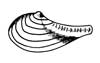
|
| NUDIBRANCH | [need definition]. See also: ASCOGLOSSAN; SEA SLUG. | |
| NURSE EGGS | Eggs which are placed in the same EGG CAPSULE as other, viable EGGS, but which do not develop; the nurse eggs simply provide post-hatching nourishment for the viable eggs. | |
| NYMPH | A projection along the bivalve hinge margin to support the EXTERNAL LIGAMENT or to reinforce the normal hinge structure; = LIGAMENT FULCRUM; = NYMPHAL PLATE. | |
| NYMPHAL PLATE | See: NYMPH. | |
| OBCONIC | Approximately cone-shaped; see also: BICONIC; CONICAL. See other gastropod shapes. | |
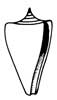
|
| OBESE | Fat; corpulent; swollen. | |
| OBLIQUE | Slanting; inclined from the horizontal or vertical. | |
| OBLIQUELY OVATE | An OVATE shape which has been titlted to one side. See other gastropod shapes. | |
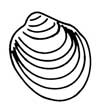
|
| OBLIQUITY | Angle between straight dorsal margin (of bivalves) and line bisecting umbonal angle (in terminology of some authors); angle between dorsal margin and most distant point of ventral margin. | |
| OBLITERATED | Eroded; worn away by attrition; rendered imperceptible. | |
| OBLONG | Longer in one direction than in another, with sides more or less parallel; see also: CYLINDRICAL; TUBULAR. | |
| OBOVATE | Reversed OVATE; having the greatest width above the APERTURE, toward the apex. OVATE, with the narrower end basal. See other gastropod shapes. | |
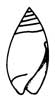
|
| OBSCURED | Not readily seen; not easily observable. | |
| OBSOLETE | Weakly marked; indistinct; weak to the point of absence; worn out; see also: CORRODED. | |
| OBTUSE | Not pointed or ACUTE; blunt; having an internal angle of between 90 and 180 degrees. | |
| OCEANIC | That part of the open sea PELAGIC zone beyond the continental shelf, vs the NERITIC zone over the continental shelf. See also: EPIPELAGIC (0-200m depth); MESOPELAGIC (200-1000m depth); BATHYPELAGIC (1000-4000m depth; ABYSSOPELAGIC (4000-6000m depth; HADAL (greater than 6,000m depth); BENTHIC; PLANKTONIC. | |
| OCELLI | The tiny, simple eyes, as in the scallop. | |
| OCTOGONAL | Having eight angles (as in some Dentalium spp.); see also: HEXAGONAL; POLYGONAL; QUADRATE; RHOMBOID. | |
| OCTOPUS |
A CEPHALOPOD of the order Octopoda or, more restrictively, a member of the genus Octopus. These organisms have eight arms which ususlly bear rows of round suckers. For a detailed definition, see Wikipedia. |
|
| ODONTOPHORE | The rasping organ of early molluscs; the RADULA lies along the middle of the dorsal surface of the odontophore. | |
| OLFACTORY | Pertaining to the sense of smell; see also: MACROSMATIC. | |
| OLIGOGYROUS | Having the number of turns reduced (as in the OPERCULUM of most MONOTOCARDIANS); see also: POLYGYROUS. | |
| OLIGOPYRENIC | The less common type of sperm, which plays no part in fertilization; it is thought that they degenerate in the receptaculum and nourish the Eupyrenic sperm (perhaps analogous to NURSE EGGS; it has also been shown that the oligopyrenic sperm provide a transport mechanism for the eupyrenic sperm; see also: SPERM; EUPYRENIC. | |
| OMNIVOROUS | Feeding on both vegetable matter (HERBIVOROUS) and animal matter (CARNIVOROUS). See also: DETRITIVOROUS. | |
| OMPHALOUS | Having an UMBILICUS; see also: ANOMPHALOUS. | |
| ONTOGENY |
The successional growth stages of a species. See also: PHYLOGENY. See Wikipedia for Ernst Haekel's "Recapitulation Theory" that ontogeny recapitulates phylogeny. |
|
| OPAQUE | Not transparent or translucent; see also: PELLUCID. | |
| OPERCULAR | Pertaining to the OPERCULUM. | |
| OPERCULAR PEG | An narrow extension of the OPERCULUM. | |
| OPERCULATE | Having an operculum; see also: INOPERCULATE. | |
| OPERCULUM (pl. OPERCULA) |
A generally oval, lid-like, CORNEUS or CALCAREOUS structure, situated on the posterior end of the FOOT of many gastropods, that closes off the APERTURE when the animal withdraws into its shell; see also: CONCENTRIC; EPIPHRAGM; MULTISPIRAL; OLIGOGYROUS; PAUCISPIRAL; POLYGYROUS; TRAP DOOR; UNGUICULATE, RIGICLAUDENT, FLEXICLAUDENT. See the website on opercula: The Humble Operculum Photo: Triplofusus giganteus (Kiener, 1840) |
|
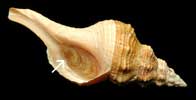
|
| OPERCULUM, ANNULATE | An OPERCULUM with a central nucleus, or nearly so, with other layers surrounding it in flattened rings. See also: MULTISPIRAL. | |
| OPERCULUM, CONCENTRIC | See: OPERCULUM, ANNULATE. | |
| OPERCULUM, MULTISPIRAL |
An OPERCULUM consisting of radiating WHORLS of uniform width; = OPERCULUM, ANNULATE; = POLYGYROUS SPIRAL. For illustrations, see The Humble Operculum website page: Operculum Structures. |
|
| OPERCULUM, PAUCISPIRAL |
An OPERCULUM having only a few whorls or turns, of rapidly increasing width; = OLIGOGYROUS SPIRAL; MULTISPIRAL. For illustrations, see The Humble Operculum website page: Operculum Structures. |
|
| OPERE CITATO OP. CIT. |
A work previously cited. | |
| OPISTHOBRANCH | Marine Mollusks which are characterised by having a single gill behind and to the right of the heart; they also have a reduced or absent shell and always lack an OPERCULUM. Included in this group are the BUBBLE SHELLS, the NUDIBRANCHS, SEA HARES and SEA BUTTERFLIES. | |
| OPISTHOCLINE |
Sloping (from lower end) in posterior direction [term applied to HINGE TEETH of bivalves and, in some genera, to body of shell]; opposite of PROSOCLINE. See photos on the "Let's Talk Seashells" website: Tricky terminology, prosocline and opisthocline. |
|
| OPISTHODETIC | Located wholly posterior to beaks, in bivalves [term applied to ligament]; opposite of PROSODETIC>/a>. | |
| OPISTHOGYRATE | In bivalves, having the BEAKS pointing backward or posteriorly; opposite of PROSOGYRATE; see also: ORTHOGYRATE; SPIROGYRATE. | |
| ORAL | Situated about or around the mouth; pertaining to the mouth; see also: ABORAL. | |
| ORBICULAR | Circular and flattish; see also: SUBORBICULAR. See other bivalve shapes. | |

|
| ORIFICE | An opening; in keyhole LIMPETS (Gastropoda: Fissurellidae), a small opening in the MANTLE CAVITY from the exterior, at and through the shell apex. | |
| ORNAMENTATION | Sculptural elements that form part of the shell morphology; see also: COWL; NODE; PIT; PUNCTATION; PUSTULE; RIDGE; SCULPTURE; SPINE; SNAIL FUR. | |
| ORNAMENTED | Sculpturally embellished; not smooth; see also: ORNAMENTATION | |
| ORTHOCLINE | Perpendicular to HINGE AXIS or almost so [term applied to HINGE TEETH and, in some genera, to body of shell]; = ACLINE. | |
| ORTHOCONE | [need definition]; see also: CYRTOCONE; BREVICONE. | |
| ORTHODONT | Type of HINGE in which direction of HINGE TEETH are parallel to CARDINAL MARGIN or almost so. | |
| ORTHOGONAL | Referring to two shell layers that are at right angles to each other. See also: NACRE. | |
| ORTHOGYRATE | In bivalves, having the BEAKS pointing toward each other; see also: OPISTHOGYRATE; SPIROGYRATE. | |
| OSCULE | Orifice in upper valve in some RUDISTS, usually near margin. | |
| OSPHRADIUM | A sensory organ in gastropods in the PALLIAL CAVITY, apparently for the reception of chemical stimuli. | |
| OSSICLE | A small, CALCAREOUS plate reinforcing the INTERNAL LIGAMENT in some bivalve genera; = LITHODESMA; = OSSICULUM. | |
| OSSICULUM | See: OSSICLE. | |
| OSTRACUM | Outer part of CALCAREOUS wall of shell, secreted at mantle edge [original usage]; entire calcareous wall of shell [usage by some later authors]; see also: PERIOSTRACUM. | |
| OUTER (layer of) LIGAMENT | Same as LAMELLAR LIGAMENT. | |
| OUTER LIP | [need definition]. | |
| OUTER LIP TOOTH | [need definition]. See: LABIAL TOOTH. See illustration: Composite Gastropod. | |
| OVAL |
Like a circle that has been somewhat flattened; see also: OVATE; SUBOVAL. See other bivalve shapes. |
|
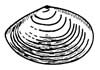
|
| OVATE |
Egg-shaped, with the basal end broader; see also: OBLIQUELY OVATE; OBOVATE. See other gastropod shapes. Photo: Granulina ovuliformis (Orbigny, 1841) |
|
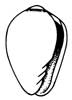 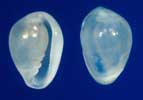
|
| OVERLAPPING | Lying at least partially one over another, as with sculptural elements such as LAMINAE, scales, or plates. | |
| OVERRIDE | To pass over without interruption (e.g., COMMARGINAL elements over radial elements of ornament). | |
| OVIDUCT | [need definition]. | |
| OVIPAROUS | Producing young via production of eggs; see also: VIVIPAROUS. | |
| OYSTER | BIVALVED clams of the families Ostreidae (edible oysters), Pteriidae (PEARL oysters), Isognomonidae (tree oysters) and Hyriidae (freshwater oysters). See also: BRANCHITELLUM. | |
| PACHYODONT | Descriptive of a bivalve shell with one heavy, blunt and shapeless hinge tooth; see also: DENTITION. | |
| PAEDOMORPHOSIS | The principle by Garstang, which promotes "escape from specialization" by attainment of sexual maturity in a larval condition. This has brought much-needed support to the annelid theory of molluscan ancestors. It would make the molluscs neotenic annelids that had lost their segmentation by dropping off the original adult stages from their life history. The TROCHOPHORE larva thus becomes the last point of contact between the two phyla; see also: PHLEBOEDESIS. See also: NEOTENY. | |
| PALATAL | Pertaining to the OUTER LIP of a spiral gastropod shell. | |
| PALATAL TOOTH | [need definition]. | |
| PALLET |
One of the two simple or compound CALCAREOUS structures at the siphonal end of some wood-boring mollusks (such as SHIPWORMS), closing the burrow when the siphons are withdrawn. Illustration: Teredo sp. (left = entire animal; center = pallets; right = shell) |
|
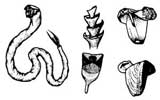
|
| PALLIAL | Pertaining to the MANTLE, or the region of the GILLS. | |
| PALLIAL CAVITY | [need definition]. | |
| PALLIAL LINE |
On the inside of some bivalve shells, a linear scar marking the attachment of the margin of the fleshy MANTLE to the shell. See illustration: Composite Bivalve. See also: INTEGROPALLIATE; MUSCULAR IMPRESSION; SINUPALLIATE.
See: Bivalve terminology, Anatomy of bivalves by Marlo Krisberg. |
|
| PALLIAL REGION | Marginal region of shell interior adjacent to PALLIAL LINE. | |
| PALLIAL RETRACTOR MUSCLE | Muscle withdrawing marginal parts of MANTLE within bivalve shell where there is no distinct line of muscle attachment. | |
| PALLIAL SINUS |
A notch or EMBAYMENT in the PALLIAL LINE caused by the attachment of the siphon's retractile muscles. It may be deep, shallow, or absent... depending on the species. See illustration: Composite Bivalve. See also: INTEGROPALLIATE; SINUPALLIATE.
See: Bivalve terminology, Anatomy of bivalves by Marlo Krisberg. |
|
| PALMATE | Shaped like an open palm; like a hand with the fingers extended. | |
| PALP PROBOSCIDES | The prolonged, grooved tentacles of the LABIAL PALPS of bivalves. | |
| PANTODONT | Dentition having the LATERAL TEETH exceeding 2 in any one group; see also: DENTITION. | |
| PAPER NAUTILUS |
Common name applied to the external temporary shell constructed by the ARGONAUT to protect its eggs; = PAPER SAILOR. This shell is not made from paper; the shell is "paper thin" (i.e., very fragile) and constructed of calcium carbonate (like most seashells) only by the female of the species and only for purposes of protecting her eggs. Additionally, the Paper Nautilus is not a nautilus at all, but rather is a member of the order Octopoda (which includes the octopusses) and family Argonautidae. [left photo by Paul S. Mikkelsen, right photo by Carly De Maye] Both photos: Argonauta argo Linne, 1758 |
|
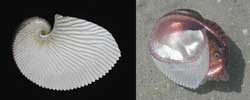
|
| PAPER SAILOR | See: PAPER NAUTILUS. | |
| PAPILLA (pl. PAPILLAE) |
Any small bump or small projection. | |
| PAPILLAE, DORSAL | [need definition]. In NUDIBRANCHS… See illustration: Composite Nudibranch. | |
| PAPILLATE | Nipple-shaped; = PAPPILLOSE. | |
| PAPYRACEOUS | Of a thin, light texture resembling that of paper (often used in reference to the Argonauta). | |
| PARALARVA | In CEPHALOPODS, the first free-living form of the organism, typically found in surface PLANKTON. | |
| PARAPHYLY | [need definition]. See also: PHYLOGENY; POLYPHYLY; MONOPHYLY. | |
| PARAPODIA | In sea hares (Gastropoda: Anaspidea), lateral expansions of the FOOT, used for swimming. | |
| PARASITE | [need definition]. See also: COMMENSAL. | |
| PARATYPE |
A specimen from the original type material of a species, designated as such to serve as an auxiliary specimen to the holotype; one of a series from primary type material, exclusive of the HOLOTYPE.
See the publication: "Terminology of Types" by Frizzell. |
|
| PARIETAL | Pertaining to the region of a gastropod shell that extends from the COLUMELLA posteriorly and around the curve of the shell. | |
| PARIETAL CALLUS | Enamel on the inside of a shell just within the APERTURE of snails; see also: COLUMELLAR CALLUS. | |
| PARIETAL DENTICLE | [need definition]; present in some Polygyridae. | |
| PARIETAL TOOTH | A shelly projection on the PARIETAL WALL of the shell of gastropods. See illustration: Composite Gastropod. See also: PARIETAL. | |
| PARIETAL WALL | In a gastropod, the region just above the columellar region, partly outside and partly inside the aperture; sometimes called the INNER LIP; see also: PARIETAL. | |
| PARIVINCULAR | Longitudinally elongated type of bivalve LIGAMENT, located posterior to beaks and comparable to cylinder split on one side with several edges attached respectively along dorsal margin of two valves; see also: ALIVINCULAR; DUPLIVINCULAR; MULTIVINCULAR. | |
| PARS | In part. | |
| PARTITION | The erect plate of shell matter deposited in some typhine species between the shoulder spine of each varix and the previous whorl, and against which the next spine often rests. | |
| PATELLATE | Saucer-shaped; cap-shaped; shaped like a human knee cap or patella; shell with a low cone, with little or no coiling; = PATELLIFORM. | |
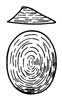
|
| PATELLIFORM | Shaped like a human knee cap or patella; = PATELLATE. See other gastropod shapes. | |
|
|
| PATRONYM | A species (or other) name honoring a specific person. | |
| PAUCISPIRAL | Having only a few WHORLS or turns, of increasing width; see also: MULTISPIRAL; CONCENTRIC. | |
| PEARL |
A CALCAREOUS spheroid secreted by the mantle of a mollusk (mostly bivalves, but some gastropods too), in layers, to reduce the irritation of some foreign particulate matter lodged within the tissues of the animal. The pearl often has a NACREOUS appearance and although predominantly white in color, they may be various colors including blue, pink, green, brown, or nearly black. See also:
MARGARITACEOUS;
MARGARITIFEROUS;
MOTHER OF PEARL. See: Glossary of Pearl Terms by Pearl-Guide.com See: Glossary of Technical Terms by Costellos.com |
|
| PEARLY LAYER | See: NACRE. | |
| PECTINATE |
A shape exemplified by the bivalve genus Pecten. see also: BIPECTINATE; MONOPECTINATE. See other bivalve shapes. |
|
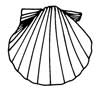
|
| PECTINIFORM |
[need definition]. Photo: Argopecten irradians concentricus (Say, 1822) |
|
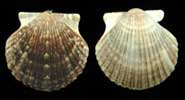
|
| PECTINITE | A FOSSIL shell of a SCALLOP. | |
| PEDAL ELEVATOR MUSCLE | Thin bundle of muscle fibers attached to a bivalve shell in the umbonal cavity and serving to raise the foot. | |
| PEDAL GAPE | Opening between margins of shell for protrusion of the FOOT; see also: CALLUM. | |
| PEDAL GLAND | A gland on the gastropod FOOT that secretes a lubricant aiding in locomotion. | |
| PEDAL GROOVE |
A longitudinal groove in the body of a snail that marks the boundary where the TUBERCULATE side wall of the foot joins the smooth ventral sole; see also: SUPRAPEDAL GROOVE. In the neomeniomorph (Solenogastres) APLACOPHORANS, a longitudinal narrow groove which functions as a foot, beginning anteriorly in a PEDAL PIT. See the WHOI website for a photo by Amelie Scheltema. |
|
| PEDAL LEVATOR MUSCLE | Same as PEDAL RETRACTOR MUSCLE. | |
| PEDAL PIT | In APLACOPHORANS, an anterior depression which marks the begining of a PEDAL GROOVE. | |
| PEDAL PROTRACTOR MUSCLE | Muscle present in some bivalve genera, attached to shell interior and serving to extend the foot. | |
| PEDAL RETRACTOR MUSCLE | Muscle attached to shell interior, and serving to retract the FOOT (of bivalves); = PEDAL LEVATOR MUSCLE. | |
| PEDICLE | See: PEDUNCLE. | |
| PEDIVELIGER | A VELIGER LARVA which has settled out of the PLANKTON and is in the process of METAMORPHOSIS, resorbing the VELUM, etc., and has the ability to crawl about with the aid of its foot. Term coined by Mel Carriker. See also: PLANTIGRADE. | |
| PEDUNCLE | A stalk or stem-like structure. | |
| PELAGIC | The open sea, made up of the NERITIC zone over the continental shelf and the OCEANIC zone beyond the continental shelf. See also: EPIPELAGIC (0-200m depth); MESOPELAGIC (200-1000m depth); BATHYPELAGIC (1000-4000m depth; ABYSSOPELAGIC (4000-6000m depth; HADAL (greater than 6,000m depth); OCEANIC; BENTHIC; PLANKTONIC. | |
| PELECYPOD | A bivalve, clam, mussel, oyster, scallop, etc. "Pelecypod" is considered an outdated term, and bivalve is usually used to replace it. The term means "hatchet foot." See also: BIVALVE. | |
| PELLUCID | Transparent, limpid; see also: DIAPHANOUS; HYALINE. | |
| PEN | The internal "shell" of SQUID; see also: GLADIUS; RACHIS; VANE. | |
| PENIS | See: VERGE. | |
| PENULTIMATE | Next to the last; see also: PENULTIMATE WHORL. | |
| PENULTIMATE WHORL | The next to the last WHORL, or the one before the BODY WHORL (of snails). | |
| PERFOLIATE | [need definition]. | |
| PERFORATE | Having a minute opening at the base of the shell; see also: IMPERFORATE; UMBILICATE. | |
| PERFORATION | A round opening, typically having the appearance of being bored. | |
| PERIOSTRACAL GROOVE | [need definition]. | |
| PERIOSTRACUM |
The outermost molluscan shell layer, composed of CONCHIOLIN; = DRAP MARIN (by French naturalists); erroneously called "epidermis" by authors; see also: OSTRACUM. Photo: Cymatium pileare (Linne, 1758) |
|
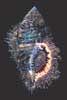
|
| PERIPATETIC | Travelling around to different places. Applies to invasive species and their advance to new areas. | |
| PERIPHERY, ANGULATE | Having the outer whorl midway between CARINATE and ROUNDED. | |
| PERIPHERY, BICARINATE | Having two CARINA or ridges at the outer edge of a whorl. | |
| PERIPHERY, CARINATE | Having one CARINA or ridge at the outer edge of a whorl. | |
| PERIPHERY, ROUND | Having the outer edge of a WHORL smoothly curved. | |
| PERIPHERY, WHORL | [need definition]. | |
| PERISTOME | Edge of the aperture on a gastropod shell, including the inner and outer lips. See illustration: Composite Gastropod. See also: HOLOSTOMATE; LABIUM; LABRUM; PERITREME; SIPHONOSTOMATE. | |
| PERISTOME, PERITREME | The margin of the APERTURE; generally said of a margin that is either continuous or interrupted only by the parietal region of the body whorl; see also: HOLOSTOMATE; SIPHONOSTOMATE. | |
| PERITREME | The whole circumference of the aperature of a spiral shell (in descriptions, it is said to be notched or entire, simple, reflected, round or oval, etc.; see also: PERISTOME. | |
| PERIWINKLE | A SNAIL in the family Littorinidae. | |
| PERSISTENT | Lasting; not lost; generally present throughout the development (of a shell); see also: EPHEMERAL. | |
| PERSONAL COMMUNICATION (abbrev: PERS. COMM.) |
Information conveyed through conversation; see also: IN LITT. | |
| PHANEROMPHALOUS | Having a completely open UMBILICUS; see also: ANOMPHALOUS; OMPHALOUS. | |
| PHARYNX | The throat; the section of the alimentary canal just behind the mouth. See also: ESOPHAGUS | |
| PHENOTYPE | Visually observable characteristics of an organism. Such characteristics are often used to distinguish SPECIES , with LUMPERS and SPLITTERS placing less or more weigh (respectively) on features. The phenotype of an organism can be influenced by the environment. See also: ECOPHENOTYPE; GENOTYPE; XENOMORPHISM. | |
| PHLEBOEDESIS | A process proposed by Lankester, who held that molluscs were derived from segmented annelids that had already acquired a full coelom, in which enlarged blood spaces encroached on the COELOM and reduced it to its molluscan dimensions; see also: PAEDOMORPHOSIS. | |
| PHOTOPHORE |
Light-producing organs. These are present in the outer tissues of CEPHALOPODS, and are used by the organism to change colors and patterns. See the detailed web page on photophore terminology, from the excellent "Cephalopod Glossary" by Richard E. Young, Michael Vecchione, and Katharina M. Mangold. |
|
| PHRAGMOCONE |
The floatation chambers of a CHAMBERED NAUTILUS or Spirula spirula; See also: CONCAMERATION; SIPHUNCLE.
See the excellent "Cephalopod Glossary" by Richard E. Young, Michael Vecchione, and Katharina M. Mangold. |
|
| PHYLOGENOMICS |
Phylogenetic studies using dozens to hundreds of genes. See also: PHYLOGENY See: Kocot, et al. 2011. Phylogenomics reveals deep molluscan relationships. Nature 477:452-456. |
|
| PHYLOGENY |
The history of the EVOLUTION of various groups or species, usually illustrated with the use of family trees. See also:
MONOPHYLY;
POLYPHYLY;
PARAPHYLY;
PHYLOGENOMICS.
See also: ONTOGENY. See Wikipedia for Ernst Haekel's "Recapitulation Theory" that ontogeny recapitulates phylogeny. |
|
| PIDDOCK |
The common name for CLAMS a member of the bivalve family Pholadidae, including the genera Barnea, Cyrtopleura, Zirfaea, Martesia and others. Left photo: Martesia striata (Linne, 1758); Right photo: Cyrtopleura costata (Linne, 1758) |
|
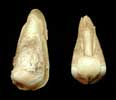 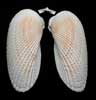
|
| PILLAR | The part of the body whorl of the gastropod shell adjacent to the COLUMELLAR LIP; also, sometimes, the columella. In bivalves, an inward extension of outer shell layer extending longitudinally up the lower valve in HIPPURITIDS; see also: PSEUDOPILLAR. | |
| PILOSE | Covered with hairs, especially with fine and soft hair. | |
| PINNATE | Protuberant and RIBBED; see also: ALATE. | |
| PIT | A small cavity or hole; a pinpoint depression; see also: PUNCTATE; PUNCTUM; QUINCUNX. | |
| PLAIT | A shelf-like fold, generally on the columella of a gastropod shell; see also: COLUMELLAR PLAIT; PLICA; FRINGED. | |
| PLANED | Flat or existing in one plane (e.g., the columellar lip of Purpura spp.). | |
| PLANISPIRAL | Coiled in a single plane; loosely used also with DISCOIDAL shells having asymmetrical sides; see also: LENTICULAR. See other gastropod shapes. | |
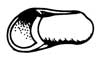
|
| PLANKTON |
Organisms that drift in the water column of salt, brackish, or fresh water. See also: ZOOPLANKTON, HOLOPLANKTON, MEROPLANKTON. See also: the glossary link on the PlanktonNet website for a large, illustrated glossary of plankton-related terminology. |
|
| PLANKTONIC | Floating or suspended in the water column, and generally incapable of overcoming the currents by swimming although some directional movement is possible, usually vertical; see also: BENTHIC; PLANTIGRADE. | |
| PLANKTOTROPHIC | Having a long LARVAL stage (up to 2-3 months) in the PLANKTON, and generally feeding while in the plankton; see also: LECITHOTROPHIC. | |
| PLANORBICULAR | See: PLANORBOID. | |
| PLANORBOID | In gastropods, having the whole coil in the same plane; = PLANORBICULAR; used in reference to ammonites. | |
| PLANTIGRADE (STAGE) | The final, or creeping stage of a gastropod; PEDIVELIGER; VELIGER. | |
| PLATE | A lamina or scale-like structure; see also: HINGE PLATE; SQUAMOUS. | |
| PLATH | A CHITINOUS or CALCAREOUS accessory typical of pholad shells, somewhat flat in shape and held in place by chitinous folds; e.g., PROTOPLAX, MESOPLAX, METAPLAX, HYPOPLAX. | |
| PLEAT | Applied to folds on the COLUMELLA. | |
| PLESIOMORPHY |
An ancestral or primitive character. See also: APOMORPHY. See the Paleos website for greater detail. |
|
| PLEURAL AREAS | Side slopes of valves of CHITONS, not including the JUGAL TRACTS. | |
| PLEUROTHETIC | Attached to a substrate; referring to a members of the Bivalvia which settle on to the substrate and attach themselves, often with the attached valve taking on the form of the substrate. See also: ATTACHED; ATTACHED BIVALVE; XENOMORPHISM. | |
| PLICA (pl. PLICAE) |
A FOLD; see also: PLAIT; RUGA. | |
| PLICATE | Folded or twisted; having PLICAE. | |
| PLICATIDIUM | Folded, secondary GILL found especially in CEPHALASPID gastropods. | |
| PLICATION | A fold of PLICA. | |
| PNEUMOSTOME | A breathing pore. Examples are found arranged in a row in the shells of Abalone (Haliotis spp.). | |
| POLYCHROMIC | Having many colors; see also: POLYCHROMISM. | |
| POLYCHROMISM | Having many colors; see also: POLYCHROMIC; VARIEGATED; POLYMORPHISM. | |
| POLYGONAL | Many sided; see also: HEXAGONAL; OCTOGONAL; QUADRATE; RHOMBOID; TRIGONAL. | |
| POLYGYROUS | Composed of many turns (as in the OPERCULUM of DIOTOCARDIANS); see also: OLIGOGYROUS. | |
| POLYGYROUS SPIRAL | See: OPERCULUM, MULTISPIRAL. | |
| POLYMORPHIC | Having many forms; see: POLYMORPHISM | |
| POLYMORPHISM | A circumstance in a group of organisms in which both the close affinities of a species and other, divergent details of morphology are present; see also: DIMORPHISM; POLYCHROMISM. | |
| POLYPHYLY | [need definition]. See also: PHYLOGENY; MONOPHYLY; PARAPHYLY. | |
| POLYPLACOPHORAN | Shells of the molluscan class Polyplacophora, commonly called a CHITON or COAT OF MAIL SHELL. | |
| POOR | A term used to designate the quality of a shell as being in bad condition, badly beachworn, and/or with major breaks; see also: GRADING SYSTEM. | |
| PORCELANEOUS | Polished; similar in color and texture to porcelain ceramic. See also: NACREOUS; VITREOUS. | |
| PORCELANEOUS LAYER | The thick, innermost layer of a shell; see also: PRISMATIC LAYER; LAMELLAR LAYER. | |
| POSTERIOR | Toward the apical end of, in coiled gastropod shells, or the siphonal end of, in bivalves; opposite of ANTERIOR; see also: OPISTHODETIC; for bivalves, see also: MARGINAL CARINA; CORSELET. | |
| POSTERIOR CANAL | = ANAL SULCUS; = ANAL CANAL. See illustration: Composite Gastropod. See also: ANTERIOR CANAL. | |
| POSTERIOR LATERAL TOOTH | LATERAL TOOTH situated posteriorly to beaks and (in heterodonts) posterior to the LIGAMENT. | |
| POSTERIOR RIDGE | A ridge, in bivalves, passing over or originating near the umbo and running diagonally towards the posteroventral part of the valve; see also: CORSELET. | |
| POSTERIOR SLOPE | Sector of surface of valve (of bivalves) running posteroventrally from UMBO; see also: CORSELET. | |
| POSTEROBASAL MARGIN | See: POSTEROVENTRAL MARGIN. | |
| POSTERODORSAL MARGIN | In bivalves, the margin of the DORSAL part of the shell POSTERIOR to the BEAKS. | |
| POSTEROVENTRAL | Being both rearward and downward; toward the rear and lower regions; see also: ANTEROVENTRAL. | |
| POSTEROVENTRAL MARGIN | In bivalves, the posterior end of the valve margin opposite the hinge; = POSTEROBASAL MARGIN. See also: ANTEROVENTRAL MARGIN; | |
| POSTLARVAL | After the LARVAL stage; after METAMORPHOSIS.. | |
| POSTMETAMORPHIC | After METAMORPHOSIS. See also: NEPIONIC; PREMETAMORPHIC. | |
| POSTNUCLEAR | Succeeding the nucleus or PROTOCONCH in the growth of a gastropod shell. | |
| POSTNUCLEAR WHORL | Any turn of a GASTROPOD shell formed after the formation of the NUCLEUS. | |
| PRECEDING WHORL | The turn of a GASTROPOD shell just previous to the one being described. | |
| PREMETAMORPHIC | Before METAMORPHOSIS. See also: POSTMETAMORPHIC. | |
| PREOCCUPIED NAME | A taxonomic species name that has been used by a previous author for a different species in the same genus and is therefore unavailable for the present species. | |
| PRICKLE | A small, pointed protuberance. | |
| PRIMARY | Of the first order; most dominant or conspicuous; see also: SECONDARY; TERTIARY; QUARTERNARY. | |
| PRIMARY HOMONYM | A name that is identical to another name. The oldest has priority and is termed the senior primary homonym with the younger name being the junior primary homonym. See also: HOMONYM; SECONDARY HOMONYM; HOMONYMY. | |
| PRIONODONT | Type of hinge in which the teeth are developed in direction transverse to cardinal margin; virtually same as TAXODONT; see also: DENTITION. | |
| PRISMATIC | Of shell structure, consisting of prisms of CALCITE or ARAGONITE; see also: LAMELLAR LAYER; PORCELLANEOUS LAYER; PRISMATIC LAYER. | |
| PRISMATIC LAYER | The thick outer layer of a shell; see also: PRISMATIC; LAMELLAR LAYER; PORCELANEOUS LAYER. | |
| PROBOSCIS | In GASTROPODS, a tube-like anterior organ bearing the mouthparts at its tip. | |
| PROBOSCIS COLUMN | [need definition]. | |
| PROCESS | A sculptural structure projecting from the main body of a shell; see also: PUSTULE. | |
| PRODISSOCONCH | A shell secreted by the LARVA or embryo and preserved at the BEAK of some adult bivalve shells or scaphopod shells; identical with VELICONCH when larva is PELAGIC. See illustration: Composite Bivalve. See also: DISSOCONCH; MESOCONCH; NEPIOCONCH; PRODISSOCONCH I; PRODISSOCONCH II; PROTOCONCH; VELICONCH. | |
| PRODISSOCONCH I | Earlier-formed part of prodissoconch, secreted by the SHELL GLAND of the LARVA; = PRODISSOCONCH; PROTOSTRACUM; PRODISSOCONCH II. | |
| PRODISSOCONCH II | Later-formed part of PRODISSOCONCH, secreted by the MANTLE edge; see also: PRODISSOCONCH I. | |
| PRODUCED | Drawn out; elongate; see also: PROTUBERANT. | |
| PROPODIUM (pl. PROPODIA) |
A slit across the anterior margin of the foot of gastropods which coincides with the boundary between the anterior part of the FOOT and the MESOPODIUM; see also: MESOPODIUM. | |
| PROSOCLINE |
Sloping (from lower end) in anterior direction (term applied to HINGE TEETH and, in some genera, to body of shell); opposite of OPISTHOCLINE. See photos on the "Let's Talk Seashells" website: Tricky terminology, prosocline and opisthocline. |
|
| PROSOCOELOUS | Same as PROSOGYRATE. | |
| PROSODETIC | Located anterior to the BEAKS, in bivalves; opposite of OPISTHODETIC. | |
| PROSOGYRATE | In bivalve shells, curved so that the BEAKS point anteriorly; opposite of OPISTHOGYRATE or OPISTHODETIC; same as PROSOCOELOUS. | |
| PROSOPON | Term recently proposed as suggested improvement on SURFACE ORNAMENT or SCULPTURE. | |
| PROTANDRY (or PROTANDROUS) adj. PROTANDRIC |
Beginning life as a male, passing through an HERMAPHRODITIC (male & female combined) stage, and finishing life as a pure female. This occurs in the slipper limpet, Crepidula fornicata, as discovered by Orton, 1909; see also: RHYTHMICAL SEXUALITY. | |
| PROTOBRANCH | [need definition]. | |
| PROTOCONCH |
The LARVAL shell, formed by all the nuclear whorls, of a gastropod shell; sometimes this includes (and sometimes excludes) the earlier NUCLEAR WHORLS. See illustration: Composite Gastropod. See also:
DISSOCONCH;
PRODISSOCONCH;
SCAPHOCONCHA;
TELEOCONCH;
VELICONCH; =
NUCLEUS. See Marlo Krisberg's graphic Counting Protoconch Whorls. Photo: Acteocina atrata Mikkelsen and Mikkelsen, 1984 |
|
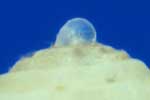
|
| PROTOPLAX | One of the ACCESSORY PLATES in the Pholadacea; flat, spearhead-like accessory plate in one piece or divided longitudinally into two, situated at the anterior end of the dorsal margin in some pholadidae. see also: HYPOPLAX; MESOPLAX; METAPLAX; SIPHONOPLAX. | |
| PROTOSTRACUM | Same as PRODISSOCONCH I. | |
| PROTOSTYLE | A stiff mucous rod projecting into the stomach from the intestine which is continuously rotated by cilia and functions in drawing the food in from the esophagus; this is the forerunner of the molluscan CRYSTALLINE STYLE; see also: GASTRIC SHIELD; STYLE SAC. | |
| PROTUBERANT | Bulging beyond the surrounding or adjacent surface; see also: PRODUCED; opposite of RECESSED. | |
| PROVINCE | A portion of the earth in which there exists a more or less distinct faunal or floral assemblage. This assemblage may be limited from extending its boundaries by either physical or environmental barriers, or both. As some physical barriers are not entirely impassible for some species, the boundaries may not appear as distinct lines, but rather broad transitional zones; see also: PROVINCE, (types). | |
| PROVINCE, ALEUTIAN | [need definition]. See also: PROVINCE, (types). | |
| PROVINCE, AUSTRORIPARIAN | That province covering the southern and southeastern coastal plain and characterized by the presence of Polygyra septemvolva and Polygyra auriculata. Similar to the TEXAN PROVINCE which is characterized by Polygyra texasiana. See also: PROVINCE, (types). | |
| PROVINCE, BOREAL | A cold-water zone, depauperate of species, lying north of Cape Cod and the CAROLINIAN PROVINCE. See also: PROVINCE, (types). | |
| PROVINCE, CALIFORNIAN | A cool-water region stretching from Washington (below the ALEUTIAN PROVINCE) to parts of Lower California (above the Panamic Province), and rich in abalones, Murex rock shells, limpets, and chitons. See also: PROVINCE, (types). | |
| PROVINCE, CARIBBEAN | A warm-water region centered in the West Indies, extending north to the Florida Keys and Bermuda, and southward to Brazil. Characteristic species are the QUEEN CONCH, Wide-mouthed Purpura and the Sunrise Tellin; see also: PROVINCE, (types). | |
| PROVINCE, CAROLINIAN | A temperate-water region extending from the south shore of Cape Cod to the northern half of Florida and westward to Texas. It is characterized by QUAHOG clams (Mercenaria), See also: PROVINCE, (types). | |
| PROVINCE, CUMBERLAND | A subdivision of the EAST AMERICAN PROVINCE. This is the most distinct province in the eastern division, typified by the genera: Clappiella, Gastrodonta, Pilsbryna, and Vitrinizonites. See also: PROVINCE, (types). | |
| PROVINCE, EAST AMERICAN | That zone extending from the plains bordering the eastern limit of the rocky mountains the Atlantic Coast. It is further subdivided into the NORTH AMERICAN, INTERIOR, CUMBERLAND, TEXAN, and AUSTRORIPARIAN PROVINCES. See also: PROVINCE, (types). | |
| PROVINCE, INDO-PACIFIC | The largest and richest shell region in the world. Its boundaries extend from East Africa eastward through the East Indies to Polynesia. The region is characterized by tropical, warm waters and coral reefs. See also: PROVINCE, (types). | |
| PROVINCE, INTERIOR | A subdivision of the EAST AMERICAN PROVINCE. See also: PROVINCE, (types). | |
| PROVINCE, JAPANESE | That temperate region lying between the cold-water ALEUTIAN PROVINCE and the tropical Indo-Pacific. See also: PROVINCE, (types). | |
| PROVINCE, LUSITANIAN | Same as MEDITERRANEAN PROVINCE. See also: PROVINCE, (types). | |
| PROVINCE, MEDITERRANEAN | That region consisting of the Mediterranean Sea and extending around Portugal to southern France and along the northwest coast of Africa; = LUSITANEAN PROVINCE. See also: PROVINCE, (types). | |
| PROVINCE, MIDDLE AMERICAN | The terrestrial faunal province which includes the south tip of Florida and Texas, the West Indies, Bermuda, Central America and most of Mexico. See also: PROVINCE, (types). | |
| PROVINCE, NORTH AMERICAN | A subdivision of the EAST AMERICAN PROVINCE. The Northern Province does not differ greatly in the characteristics of its land snail fauna from that of the INTERIOR PROVINCE, but its climate is too severe for any but the most hardy species. It is typified mainly by small zonitids and pupillids. See also: PROVINCE, (types). | |
| PROVINCE, PANAMIC | That tropical region extending from the Gulf of California to northern Ecuador. Because it was connected to the Caribbean in past geologic times, the fauna resembles that of the West Indies. The region is typified by presence of the genus Strombina. See also: PROVINCE, (types). | |
| PROVINCE, SOUTH AFRICAN | A cool-water region around the southern tip of Africa, the zone is rich in giant limpets, turbans, Thais rock shells, plus strange cool-water cowries and cone shells. See also: PROVINCE, (types). | |
| PROVINCE, TEXAN | That province covering most of Texas, that is typified by the presence and abundance of Polygyra texasiana and related species. Similar to the AUSTRORIPARIAN PROVINCE which is typified by other species of Polygyra. See also: PROVINCE, (types). | |
| PROVINCE, WEST AMERICAN | That faunal province west of the rockies. See also: PROVINCE, (types). | |
| PROVINCULUM | A primitive hinge composed of minute teeth developed before the permanent DENTITION in some bivalve molluscs. The median part of hinge margin of the PRODISSOCONCH, usually bearing small teeth or CRENULATIONS. | |
| PROXIMAL | Nearest to the base or point of attachment; opposite of DISTAL; see also: CONTIGUOUS. | |
| PSEUDOCARDINAL | [need definition]. | |
| PSEUDOCARDINAL TOOTH | Tooth irregular in form situated close to the beak (as in some Unionaceans). | |
| PSEUDOCONCH | [need definition]; present in the Cymbulidae (Opisthobranchia: Thecosomata). | |
| PSEUDOCTENODONT | With numerous short HINGE TEETH transverse to the HINGE MARGIN, but descended from forms in which some teeth were longitudinally directed and more or less elongate; see also: CTENOODONT; DENTITION; PSEUDOTAXODONT. | |
| PSEUDOLATERAL TOOTH | LATERAL TOOTH, proximal end of which is close to the BEAK. | |
| PSEUDOPILLAR | Low, broad, inward projection of shell wall (present in some RADIOLITIDS); see also: PILLAR. | |
| PSEUDOTAXODONT | With numerous irregular short HINGE TEETH transverse to HINGE MARGIN and known to be unrelated to CTENODONT and PSEUDOCTENODONT forms; see also: DENTITION; TAXODONT. | |
| PSEUDOUMBILICUS | An opening formed by the distal portions of the canals of previous varices that are arranged obliquely but adjacent to one another to form an UMBILICUS-like pit (as in the Muricidae). See illustration: Composite Gastropod. | |
| PTERIIFORM |
A shape exemplified by the bivalve genus Pteria. See other bivalve shapes.
Photo: Pteria colymbus (Roding, 1798) |
|
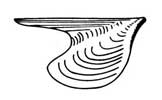 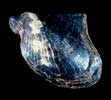
|
| PTEROPOD | A member of the group of pelagic gastropods (Pteropoda) known as "SEA BUTTERFLIES" and belonging to the orders Thecosomata and Gymnosomata; see also: HETEROPOD. | |
| PULMONATE | A member of the air-breathing subclass of gastropod molluscs, the Pulmonata. | |
| PUNCTATE |
With many pinprick-like depressions. See illustration: Composite Gastropod and Composite Bivalve. See also: PIT; QUINCUNX.
Photo: Acteon punctostriatus (C.B. Adams, 1840) |
|
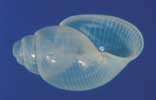 
|
| PUNCTATION | Any pattern of many minute PITS; see also: PUNCTATE. | |
| PUNCTUM (pl. PUNCTA, never PUNCTAE) |
A pinprick-like depression of the surface; see also: PIT. | |
| PUPIFORM | Shaped like members of the genus Pupilla [Pupillidae]. See other gastropod shapes. | |
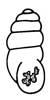
|
| PUSTULATE | Having a knobby texture, the knobs generally smaller than tubercles; PUSTULOSE; see also: MAMMILLATE; PAPILLATE; TUBERCLES. | |
| PUSTULE | A pimple-like or blister-like swelling; see also: GRANULE; PROCESS. | |
| PUSTULOSE | Full of pustules; = PUSTULATE. See illustration: Composite Gastropod. | |
| PYRAMIDAL | Having the form of a solid triangle, i.e., formed like a pyramid. | |
| PYRIFORM | Shaped like a pear. | |
| QUADRANGULAR | Having four sides and four angles. | |
| QUADRATE |
Square or rectangular in general outline; applied to the outline of shells which is formed by nearly straight lines meeting at approximately right angles; see also: HEXAGONAL; POLYGONAL; OCTOGONAL; RHOMBOID; SUBQUADRATE; TRAPEZIFORM; TRAPEZOIDAL. See other bivalve shapes. Photo: Mysella sp. undet. |
|
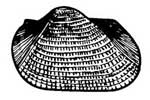 
|
| QUAHOG | The "hard shell clam" Mercenaria mercenaria. Pronounced: KO-hawg. The young clams are called LITTLENECK clams and the older (but not fully mature and huge) are called CHERRYSTONE clams. | |
| QUATERNARY | Of the fourth order, generally indicating little prominence or strength, as in sculptural elements; see also: PRIMARY; SECONDARY; TERTIARY. | |
| QUEEN CONCH | A strombid gastropod, Strombus gigas. See also: ROLLER. | |
| QUENSTEDT MUSCLE | Small muscle of unknown function represented by scar below LIGAMENT area in Ostreidae. | |
| QUINCUNX | An arrangement of 5 objects (such as dots, or pits) in a square or rectangle, one at each corner and one in the middle (pronounced: kwin' kungks); such arrangements of pits are often found in the Polyplacophora or CHITONS. | |
| RACHIDIAN TOOTH | The central tooth of a RADULA; see also: RADULA FORMULA. | |
| RACHIGLOSSATE | See: STENOGLOSSATE | |
| RACHIS | The stem or main shaft of the PEN of a SQUID. See also: VANE. | |
| RADIAL | Arranged in a ray-like pattern; characterized by divergence from a center; = RADIATING. | |
| RADIAL AREAS | In CHITONS (the Polyplacophora), the terminal areas plus lateral areas of the MEDIAN VALVES (which show radiating sculpture). | |
| RADIAL CORD | [need definition]. See illustration: Composite Bivalve. | |
| RADICATED | Attached, and as if it were rooted by means of a fibrous BYSSUS; see also: ATTACHED. | |
| RADIOLITID | [need definition]. | |
| RADULA (pl. RADULAE) |
A ribbon which supports rows of chitinous teeth; this characteristic is found only in molluscs; see also:
ASCUS SAC;
CUSPIDOBLAST;
ODONTOPHORE;
RADULA FORMULA;
UNISERIATE. Mikkelsen, P.S. 1985. A rapid method for slide mounting of minute radulae, with a bibliography of radula mounting techniques. Nautilus 99(2-3):62-65. [request a reprint! or download a copy] |
|
| RADULA FORMULA |
A series of numbers indicating the number of MARGINAL TEETH, LATERAL TEETH and the RACHIDIAN TOOTH, and (again) the lateral teeth and marginals. Example: a formula of 3+6+R+6+3 indicates 3 marginal teeth, 6 lateral teeth and 1 rachidian (R) tooth. The radula formula may be simply "1" if the radula is UNISERIATE, having only rachidian teeth. See also: DOCOGLOSSATE; STENOGLOSSATE; RHIPIDOOGLOSSATE; TAENIOGLOSSATE; TOXOGLOSSATE. See the excellent illustrations on Wikipedia. |
|
| RADULA RIBBON | The flexible structure in which the radular teeth are embedded; see also: RADULA. | |
| RAMOSE (=RAMOUS) |
Having projecting parts or branches. See also: BIRAMOSE; TRIRAMOSE. | |
| RAMP, SUTURAL | [need definition]. See illustration: Composite Gastropod. | |
| RAMUS (pl. RAMI) |
A branch or leaf-like process, generally borne distally on a SPINE. | |
| RANGE | The geographic limits within which a species lives. | |
| RAPHITOMA BICOLOR | [need definition]. | |
| RAZOR CLAM (=RAZOR SHELL) |
Common name applied to the ELONGATE bivalve shells of the genus Solen. Photo: Solen viridis Say, 1821 |
|
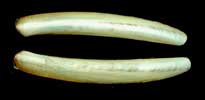
|
| RECENT | The present geologic epoch (the word Recent is usually capitalized when used in this manner). | |
| RECESSED | Situated within a cavity, as within the APERTURE; opposite of PROTUBERANT. | |
| RECTILINEAR | In a straight line; see also: LINEAR. | |
| RECURVED | Curved or bent backward; when used in reference to symmetrical CONICAL univalves, signifies that the apex is turned towards the posterior margin (as in Emarginula spp.); see also: DEFLEXED; REFLECTED; REFLEXED. | |
| REFLECTED | Bent backwards; reflexed; see also: INFLECTED; RECURVED; DEFLEXED; REFLEXED. | |
| REFLEXED | [need definition]. See also: DEFLEXED; RECURVED. | |
| REMOTE | Distant from the point of reference; used in reference to LATERAL HINGE TEETH which are placed at a distance from the cardinal teeth; see also: DISTAL. | |
| RENIFORM | Shaped like a kidney (e.g., the aperture of Ampullaria spp.). | |
| REPENT | Descriptive of shells which, being ATTACHED by the whole length of their shell, give the appearance of creeping or crawling. | |
| RESILIAL PIT | One of a series of small pits in line below the RESILIUM. These occur in three genera: Mytilus, Mytella and Perna. | |
| RESILIAL RIDGE | The point of attachment of the LIGAMENT. See also: RESILIUM. | |
| RESILIFER or RESILIIFER |
The socket-like structure (fossette or CHONDROPHORE, depending on shape) that supports the INTERNAL LIGAMENT in certain bivalves. See also: BOURRELET. | |
| RESILIUM | An internal ligament, irrespective of composition ("cartilage" of earlier authors), in a resilifer and under compressional stress; see also: LITHODESMA; RESILIFER; RESILIAL PIT; RESILIAL RIDGE; TENSILIUM. | |
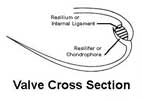
|
| RESORBED | Dissolved and removed from a solid structure, as in the removal of a portion of the shell's surface in order to permit further growth of the shell after a resting stage (marked in the Muricidae by a VARIX). | |
| RESPIRATORY PORE | See: PNEUMOSTOME. | |
| RESTING STAGE | A stage between periods of active growth, marked in the shell by the formation of a varix. | |
| RETICULATE |
Netted; covered with a network. See illustration: Composite Bivalve. See also: CANCELLATE. Photo: Cancellaria reticulata (Linne, 1767) |
|
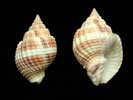
|
| RETRACTED | In gastropods, the state of the animal being withdrawn into its shell; also the condition of its TENTACLES being withdrawn or (in NUDIBRANCHS) a BRANCHIAL PLUME being withdrawn. In bivalves, the condition of the clam having its FOOT and/or SIPHONS withdrawn. See also: EXTENDED. | |
| RETRACTILE | Capable of reducing length by inverting like a glove when the fingers are withdrawn; see also: CONTRACTILE; INVERSIBLE. | |
| RETRACTOR MUSCLE | [need definition]; see also: ADDUCTOR MUSCLE. | |
| REVERSED SHELL | See: SINISTRAL. | |
| REVOLVING | Of cords or grooves on a snail shell, turning with whorls, or spirally. . | |
| RHACHIDIAN | See: RACHIDIAN. | |
| RHINOPHORE | One of a pair of olfactory tentacles in the true NUDIBRANCH and shelled OPISTHOBRANCHS which replaces the lost OSPHRADIUM; in gastropods, the posterior pair of TENTACLE. See illustration: Composite Nudibranch. | |
| RHIPIDOGLOSSATE |
A type of
RADULA with the
RADULA FORMULA consisting of a
RACHIDIAN TOOTH, with 3 or more
MARGINAL teeth and numerous
LATERAL teeth. Pilsbry, H.A. 1889. The radula in rhipidoglossate molluscs. Proc. Acad. Nat. Sci. Phila. 41:136-137. |
|
| RHOMBOID | Roughly diamond-shaped, with 4 equal sides and no right-angled corners; see also: QUADRATE. | |
| RHYNCHOTEUTHIS | A LARVAL stage of the CEPHALOPOD family Ommastrephidae (a taxonomic group of SQUID). | |
| RHYTHMICAL SEXUALITY | A type of PROTANDRY in which there is a regular return to the male phase after the eggs are laid. | |
| RIB, AXIAL | [need definition]. See illustration: Composite Gastropod. See also: SCLEROCHRONOLOGY; VARIX. | |
| RIB, CONCENTRIC | A RIB that follows COLLABRAL LINES. See illustration: Composite Bivalve. | |
| RIB, DIRECTIVE | A rib, forming a part of surface ornament of a shell, that lies entirely within a single plane; see also: DIRECTIVE SPIRAL. | |
| RIB, DIRECTIVE | A RIB, forming part of surface ORNAMENTATION of shell, that lies entirely within a single plane. | |
| RIB, LABIAL | A varix; a thickened or extensive AXIAL RIB. | |
| RIB, LONGITUDINAL | [need definition]. See illustration: Composite Gastropod. | |
| RIB, RADIAL |
A RIB emanating outward from a central point of origin, usually along with other ribs. See illustration: Composite Bivalve. Photo: Anadara ovalis (Bruguiere,1789) |
|
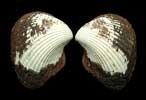
|
| RIB | A raised, elongate structural element, generally axially oriented; see also: RIB, (types); RIB-STRIAE; RIBLET; RIPPLED; STRIAE; VARIX. | |
| RIBBED | Having RIBS. | |
| RIBLET | A minor rib; see also: STRIAE. | |
| RIBLET, PRIMARY | On shell with riblets of different orders of strength, the riblet that appears early in ontogeny and remains longer than those appearing later; see also: RIBLET, SECONDARY. | |
| RIBLET, SECONDARY | On shell with riblets of different orders of strength, the riblet that appears somewhat later in ONTOGENY than primary riblets and remains weaker than these; see also: RIBLET, PRIMARY. | |
| RIB-STRIAE | Transverse undulations of the shell surface which are more prominent than STRIAE but less prominent than RIBS; see also: STRIAE; RIB; RIBLET. | |
| RIDGE | [need definition]. | |
| RIGHT HANDED | Same as DEXTRAL. | |
| RIGHT VALVE (abbrev: RV) |
That valve of a bivalve lying on the observer's right-hand side when the shell is placed with anterior end pointing away from the observer, and with COMMISSURE vertical, the hinge being uppermost; see also: LEFT VALVE. Visit Let's Talk Seashells for how to distinguish between right and left valves. | |
| RIGICLAUDENT |
A type of OPERCULUM that does not flex upon retraction.
See also: FLEXICLAUDENT. See the 1998 article by Checa and Jiménez-Jiménez: Constructional morphology, origin, and evolution of the gastropod operculum.. |
|
| RIPPLED | Finely and indistinctly RIBBED. | |
| ROBUST | Strong in structure; prominently formed; opposite of WEAK. | |
| ROLLER |
Common name for a JUVENILE specimen of the Queen Conch, Strombus gigas; without the flared outer lip of a mature specimen, the shell has a greater tendency to roll in strong currents. Photo: Strombus gigas Linne, 1758 |
|
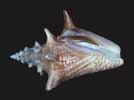
|
| ROSTRATE | Having a beak-like projection (as in a long, straight SIPHONAL CANAL, e.g. Cuspidaria spp.); = NUCULANIFORM; see also: BEAK. See other bivalve shapes. | |
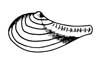
|
| ROSTROCONCH | A member of the molluscan class Rostroconchia, a group of extinct (from the Paleozoic era) molluscs with pseudo-BIVALVED shells, as adults; probable ancestors of BIVALVES. See the Paleos website for definition, references, images, and systematics. | |
| ROSTRUM | [need definition]. | |
| ROTUND | Approximately circular or globular. | |
| ROUNDED | Having an evenly curved periphery; not angulate or CARINATE; see also: WHORL, ROUNDED. | |
| RUDIST | An extinct group of marine HETERODONT bivalves. For a detailed definition, see Wikipedia. | |
| RUFFLED | Having many erect LAMELLAE, like a ruff. | |
| RUFOSE | Reddish or reddish-brown colored; = RUFOUS. | |
| RUGA (pl. RUGAE) |
An irregular fold in the surface SCULPTURE. | |
| RUGOSE | Full of wrinkles or ripples; see also: WRINKLED. | |
| RV | Abbreviation for "RIGHT VALVE" of a bivalve shell. See also: LV. | |
| SACOGLOSSAN | Old, outdated term for ASCOGLOSSAN. | |
| SAGITTAL | Anteroposteriorly directed plane of symmetry of shell and soft parts. | |
| SAND COLLAR | The egg mass of the MOON SNAIL. A circular ring, with a larger diameter at the base, of ribbonlike material composed of hardened mucous, sand and egg capsules of the Moon Snail. | |
| SARCOBELUM | In some slugs, the dart sac is lost as such, and is converted into an exertile stimulating organ, the sarcobelum; see also: DART SAC. | |
| SCABROUS | Rough; covered with minute points, DENTICLES, or SCALES. | |
| SCABROUS LAMELLAE | Thin LAMELLAE having scale-like projections at their intersections with spiral cords. | |
| SCALARIFORM | Loosely coiled; see also: TIGHTLY COILED. | |
| SCALE | Thin, erect, plate-like structures; a localized, thin and flat projection of the outer layer of shell, commonly situated on a COSTA; see also: IMBRICATE; SQUAMOUS; VAULTED SCALE. | |
| SCALE | [need definition]. In CHITONS… See illustration: Composite Chiton. | |
| SCALLOP | Bivalves of the family Pectinidae and (Glass Scallops) Propeamussiidae; See also: PECTINITE. See Henk Dijkstra's website on Scallops. | |
| SCALLOPED | Edged with rounded projections. | |
| SCAPHOCONCHA | The secondary shell of the ECHINOSPIRA larva. See also: VELICONCH. | |
| SCAPHOPOD | A member of the class Scaphopoda, a group of molluscs made up of [need definition]. Also commonly called a TUSK SHELL. See also: CAPTACULA. See illustration at UCMP. | |
| SCAR, MUSCLE | See: MUSCLE SCAR. | |
| SCHIZODONT | Descriptive of an ACTINODONT bivalve HINGE of which the individual teeth have DENTICULATED edges, with one tooth (median of LV) broad and bifid; see also: ACTINODONT; DENTITION. | |
| SCIENTIFIC NAME | The Latin BINOMIAL name applied to SPECIES, comprised of the GENUS and SPECIES name legally proposed according to the rules of the ICZN. See also: COMMON NAME. | |
| SCISSULATE | Diagonal sculpture across a shell. See also: DIVARICATE. | |
| SCISSULATIONS | The wavy sculptural lines on many shells, such as the tellins. | |
| SCLEROCHRONOLOGY |
The study of the formation and interpretation of growth increments in accretionary hard parts of invertebrate and vertebrate organisms as well as coralline red algae. See also:
GROWTH RING
VARIX. See also: 1st International Sclerochronology Conference, St. Petersburg, Florida USA; July 17-21, 2007. 2nd International Sclerochronology Conference, Mainz, Germany; July 24-28, 2010. 3rd International Sclerochronology Conference, Caernarfon, North Wales, UK; May 18-22, 2013. |
|
| SCROBICULATE | Having small ditches or FURROWS marked on the surface; see also SULCATE. | |
| SCULPTURE | The morphological elements of shell structure and ORNAMENTATION; see also: AXIAL SCULPTURE; CONCENTRIC SCULPTURE; CORSELET; MACROSCULPTURE; MICROSCULPTURE; PROSOPON; QUINCUNX; SCALE; SMOOTH. | |
| SEA BUTTERFLY | Members of the PLANKTONIC group of molluscs known as PTEROPODS; see also: HETEROPOD. | |
| SEA HARE | Members of the suborder Aplysiomorpha (Opisthobranchia). | |
| SEA SLUG | A NUDIBRANCH or an ASCOGLOSSAN. See also: SLUG. | |
| SEA SNAIL PURPLE SEA SNAIL |
Snails of the genus Janthina which float in the open sea as part of the PLANKTON. Their purple shell color is acquired from their food source, siphonophores such as the Portuguese Man of War, Physalia physalis, the By-The-Wind Sailor, Velella vella, and Blue Buttons, Porpita porpita. | |
| SEALED | Closed; said of the siphonal canal, anal tubes, or spines; see also: COALESCED; SEAM. | |
| SEAM | A closure line, along which two surfaces are fused; see also: SEALED. | |
| SECONDARY | Less than primary in strength; second order; see also: PRIMARY; TERTIARY; QUATERNARY. | |
| SECONDARY HOMONYM | A homonym that results from one SPECIES being placed into a GENUS where the species name is in use for a different species. The older of the two names is the senior secondary homonym. See also: HOMONYM; PRIMARY HOMONYM; HOMONYMY. | |
| SECURIFORM | Hatchet-shaped. | |
| SEDENTARY | Staying in one place; see also: NESTLER; SESSILE. | |
| SELENIZONE | The spiral band of crescentic growth lines generated by a NOTCH or narrow slit in the Archaeogastropods; a slit band (e.g., the slit of the "SLIT SHELLS" such as Pleurotomaria spp.; Bayerotrochus spp.). | |
| SEMICORDATE | Half heart-shaped; see also: CORDATE; CORDIFORM. | |
| SEMIDISCOIDAL | Forming half of a circular disk; see also: DISCOIDAL. | |
| SEMILUNATE | Half moon-shaped; see also: LUNATE. | |
| SENSU LATO (abbrev: SL or S.L.) |
In the broad sense (used with respect to taxonomic categories); e.g., Strombus sensu lato = all subgenera in the genus Strombus; see also: SENSU STRICTO. | |
| SENSU STRICTO (abbrev: SS or S.S.) |
In the strict sense (used with respect to taxonomic categories); In the restricted sense (e.g., Strombus, sensu stricto = the subgenus Strombus itself and not any of the other subgenera in the genus Strombus) = Strombus Strombus spp.; see also: SENSU LATO. | |
| SEPTIBRANCH | [need definition]. | |
| SEPTUM | A deck-like shelly process in the anterior end of some bivalves. | |
| SERRATE | Finely notched or saw-like at the edge; see also: DENTICULATE. | |
| SERRATION | A single tooth in a NOTCHED edge. | |
| SESSILE | Living attached (usually permanently) to a substrate; see also: NESTLER; SEDENTARY | |
| SETIFEROUS | Hairy; see also HIRSUTE. | |
| SHELF | A flattened surface, as on the upper portion of a PLAIT or CARINA. The DECK of a Crepidula shell. | |
| SHELL | The CALCAREOUS structure secreted by the molluscan MANTLE. Most mollusks have external shells, some have internal shells, and others (as adults) have no shell; = TEST. | |
| SHELL CLUB | An organized group of individuals, amateur and professional, interested in the phylum Mollusca. Although the name implies only shells (of marine, freshwater, terrestrial, arboreal, marine and fresh water molluscs), club members often have broader interests to include those molluscs without shells as adults (e.g., nudibranchs, ascoglossans, cephalopods, aplacophorans). Typically, regular meetings are held, presentations are made, and field trips organized; often, a newsletter and/or website is published. A list of shell clubs (and related organizations) is maintained on the Conchologists of America (COA) website. See also: MALACOLOGICAL SOCIETY. | |
| SHELL COLLECTION | An accumulation of molluscan shells. This collection can vary from a basket of shells to a massive amount of shells, all of which are (typically) cataloged with a taxonomic name and (more importantly) collection data. Professional collections are maintained at a variety of museums, for example the United States National Museum (USNM), Philadelphia Academy of Natural Sciences (ANS), etc. Many "shell collections" are better classified as mollusc collections because they contain the preserved shelless molluscs as well. Often the professional collections are repository sites for TYPE SPECIMENS. Some "shell" collections (or sub-collections) may be entirely of a variety of OPERCULA. | |
| SHELL GLAND | The gland that secretes the shell for the PRODISSOCONCH I. | |
| SHELL SHOW | An event, usually hosted by a SHELL CLUB, where many people display ("show") their shells (a portion of their SHELL COLLECTION) to the public. The displays usually are submitted in various categories (e.g., scientific, MINIATURES, art, one family, one species, etc.) for judging by selected experts. Ribbons, plaques, trophies, etc. are awarded to selected displays. A list of shell shows (and related events) is posted on the COA website. | |
| SHELLFISH | A culinary term referring to edible shelled molluscs (as well as some crustaceans and echinoderms), including (but not limited to): MUSSELS, QUAHOGS, SCALLOPS, and PERIWINKLES. | |
| SHELLFISH LISTSERV |
A mailing list on a LISTSERV hosted by the National Shellfisheries Association (NSA). "The purpose of the Forum e-mail list is to promote open exchange of ideas among those working with or interested in any aspect of shellfisheries - research, management, regulation, commercial production, etc." Another "SHELLFISH" mailing list is provided by the Washington State Department of Health as a service to the shellfish industry and partner agencies and organizations who are involved in commercial shellfish harvest management. See also: CONCH-L; GASTROPODNET; MOLLUSCAlist; STROMBUS-L. See the compilation of information about Molluscan Listserves. |
|
| SHELLY | Composed of CALCIUM CARBONATE; CALCAREOUS; with a PORCELANEOUS rather than a HORNY texture; = TESTACEOUS. | |
| SHIELD, PARIETAL | [need definition]. See illustration: Composite Gastropod. | |
| SHIPWORM |
Bivalves of the genera Teredo and Bankia which, in addition to wharf pilings and other wood, bore into ships with wooden hulls, often in great numbers and impacting the integrity of the wood to the point of destroying the ships (sometimes while at sea!); see also: BORING BIVALVE; TEREDINIFORM. Illustration: Teredo sp. (left = entire animal; center = PALLETS; right = shell) |
|
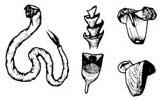
|
| SHOULDER | The portion of each whorl of a gastropod shell lying between the SUTURE and the angle, periphery, or SHOULDER margin. See illustration: Composite Gastropod. | |
| SHOULDER MARGIN | The periphery or outermost edge of a WHORL. | |
| SHOULDER SPINE | A spine at or above the SHOULDER margin. | |
| SHOULDERED | Having an angulation of the whorl at its periphery or outermost edge, even if this is indefinite, as in the case of a CONVEX profile. | |
| SICKLE-SHAPED | Strongly curved in a single arc. | |
| SIMPLE | Single, entire, uninterrupted or undivided; see also: CONTINUOUS; HOLOSTOMATE. | |
| SINISTRAL |
In gastropods, the direction of coiling in which, with the shell held upright (apex at the top), the APERTURAL opening is at the left; and in which, with the shell viewed from above the APEX, the coiling proceeds from the apex in a counterclockwise direction; = LEFT HANDED; opposite of DEXTRAL; See also:
ACHIRAL;
CHIRALITY;
HETEROSTROPHY;
ENANTIOMORPH;.
See other gastropod shapes. Illustration: Physella sp.; Photo: Busycon contrarium (Conrad, 1840) See: Sinistral Shells - by design or accident |
|
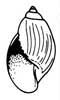 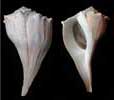
|
| SINOPALLIATE | The condition. in bivalves, of having a PALLIAL SINUS; see also: INTEGROPALLIATE. | |
| SINUATE | Curved; excavated. | |
| SINUOUS | Winding. | |
| SINUPALLIATE | See: SINOPALLIATE. | |
| SINUS | A bend or embayment, either in growth lines or in the attachment scar of the MANTLE; PALLIAL SINUS. | |
| SIPHON | A tubular fold of MANTLE tissue, for the passage of water currents, whether INHALENT or EXHALENT in BIVALVES. In SQUID, this is an organ of propulsion. | |
| SIPHONAL AREA | Posterior sector of surface of shell, commonly demarcated anteriorly by an UMBONAL ridge; secreted where mantle edge has openings or is produced to form SIPHONS for passage of respiratory currents. | |
| SIPHONAL BAND | Longitudinal band (one of two) on the surface of some RUDISTS (mainly RADIOLITID) differing in ornament from the rest of the surface and thought by some to have been secreted at part of MANTLE EDGE where respiratory current entered or left the shell. | |
| SIPHONAL CANAL | A complete or incomplete tubular shell extension through which the anterior SIPHON is extended; if protruded, this is called a ROSTRUM; = CAUDAL CANAL; = ANTERIOR CANAL. See illustration: Composite Gastropod. See also: BASAL FOLD; SPOUT. | |
| SIPHONAL FASCIOLE | A ridge formed on the SIPHONAL CANAL, sometimes bearing remnants of previous canals. See illustration: Composite Gastropod. | |
| SIPHONAL NOTCH | [need definition]... See also: SIPHONOSTOMATE. | |
| SIPHONAL RETRACTOR MUSCLE | Muscles serving to withdraw SIPHONS partly or wholly within shell. | |
| SIPHONAL SCAR | The opening or winding sinus in the PALLIAL impression of a bivalve shell, in the place where the animal's siphonal tube passes. | |
| SIPHONAL SINUS | [need definition]; see also: BASAL FASCIOLE. | |
| SIPHONOPLAX | One of the shelly ACCESSORY PLATES in the Pholadacea; a tubular secondary CALCAREOUS structure forming a posterior extension of the shell in some Pholadidae and protecting the proximal end of the SIPHONS; see also: HYPOPLAX; MESOPLAX; METAPLAX. | |
| SIPHONOSTOMATE | Descriptive of a shell with a discontinuous PERISTOME, interrupted anteriorly by a sinus that may be prolonged into a shell siphon, called the SIPHONAL NOTCH or canal; = SIPHONOSTOMATOUS; see also: HOLOSTOMATE. | |
| SIPHONOSTOMATOUS | See: SIPHONOSTOMATE. | |
| SIPHUNCLE |
In CEPHALOPODS, the delicate, hose-like extension from the VISCERAL MASS that runs through all the chambers of the shell in Nautilus and Spirula; a small SIPHON; see also: PHRAGMOCONE.
See the excellent "Cephalopod Glossary" by Richard E. Young, Michael Vecchione, and Katharina M. Mangold. |
|
| SLIPPER SHELL | Gastropods of the genus Crepidula where the underside of the shell has the appearance of a slipper. See also: DECK; DIAPHRAGM. | |
|
|
| SLIPPER-SHAPED | Resembling a person's slipper, e.g., when viewing an upside-down shell of the genus Crepidula, with the DECK of the shell forming the upper part of the slipper. See other gastropod shapes. | |

|
| SLIT BAND | See: SELENIZONE. | |
| SLIT SHELL | A SNAIL of the family Pleurotomariidae. These snails have a slit called a SELENIZONE. | |
| SLOPE, SUTURAL | [need definition]. See illustration: Composite Gastropod. | |
| SLUG | A common designation for a SNAIL without an external shell; the shell is either rudimentary and enclosed in the MANTLE, or wanting entirely; see also: SLUG, SEA. | |
| SMOOTH | Not rough; lacking SCULPTURE. See illustration: Composite Bivalve. See also: MALLEATE | |
| SNAIL | Common term for a GASTROPOD. See also some common names for various types of snails: ABALONE; AUGER; CARRIER SHELL; ESCARGOT; LIMPET; MOON SNAIL; NUDIBRANCH; PERIWINKLE; SEA BUTTERFLY; SLIT SHELL; SLUG; SEA SNAIL; SEA SLUG. | |
| SNAIL FUR |
Common term for ORNAMENTATION in which epibionts (e.g., Hydractinea spp.) are attached to and cover gastropod shells. See: Epibiotic on Ilynanassa trivittata, Hydractinia echinata - Snail Fur |
|
| SOCKET | In bivalves, a recess for the reception of a HINGE TOOTH from the opposite VALVE. | |
| SOLENOGASTER | Common name for a member of the molluscan class Aplacophora. | |
| SOLID | Strong, thick, or sturdy; see also: STOUT. | |
| SPADIX | A HECTOCOTYLISED special portion of the TENTACLE crown of Nautilus, involving four TENTACLES of one of the lobes of the right side; this forms a sleeved projection with a glandular tip; see also: HECTOCOTYLUS. | |
| SPAT | The settled, newly-attached to the substrate LARVAE of OYSTERS (the Ostreidae), usually, but can refer to that of any bivalve. The spat metamorphose to form a juvenile clam, which matures attached to the substrate at that location for the rest of its life. | |
| SPATHATE | [need definition]; (see description of Aequipecten glyptus in: Abbott, 1974.) | |
| SPECIES | [need definition]; see also: SUBSPECIES; DIAGNOSIS. | |
| SPECIES NOVUM (abbrev: SP. NOV.; SPEC. NOV.) |
A new SPECIES; Used in publication the first time (and first time only!) that a new BINOMEN is presented; e.g. "Acteocina atrata, spec. nov." as published in The Veliger 27(2):164-192. See also: GENUS NOVUM | |
| SPECIMEN | [need definition]. | |
| SPERM | [need definition]; see also: EUPYRENIC; OLIGOPYRENIC; SPERMATOPHORE. | |
| SPERMATHECA | [need definition]. | |
| SPERMATOPHORE | A CHITINOUS envelope which encloses SPERM, and is secreted by the male duct in the FLAGELLUM, a tubular outgrowth of the PENIS; see also: CEMENT BODY. | |
| SPICULE | One of the small, slender, pointed, hard bodies in the integument, which serves as stiffening. Spicules may be prominent in the GIRDLE of CHITONS. See illustration: Composite Chiton. | |
| SPINATION | The total complement of spines; the spine pattern. | |
| SPINDLE-SHAPED |
Round; tapering toward each end; FUSIFORM. See other gastropod shapes. Photo: Triplofusus giganteus (Kiener, 1840) |
|
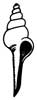 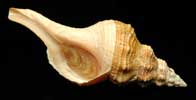
|
| SPINE | A more or less slender and elongate projection of a shell, either tapering to a point or spreading out distally into fronds or FOLIATIONS. See illustration: Composite Gastropod and Composite Bivalve. See also: SPINELET; SPLIT SPINE. | |
| SPINE-TUBE | A tapering SPINE having a hollow interior. | |
| SPINIFEROUS | Bearing many spines; = SPINOUS. | |
| SPINOUS | Bearing many spines; = SPINIFEROUS; see also: ACULEATE; MURICATED. | |
| SPIRAL | Revolving, as lines going in the direction of the turning of the WHORLS; see also: LOGARITHMIC SPIRAL; SUBSPIRAL. | |
| SPIRAL CORD | [need definition]. See illustration: Composite Gastropod. | |
| SPIRAL GROOVE |
A GROOVE that encircles the spire of a shell. Revolving grooves going in the direction of the turning of the whorls. Photo by Marlo F. Krisberg; Echinolittorina riisei (Mörch, 1876). |
|
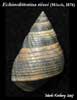
|
| SPIRAL SCULPTURE | Sculpture following the HELICAL growth of the gastropod shell. | |
| SPIRALLY COILED | See: HELICAL. See also: IRREGULARLY COILED; LOOSELY COILED; TIGHTLY COILED. | |
| SPIRE | [need definition]. | |
| SPIRE ANGLE | The angle at which the whorls of a spire increase in size. See illustration: Composite Gastropod. | |
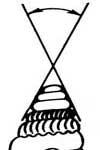
|
| SPIRE WHORL | One turn (360 degrees) of the spire, exclusive of the BODY WHORL. | |
| SPIRE, INVOLUTE | The condition of having the POSTNUCLEAR WHORLS higher than, and enveloped by the NUCLEAR WHORLS; see also: SPIRE, SUNKEN. | |
| SPIRE, SUNKEN | The condition of having the POSTNUCLEAR WHORLS higher than the spire, or NUCLEAR WHORLS (the nuclear whorls are not hidden from view, as with an involute spire); see also: SPIRE, INVOLUTE. | |
| SPIRE | The cone of whorls produced, by the downward growth from the APEX, of shelled, non-symmetrical gastropods, including all whorls above the aperture. See illustration: Composite Gastropod. See also: SPIRE ANGLE. | |
| SPIROGYRATE | Coiled outward from the SAGGITAL plane; term applied to the UMBONES of bivalves; see also: OPISTHOGYRATE; ORTHOGYRATE. | |
| SPLANCHNIC GANGLION | That portion of the CEPHALOPOD nervous system which is responsible for the well-integrated rhythms of the complicated stomach and DIGESTIVE GLAND. | |
| SPLIT SPINE | A SPINE with incurled, but not fused margins. | |
| SPLITTER | In taxonomy, one who recognizes more species because they believe that differences between two or more PHENOTYPES are species specific and that they all should be treated as more than one species. See also: LUMPER. | |
| SPLITTING | Opposite of LUMPING, i.e., the perception of a multiplicity of forms and the acceptance of them as discrete entities, while others may consider the same group as one entity. | |
| SPOUT | An elongated, tube-like canal structure. | |
| SQUAMOUS | Scaly; with the appearance of being scaly; see also: IMBRICATE. | |
| SQUARE-SHAPED | See: QUADRATE. | |
| SQUID |
[need definition]. A CEPHALOPOD… see also: GIANT SQUID.
See the detailed web page on squid terminology, from the excellent "Cephalopod Glossary" by Richard E. Young, Michael Vecchione, and Katharina M. Mangold. |
|
| STEAMER | A clam, Mya arenaria favored in the northeastern USA for being steamed and eaten; see also: CHERRYSTONE; LITTLENECK; QUOHOG. | |
| STEINKERN | An ENDOCAST. | |
| STENOGLOSSATE | "Close-toothed" or "narrow-tongued"; pertaining to the Stenoglossa, in which the Muricidae are included; = rachiglossate. The columbellid radula is considered representative of the stenoglossate type of RADULA FORMULA: (see: J. Moll. Stud. (1977), 63:65-67.) | |
| STEREOGLOSSATE | See: DOCOGLOSSATE | |
| STOUT | Sturdy, solid, or bulky; see also: SOLID. | |
| STREPTONEUROUS | The condition in PROSOBRANCH gastropods of having the mantle cavity and contained organs located anteriorly; see also: EUTHYNEUROUS. | |
| STRIA (pl. STRIAE) |
Very narrowly INCISED shallow groove (Cox, 1960); this term especially used to refer to one of a series of parallel or concentric grooves (= striae); see also: LIRA; GROOVE; RIB-STRIAE; RIB. | |
| STRIA, AXIAL | [need definition]. See illustration: Composite Gastropod. | |
| STRIA, RADIAL | A STRIA emanating outward from a central point of origin, usually along with other striae. See illustration: Composite Bivalve. | |
| STRIA, SPIRAL | [need definition]. See also: CORD. See illustration: Composite Gastropod. | |
| STRIATE | Marked with fine parallel GROOVES, scratched, or slightly raised lines or STRIAE; see also: VERMICULATION. | |
| STRIATION | A single line or scratch; a STRIA; a pattern of striae. | |
| STRIGA | A transverse band of color (pl=STRIGAE). See also: STRIGATE . | |
| STRIGATE | Having STRIGAE, or transverse bands of color (i.e., STRIGATIONS). | |
| STROMBIFORM | See: STROMBOID. | |
| STROMBOID |
Shaped like some members of the genus Strombus. = STROMBIFORM. See other gastropod shapes.
Photo: Strombus raninus Gmelin, 1791 |
|
 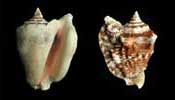
|
| STROMBOID NOTCH |
A sinuation in the outer lip of shells of the family Strombidae, or a similar situation in other gastropod shells; see also: TURRID NOTCH. Photo: Strombus raninus Gmelin, 1791 For another labelled photo, see the site: Seashells of New South Wales |
|
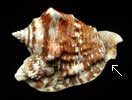
|
| STROMBUS-L LISTSERV |
A mailing list on a LISTSERV which is hosted by the Gulf and Caribbean Fisheries Institute (GCFI) and is dedicated to "Queen conch fisheries, management, conservation, aquaculture, restoration".
See also: CONCH-L; GASTROPODNET; MOLLUSCAlist; SHELLFISH. See the compilation of information about Molluscan Listserves. |
|
| STRUT | A SCULPTURAL element lending strength or stiffness to the whole structure. | |
| STUMP | A stub; a small remnant of a structure. | |
| STYLE | See: CRYSTALLINE STYLE; PROTOSTYLE. | |
| STYLE SAC | That part of the intestine in which the PROTOSTYLE rotates. | |
| SUB | A prefix indicating less than, below, or almost. | |
| SUBACUTE | Only moderately ACUTE. | |
| SUBANGULATE | Weakly angled; OBTUSE. | |
| SUBCENTRAL | Nearly central; slightly off center; see also: CENTRAL. | |
| SUBDUED | Weak; not evident. | |
| SUBELLIPTICAL | [need definition]. See other bivalve shapes. | |
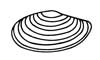
|
| SUBEQUILATERAL | Applied to bivalve shells which are nearly equal in size; see also: EQUILATERAL; INEQUILATERAL; INEQUIVALVE. | |
| SUBJECTIVE SYNONYMY | A name representing, in the author's opinion, the same entity as that represented by another name; see also: SYNONYM. | |
| SUBMARGIN | One of the dorsal edges of the disk or body of a shell in the Pectinacea, adjoining the lower body of the AURICLE. | |
| SUBMICROSCOPIC | Not clearly visible under a light microscope; see also: MICROSCOPIC. | |
| SUBORBICULAR | Having a shape of a misshapen circle; see also: ORBICULAR. See other bivalve shapes. | |
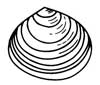
|
| SUBOVAL |
Like a circle that has been only slightly flattened; see also: OVAL; OVATE. See other bivalve shapes. |
|
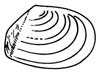
|
| SUBQUADRATE |
Not quite QUADRATE, but nearly so; see also:
SUBELLIPTICAL. See other bivalve shapes. |
|
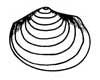
|
| SUBSEQUENT DESIGNATION | The designation of the TYPE SPECIES of a GENUS subsequent to the description of the genus. | |
| SUBSPECIES | [need definition]; see also: FORM; SPECIES; VARIETY. | |
| SUBSPIRAL | Not sufficiently SPIRAL to form a complete VOLUTION. | |
| SUBSTRATE | The surface on which an organism lives, generally underwater; = SUBSTRATUM. | |
| SUBSTRATUM | See: SUBSTRATE. | |
| SUBSUTURAL | Below the SUTURE; at the upper margin of the younger (newer) of two successive WHORLS. | |
| SUBTIDAL | Below the lowest tide line and extending generally to the edge of the continental shelf. | |
| SUBTRIGONAL |
Not quite TRIGONAL, but nearly so. See other bivalve shapes. Photo: Nucula proxima Say, 1822 |
|
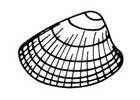 
|
| SUCKER | A suction cup on the ARMS and TENTACLES of CEPHALOPODS. See also: ACETABULUM. | |
| SUCTORIAL | Having the mouth parts modified for ingesting juices of plants or soft-bodied animals. | |
| SUFFUSED | Covered over or flushed with a tint of color. | |
| SULCATE | Having a deep slit, FISSURE, or FURROW; see also: SCROBICULATE. | |
| SULCUS (pl. SULCI) |
A deep slit, fissure, or furrow; see also: SULCUS, ANAL; SULCUS, AURICULAR. | |
| SUMMIT | Most dorsal point of profile of a VALVE (of bivalves) when the specimen is viewed along the CARDINAL AXIS or from the side with the cardinal axis horizontal. | |
| SUPERFLUOUS NAME | An unnecessary name, in most cases one applied to an entity that already has a valid name. | |
| SUPRAPEDAL GROOVE | A groove above, and running parallel to, the PEDAL GROOVE in certain snails. | |
| SUPRASUTURAL | Above the SUTURE. | |
| SURFACE SCULPTURE | The ORNAMENTATION of the exterior of a molluscan shell. | |
| SUTURAL | Referring to or associated with the SUTURE. | |
| SUTURAL SINUS | [need definition]. | |
| SUTURAL TUFT | [need definition]. In CHITONS… See illustration: Composite Chiton. | |
| SUTURE | A continuous spiral line following the junction of consecutive WHORLS in a gastropod shell; see also: SUTURE, (types). | |
| SUTURE, ADPRESSED | [need definition]; see also: SUTURE, IMPRESSED; SUTURE, CHANNELED. | |
| SUTURE, CHANNELED | [need definition]. See illustration: Composite Gastropod. See also: SUTURE, ADPRESSED; SUTURE, IMPRESSED | |
| SUTURE, CRENATE | [need definition]. See illustration: Composite Gastropod. | |
| SUTURE, CRENULATE | [need definition]. | |
| SUTURE, IMPRESSED | [need definition]; see also: SUTURE, ADPRESSED; SUTURE, CHANNELED. | |
| SUTURE, INDENTED | [need definition]. | |
| SUTURE, INDISTINCT | [need definition]. See illustration: Composite Gastropod. | |
| SUTURE, STRONGLY INDENTED | [need definition]. | |
| SWELLING | An enlargement, generally GLOBOSE. | |
| SWOLLEN | Enlarged; INFLATED; TUMID. | |
| SYMPLESIOMORPHY |
A character shared by a number of groups, but inherited from ancestors older than the last common ancestor. See also: PLESIOMORPHY. See the Paleos website for greater detail. |
|
| SYNAPOMORPHY |
An APOMORPHY shared by two or more groups which originated in their last common ancestor. See the Paleos website for greater detail. |
|
| SYNONYM | One of two or more names given to a SPECIES; customarily, the later of two different names that have been bestowed upon a single species or GENUS... technically, both are synonyms, one senior and the other junior; see also: CHRESONYMY; JUNIOR SYNONYM; SYNONYMY. . | |
| SYNONYMIZE | To state that two or more names represent the same biological entity. See also: SYNONYM. | |
| SYNONYMY | A list of the various different scientific names, regardless of validity or correctness, that have been used to designate a single biological entity. See also: CHRESONYMY; HOMONYMY; SUBJECTIVE SYNONYMY; SYNONYM. | |
| SYNTOPIC | Sharing the same HABITAT within the same geographic locality or range. | |
| SYNTYPE |
One of a number of specimens studied by the author of a species name, of which group no single SPECIMEN was designated as a HOLOTYPE.
See the publication: "Terminology of Types" by Frizzell. |
|
| SYNTYPIC | Pertaining to a SYNTYPE or syntypes. | |
| SYSTEMATICS | The discipline of biological CLASSIFICATION. One who studies systematics is a SYSTEMATIST. | |
| SYSTEMATIST | One who forms, revises, or adheres to a system of CLASSIFICATION of biological categories; one who studies SYSTEMATICS. See also: TAXONOMIST. | |
| TABULATE | Table-like; sharply angulate (approaching 90 degrees); said especially of the SHOULDER or PERIPHERY of each WHORL. | |
| TABULATION | A table-like ANGULATION. | |
| TAENIOGLOSSATE | A type of RADULA structure consisting of a central RACHIDIAN tooth, a LATERAL lateral tooth, and a pair of MARGINAL teeth (e.g., members of the Cypraeidae and Cymatiidae). This condition is referenced by the RADULA FORMULA: 2+1+R+1+2 | |
| TAIL VALVE |
The first of (typically) eight valves of a CHITON. See also: HEAD VALVE; MEDIAN VALVE. See illustration: Composite Chiton. |
|
| TANGENTIAL | Divergent, digressive; of the nature of a tangent; touching briefly and then divergent. | |
| TAPERING | Decreasing gradually in circumference; generally said of a cylindrical form or structure. | |
| TAPHONOMY | Referring to the immediate post-mortem period between death and final entombment of the skeletal remains in the sediment; see also: FOSSIL. | |
| TAUTONYMY | A situation in which the type species of a genus is designated as such by virtue of having a specific name identical to that of the newly erected generic name. | |
| TAXODONT | Having numerous short HINGE TEETH more or less similar in shape and mostly set at an angle to the HINGE MARGIN. See illustration: Composite Bivalve. See also: DENTITION; PRIONODONT; PSEUDOTAXODONT. | |
| TAXON (pl. TAXA) |
A grouping of organisms under a "common" (i.e., single) name; a unit of classification at any level, implying biological relationship. | |
| TAXONOMIST | One who studies TAXONOMY. | |
| TAXONOMY | The classification of animals or plants according to relationship; One who studies taxonomy is a TAXONOMIST. See also: SYSTEMATICS. | |
| TECTIBRANCH | Molluscs of the order Cephalaspidea, or "BUBBLE SHELLS" usually having a shell present, gills present, head with a tentacular shield, jaws feeble or none, stomach usually with GIZZARD PLATES, and with or without an OPERCULUM. | |
| TEETH |
In bivalves, the shelly protuberances on the dorsal margin of a VALVE which fit into corresponding sockets of the opposite valve. In gastropods, the RADULA. In cephalopods, see: BEAK. |
|
| TEGMENTUM | Outermost layer, with SCULPTURE and coloration, of a CHITON shell. | |
| TELEOCONCH (or TELOCONCH) |
The gastropod shell, apart from the NUCLEUS; = POSTNUCLEAR WHORLS; complement of the PROTOCONCH; see also: ADULT WHORLS. | |
| TELEODONT | With differentiated CARDINAL TOOTH and LATERAL TEETH, as in DIAGENODONT forms, but with additional elements giving rise to more complicated hinge (example: Venus); see also: DENTITION. | |
| TELUM AMORIS | The "love dart" produced by the DART SAC; it is about 5/16 of an inch long and delicately ridged, finely pointed, and calcareous; it is exchanged by the partners with some velocity before courtship, lodging in the integument and serving as a releaser stimulus for courtship behavior. | |
| TENSILIUM | The outer band of the LIGAMENT, composed of CONCHIOLIN but without lime, usually with a conchoidal fracture, it is HORNY and tensional. | |
| TENTACLE (1) | In snails: an elongate sensory structure on the heads of snails; in some groups (e.g., Stylommatophora) it bears an eye at its tip, while in others (e.g., Basommatophora) at the base; see also: CEPHALIC TENTACLE; RHINOPHORE; EYE STALK. | |
| TENTACLE (2) |
In squid, one of the 4th pair (dorsal pair = No. 1) of the 5 pair of appendages surrounding the mouth; usually longer than the "ARMS"; (the other 4 pair of appendages) and extensible; see also: HECTOCOTYLUS. See the detailed web page on tentacle terminology, from the excellent "Cephalopod Glossary" by Richard E. Young, Michael Vecchione, and Katharina M. Mangold. |
|
| TENTACLE, CEPHALIC | A tentacle on the head. In gastropods, the anterior pair of tentacles; see also: RHINOPHORE. | |
| TENTACLE, EPIPODIAL | A tentacle on the FOOT, or (in some species) arising from a continuous fold set along the side of the foot, known as the EPIPODIUM. | |
| TENTACLE, LABIAL | = ORAL TENTACLE. See illustration: Composite Nudibranch. | |
| TENTACLE, ORAL | [need definition]. In nudibranchs… ; = LABIAL TENTACLE. See illustration: Composite Nudibranch. | |
| TENTACLE, PALLIAL | A tentacle, in rissoids and some other MESOGASTROPODS, growing from the edge of the mantle skirt on the right side and occasionally also on the left. In turritellids, a whole series of pallial tentacles lies around the entrance to the MANTLE CAVITY. | |
| TENTACLES, METAPODIAL | One of two tentacular outgrowths (in the rissoids, lacunids, nassids, etc.) at the hind end of the FOOT or at the point where the OPERCULUM is attached. | |
| TENTACULAR | Referring to the TENTACLES. | |
| TENTACULAR SHIELD | [need definition]; present in the TECTIBRANCHS and CEPHALASPIDS. | |
| TEREBRATING SHELLS | Those shells which bore into rock or wood; = BORERS. | |
| TEREDINIFORM |
A shape exemplified by the SHIPWORM bivalve genus Teredo. See other bivalve shapes. Illustration: Teredo sp. (left = entire animal; center = PALLETS; right = shell) |
|
|
|
| TERMINAL AREAS | In CHITONS (the Polyplacophora), the HEAD VALVE and the radially sculptured posterior part of the TAIL VALVE. | |
| TERRESTRIAL | Pertaining to or living on land; see also: ARBOREAL; HABITAT. | |
| TERTIARY | Of the third order, generally said of sculpture; see also: PRIMARY; SECONDARY; QUARTERNARY. Also, the geological era extending from the Paleocene to the Pleistocene (about 60 million years duration). | |
| TESSELLATE | Divided into squares; see also: CANCELLATE. | |
| TEST | A CONCH. | |
| TESTACEOUS | Shelly; bearing a shell or composed of shelly material; see also: TEST. | |
| TESTE | In the testimony of; see also: AUCTT; IN LITT; PERS. COMM.. | |
| TETRABRANCH | Possessing four GILLS; that name applied to Nautilus (all other living cephalopods being DIBRANCHS); see also: BRANCH; DEMIBRANCH. | |
| TEUTHOLOGIST | A specialist in the study of CEPHALOPODS; see also: CONCHOLOGIST; MALACOLOLOGIST. | |
| TEUTHOLOGY | The study of CEPHALOPODS; see also: CONCHOLOGY; MALACOLOGY. | |
| THECOSOMATA | The shelled PTEROPODS, generally held to be derived from bulloids... foot reduced, but the epipodia greatly expanded and used for swimming, gizzard armed with 4 plates, jaws and a small triserial radula present, only one genus (Peraclis) has a true gill, penis unarmed, all have CALCAREOUS shells, except for the Cymbulidae which have a TRANSPARENT PSEUDOCONCH; see also: GYMNOSOMATA. | |
| THICKNESS | Used by some authors to denote the shell measurement termed INFLATION, but also commonly applied to the distance between the inner and outer surfaces of the wall of a shell. | |
| THREAD | A very fine spiral sculptural element of a shell; see also: LIRA. | |
| THREAD, SPIRAL | [need definition]. See illustration: Composite Gastropod. | |
| THREADED | SCULPTURED with many very fine spiral lines. | |
| TIGHTLY COILED | Having many, narrowly expanding WHORLS; see also: LOOSELY COILED; IRREGULARLY COILED; SPIRALLY COILED. See other gastropod shapes. | |
| TOOTH | A spur-like projection on the margin of a shell structure, more especially, an element of RADULAR dentition (in gastropods) or HINGE dentition (bivalves); see also: PARIETAL TOOTH; PALATAL TOOTH; TEETH. | |
| TOPOTYPE |
A specimen collected from the TYPE LOCALITY. See the publication: "Terminology of Types" by Frizzell. |
|
| TORSION | The displacement of the MANTLE-and-shell from the enclosed VISCERAL MASS, rotating by growth stages in a flat or extended helix, and accompanied by the cessation of development of one-half of many of the paired organs in the soft parts; see also: DETORSION; GARSTANG'S THEORY. | |
| TOXOGLOSSATE | A type of UNISERIATE RADULA, characteristic of the Conidae, resembling a harpoon tip and delivering a powerful venom (CONOTOXIN ). See also: RADULA FORMULA. | |
| TRAILING EDGE | The hind portion of a structure, behind the leading edge; see also: LEADING EDGE. | |
| TRANSLUCENT | Allowing light to pass through, but not undistorted images; see also: TRANSPARENT; DIAPHANOUS; PELLUCID. | |
| TRANSPARENT | Allowing both light and undistorted (or nearly so) images to pass through; see also: TRANSLUCENT; DIAPHANOUS. | |
| TRANSPOSED HINGE TOOTH |
[need definition]. See: TRANSPOSED HINGE. See: Van der Schalie, H. 1936. Transposed hinge teeth of North American naiades. Nautilus 49(3):79-84. |
|
| TRANSVERSE | Crossing the shell horizontally (i.e., spirally); see also: AXIAL; SPIRAL. In bivalves, the direction perpendicular to that of the CARDINAL AXIS in plane of valve margins; see also: CONCENTRIC; DIVARICATE. | |
| TRAP DOOR | Common, non-technical name for the OPERCULUM. | |
| TRAPEZIFORM | With four straight sides, only two of which are parallel; see also: POLYGONAL; QUADRATE. | |
| TRAPEZOIDAL | With four straight unequal sides, no two of which are parallel; see also: POLYGONAL; QUADRATE. | |
| TRIAD | A group of three (as in SPIRAL cords). | |
| TRIANGULATE | Having three sides, as in the shape of a triangle; see also: TRIGONAL. | |
| TRIDENTATE | Having three TEETH or points. | |
| TRIGONAL |
Having three sides and angles; triangular in outline; see also: TRIANGULATE; DELTOID; DONACIFORM. See other bivalve shapes. Photo: Parastarte triquetra (Conrad, 1846) |
|
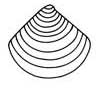 
|
| TRIGONALLY SUBOVAL | Having features of being triangular and somewhat OVAL in shape. See other bivalve shapes. | |
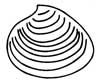
|
| TRILOBATE | Having three lobes or parts; see also: BILOBATE; LOBATE. | |
| TRIPARTITE | Having three parts; see also: BIPARTITE. | |
| TRIPTEROUS | Three-winged; generally meaning TRIVARICATE with ALATE VARICES. | |
| TRIRAMOSE (=TRIRAMOUS) |
Having two projecting parts or branches. See also: Having projecting parts or branches. See also: RAMOSE; BIRAMOSE. | |
| TRIVARICATE | Having three VARICES for each full turn of a WHORL. | |
| TROCHOID or TROCHIFORM |
Having the form of a top; conical, with the base of the cone at the APERTURE; see also: TURBINATE. See other gastropod shapes. | |
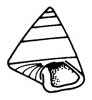
|
| TROCHOPHORE | The first LARVAL stage of molluscs, it is followed in gastropods and bivalves by the VELIGER stage. | |
| TRUNCATE | Terminating bluntly; see also: DECOLLATE. | |
| TUBE | A long, slender, hollow structure. | |
| TUBERCLE | A small, rounded projection; a knob. | |
| TUBERCULATE | Having TUBERCLES. | |
| TUBULAR | Cylindrical, (pertaining to the gastropod families Caecidae, Vermetidae, etc.), often used to mean open at both ends (as in the scaphopods, or TUSK SHELLS). See other gastropod shapes. | |
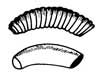
|
| TUMID | See: TURGID. | |
| TUNNEL | A tube; generally said of subsurface structures in the INTRITICALYX of ASPELLOID species. | |
| TURBINATE | Having a broadly conical spire and a convex base, as in the gastropod family Turbinidae; see also: TROCHOID. See other gastropod shapes. | |
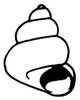
|
| TURGID | Swollen, enlarged, puffed up or distended; strongly inflated; = VENTRICOSE; = TUMID; see also: INFLATED; SWOLLEN. | |
| TURRETED | Having a tall and generally tabulate SPIRE; having the tops of the whorls flattened. | |
| TURRICULATE | Having the form of a tower; = TURRIFORM. See other gastropod shapes. | |
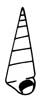
|
| TURRID NOTCH |
An ANAL NOTCH, or a break in the wall of the outer lip where it joins the BODY WHORL; see also: STROMBOID NOTCH. Photo: Pyrgocythara plicosa (C.B. Adams, 1850) |
|
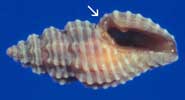
|
| TURRIFORM | Tower-shaped; = TURRICULATE. See other gastropod shapes. | |
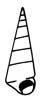
|
| TURRITED | See: TURRETED. | |
| TUSK SHELL | A SCAPHOPOD shell. Other common names: ELEPHANTS TUSK; BOARS TUSK. | |
| TYPE DEPOSITORY | The scientific collection in which a TYPE SPECIMEN is deposited. | |
| TYPE LOCALITY | The geographical area from which TYPE MATERIAL was originally collected and which was cited as such by the author. | |
| TYPE MATERIAL |
[need definition]. See the publication: Frizzell, Donald Leslie. 1933. Terminology of Types. American Midland Naturalist 14(6):637-668. |
|
| TYPE SPECIES | A SPECIES chosen as representative of an entire GENUS. | |
| TYPE SPECIMEN |
The single specimen upon which a name is based; the name-bearer; see also: HOLOTYPE; LECTOTYPE; PARATYPE. See the publication: "Terminology of Types" by Frizzell. |
|
| TYPHLOSOLE | In BIVALVE mollusks, an infolding along the inner wall of the intestine. | |
| ULTIMATE | Final; APICAL; DISTAL. | |
| ULTRADEXTRAL | Having seemingly SINISTRAL shell coiling; having the soft parts DEXTRAL, but with the shell WHORLS being added above instead of below the periphery; HYPERSTROPHIC. | |
| UMBILICAL | Pertaining to the UMBILICUS. | |
| UMBILICAL CHINK | A long, narrow cleft in the UMBILICUS. | |
| UMBILICAL PIT | An opening or depression in the UMBILICUS. | |
| UMBILICATE | Having an UMBILICUS; = OMPHALOUS; see also: PERFORATE; ANOMPHALOUS. | |
| UMBILICUS | The open AXIS of a LOOSELY COILED spiral gastropod shell. See illustration: Composite Gastropod. See also: PSEUDOUMBILICUS; PHANEROMPHALOUS; OMPHALOUS; ANOMPHALOUS. | |
| UMBO (pl. UMBONES) |
Region of VALVE (in bivalves) surrounding point of maximum curvature of longitudinal DORSAL profile and extending to the BEAK, when not coinciding with it (many authors treat "beak" and "umbo" as synonymous, but with most shells, two distinct terms are needed). See illustration: Composite Bivalve. See also: NATES; PRODISSOCONCH.
See: Bivalve terminology, Anatomy of bivalves by Marlo Krisberg. |
|
| UMBONAL | Pertaining to the UMBONES. | |
| UMBONAL ANGLE | In pectinoid shells, the angle of divergence of UMBONAL FOLDS. In other shells, approximate angle of divergence of POSTERODORSAL and ANTERODORSAL parts of longitudinal profile. | |
| UMBONAL CAVITY | Part of the interior of the valve (of bivalves) that lies within the UMBO and under the HINGE PLATE (when present). | |
| UMBONAL DEPRESSION | Small depression at the tip of the UMBO in some Arcacea. | |
| UMBONAL FOLD | In pectinoid shells, the ridge originating at the UMBO and setting off the body of the shell from the AURICLE. | |
| UMBONAL POLE | Point of maximum curvature of longitudinal dorsal profile of valve. See also: UMBO. | |
| UMBONAL RIDGE | A radial ridge that sets off the posterior from the central and anterior slopes of a bivalve shell. See also: UMBO. | |
| UMBONAL SLOPE | The line of greatest CONVEXITY which can be traced from the BEAK to the anterior or posterior ventral corners of the valve of bivalves; see also: CORSELET. | |
| UNCINATE | Hooked. | |
| UNDATE | Wavy; see also: UNDULATE. | |
| UNDULATE | Wavy or minutely wavy; having a wavy margin or surface; see also: UNDATE. | |
| UNGUICULATE | Claw-shaped; often said of certain OPERCULA (in which the layers are disposed laterally, and the nucleus constitutes part of the outer edge). | |
| UNILOCULAR | [need definition]; see also: LOCULAR; MULTILOCULAR. | |
| UNISERIATE | A series containing only one; see also: UNISERIATE RADULA | |
| UNISERIATE RADULA | A RADULA which only has a RACHIDIAN TOOTH (as in ASCOGLOSSANS), lacking LATERAL TEETH and MARGINAL TEETH; see also: RADULA FORMULA; MULTISERIATE RADULA; TOXOGLOSSATE. | |
| UNIVALVE | A shell consisting of a single piece, as in most GASTROPODS; see also: BIVALVE. | |
| UPPER VALVE | In attached bivalves, the valve which is not attached to the substrate; = FREE VALVE. See also: LOWER VALVE. | |
| URICOTELIC | The renal condition in land gastropods in which nitrogenous excretion requires loss of little water, as almost insoluble uric acid is excreted. White, crystalline deposits accumulate in the gland cells of the kidney, being discharged as spherules at rather long intervals --- four to six weeks in the Roman Snail, or remaining during HIBERNATION in a "kidney of accumulation;" see also: AMMONOTELIC. | |
| VALVE | One of the shelly halves of a clam (or BIVALVE) shell, or the single shell of a GASTROPOD (UNIVALVE), or one of the 8 (typically) shelly plates of a CHITON. See illustration: Composite Chiton. | |
| VALVE CALLUS | Same as: INSERTION PLATE. | |
| VALVE, ATTACHED | In ATTACHED BIVALVES, the valve which is attached to the substrate; = INFERIOR VALVE; = LOWER VALVE. See also: ATTACHED; UPPER VALVE. | |
| VALVE, CENTRAL AREA | [need definition]. In CHITONS, … See illustration: Composite Chiton. | |
| VALVE, LATERAL AREA | [need definition]. In CHITONS, … See illustration: Composite Chiton. | |
| VANE | The broad, flat, lateral extension on each side the RACHIS (central shaft) of the PEN of a SQUID. | |
| VARICAL | Pertaining to a VARIX. | |
| VARICAL BUTTRESS | A reinforcing structure attached to a VARIX and to the shell surface. | |
| VARICAL FLANGE | The usually brief terminal edge of a VARIX, slightly raised from the shell surface or otherwise distinct. A wing-like, elevated lamina growing from the top of a varix; see also: VARICAL WING. | |
| VARICAL MARGIN | The free, often sculptured, generally SERRATE or CRENULATE edge of a VARIX. | |
| VARICAL PLANE | The orientation of the VARIX with reference to the shell surface. | |
| VARICAL SPINE | A sharp projection arising from a VARIX. | |
| VARICAL WEBBING | A finely undulate flange that is reinforced by LAMINAE or scale-like elements. | |
| VARICAL WING | An expanded, thin, blade-like or flange-like projection or extension of the VARIX. | |
| VARICED | Having VARICES. | |
| VARICOSE | See: VARICED. | |
| VARIEGATED | Having mixed color patterns; see also: POLYCHROMISM. | |
| VARIETY | A minor FORM of a species, such as one having a special color or shape (e.g., an ECOLOGIC FORM), but not recognized as a SUBSPECIES. | |
| VARIX (pl. VARICES) |
A thickened or extensive axial ridge indicative of a resting stage in the growth of the mollusc, as reflected in the shell; in some cases including all structures associated with interruption of growth. See illustration: Composite Gastropod. See also: INTERVARICAL SPACE; AXIAL RIB; LABIAL RIB; SCLEROCHRONOLOGY. | |
| VATERITE | One crystalline form of CALCIUM CARBONATE, CaCO3; see also: ARAGONITE; CALCITE. | |
| VAULTED SCALE | A curved, erect SCALE tilted in the direction of shell growth. | |
| VECTOR | An animal that carries and transmits disease-causing organisms. | |
| VELICONCH | The shell borne by VELIGER larvae, later comprising the nucleus of the PROTOCONCH; identical with PRODISSOCONCH when larva is PELAGIC and of a bivalve or scaphopod. See also: SCAPHOCONCHA. | |
| VELIGER |
A larval stage of gastropods and bivalves, possessing a shell (the VELICONCH) and enclosed within the EGG CAPSULE or released and free-swimming or a variable period of time; see also:
DORATOPSIS; ECHINOSPIRA; PEDIVELIGER; PLANTIGRADE; TROCHOPHORE. Illustration: Acteocina canaliculata [from: Mikkelsen and Mikkelsen 1984. Veliger 27(2):164-192.] |
|
|
| VELUM (pl. VELA) |
The locomotory organ of a VELIGER: a membranous structure composed of two or more lobes fringed with minute, hair-like structures or CILIA. | |
| VENOM | See: CEPHALOTOXIN; CONOTOXIN. | |
| VENTRAL | Of, pertaining to, or situated on the lower side in a dorsoventral organism; on the apertural surface of a gastropod shell; at or toward that part of the bivalve shell opposite the HINGE; see also: DECURRENT; DORSAL. | |
| VENTRICOSE | Swelling out on one side; inflated; see also: TUMID; TURGID; INFLATED. | |
| VERGE | The PENIS, or male COPULATORY ORGAN of a mollusc. | |
| VERMICULATION | Surface sculpture of irregular wavy lines or grooves; see also: LIRATE; STRIATE. | |
| VERNACULAR NAME | The name of a taxon in any language other than the language of zoological nomenclature; the popular or COMMON NAME. See also: Eddie Hardy's website: "Hardy's Internet Guide to Marine Gastropods" which has an index of common names. see also: SCIENTIFIC NAME. | |
| VINCULUM | Secondary shelly matter associated with basic dental structures, which commonly takes the form of a bridge between two adjacent teeth, thus causing DENTITION to appear simpler than it is. | |
| VISCERAL MASS | That portion containing the viscera, or gut; in cephalopods, the internal organs enclosed by the MANTLE: heart, gills, stomach, etc. | |
| VITREOUS | Glassy. See also: PORCELANEOUS. | |
| VIVIPAROUS | Producing fully formed young within the body of the parent; see also: OVIPAROUS. | |
| VOLUTION | One of the whorls or turns of a spirally coiled shell or OPERCULUM; see also: WHORL. | |
| WAMPUM |
Strings of white or white and purple beads, once made by Indian tribes native the the eastern United States, from the shells of Whelks and Quahog shells. These beads were used to commemorate some event of significance or used as general currency. See the excellent description and images in Wikipedia. |
|
| WEAKLY | Poorly; not strongly; generally said of the development or strength of shell SCULPTURE. | |
| WEB | In cephalopods, the membrane connecting the arms in many species; see also: WEBBING. | |
| WEBBING | Lamellate SCULPTURAL elements crossed by other reinforcing SCULPTURE. | |
| WENTLETRAP | COMMON NAME applied to shells of the genus Epitonium. | |
| WHELK | A COMMON NAME referring to any large snail of the genera Buccinum, Colus, Busycon, or Fasciolaria; generally all members of the family Fasciolariidae, thus making the vernacular name "Horse Conch", Triplofusus giganteus (previously Pleuroploca gigantea), a misnomer as it is a whelk and not a "conch" (i.e., member of the family Strombidae) and therefore more appropriately called a Horse Whelk, although the common usage will likely not change. | |
| WHORL | A single complete turn of 360 degrees in the spiral growth of a gastropod shell or OPERCULUM; see also: BODY WHORL; PENULTIMATE; PERIPHERY, (types); WHORL, (types); VOLUTION. | |
| WHORL PERIPHERY | The part of a GASTROPOD shell that is farthest from the AXIS of coiling; = WHORL PERIPHERY. See illustration: Composite Gastropod. See also: PERIPHERY, (types); WHORL, (types). | |
| WHORL, ANGULATE | Having the outer PERIPHERY of the whorl midway between CARINATE and rounded. | |
| WHORL, BICARINATE | Having two CARINA on the PERIPHERY of a whorl. | |
| WHORL, CARINATE | Having one or more CARINA on the PERIPHERY of a whorl; see also: WHORL, BICARINATE; WHORL, MONOCARINATE. | |
| WHORL, CONVOLUTE | Having the body WHORL of the shell expand abruptly so as to wrap around and conceal all the older, subsequent whorls as in Cyprea spp.. | |
| WHORL, DESCENDING | The lowering of the last stages of growth of the BODY WHORL. | |
| WHORL, DISCONTIGUOUS | Having subsequent WHORLS not touching the previous; = WHORL, DISJUNCT; = GYROCONIC. | |
| WHORL, DISJUNCT | Having subsequent WHORLS not touching the previous; = DISCONTIGUOUS; = GYROCONIC; see also: LOOSELY COILED. See other gastropod shapes. | |
|
| WHORL, FLATTENED | The condition of having the PERIPHERY of a whorl being flat. | |
| WHORL, HALF | Half of a full turn in the shell spiral of a gastropod; 180 degrees of shell growth. | |
| WHORL, MONOCARINATE | Having a single CARINA on the PERIPHERY of a whorl; see also: WHORL, BICARINATE. | |
| WHORL, ROUNDED | Having a smooth curve on the outer PERIPHERY of a whorl. | |
| WHORL, SHOULDERED | Having an angulation of the whorl at its PERIPHERY or outermost edge. | |
| WHORL, SUCCEEDING | A whorl later in the growth sequence and usually larger than the WHORL in question. | |
| WHORLS, NUMBER OF | The count of revolutions of a shell or of an OPERCULUM. | |
| WIDTH | The thickness of an entire shell, from left to right sides. See illustration: Composite Gastropod. See also: DIAMETER; HEIGHT; LENGTH; WRS. | |
| WING | A more or less elongate triangular terminal part of the HINGE area in shells of such bivalve groups as the Pectinacea and the Pteriacea; = EAR; see also: VARICAL WING. | |
| WINGED | Having a wing or wings. | |
| WRINKLED | Corrugated; furrowed; finely and irregularly ridged; see also: RUGOSE. | |
| WRS WORLD RECORD SIZE |
The abbreviation (acronym) for World Record Size. Such records for maximum size are maintained in the "Registry of World Record Size Shells", by Kim Hutsell, Linda Hutsell and Don Pisor; it is available from San Diego Shell Club in California, USA; Snail's Pace Productions. Earlier versions of a WRS catalog were published by Wagner and Abbott, published by American Malacologists. See also: MICRO; MINI; MINIATURE and the website: WRS Shells. See also: GERONTIC | |
|
| XENOMORPHISM | Special SCULPTURE at the UMBO region of the unattached valve resembling the configuration of the substratum onto which the attached valve is or was originally fixed. Known in the Anomiidae, Gryphaeidae, Ostreidae and other PLEUROTHETIC and cemented families. It is on the right valve in oysters and on the left valves in Anomia. Erroneously called ALLOMORPHISM by some authors. See pp. 98-99 of: Stenzel, H.B., et. al., 1957. | |
| YOLK LARVAE | See: LECITHOTROPHIC. | |
| ZOOPLANKTON | PLANKTON consisting of animals, vs. plants (phytoplankton) or bacteria (bacterioplankton). Various mollusks are part of the plankton, such as PTEROPODS and Janthina spp. | |
| ZYGONEURY | The connection by direct link of the pleural and parietal GANGLION on either side. | |